How to Choose a DC Power Supply for Your Lab or Production Line
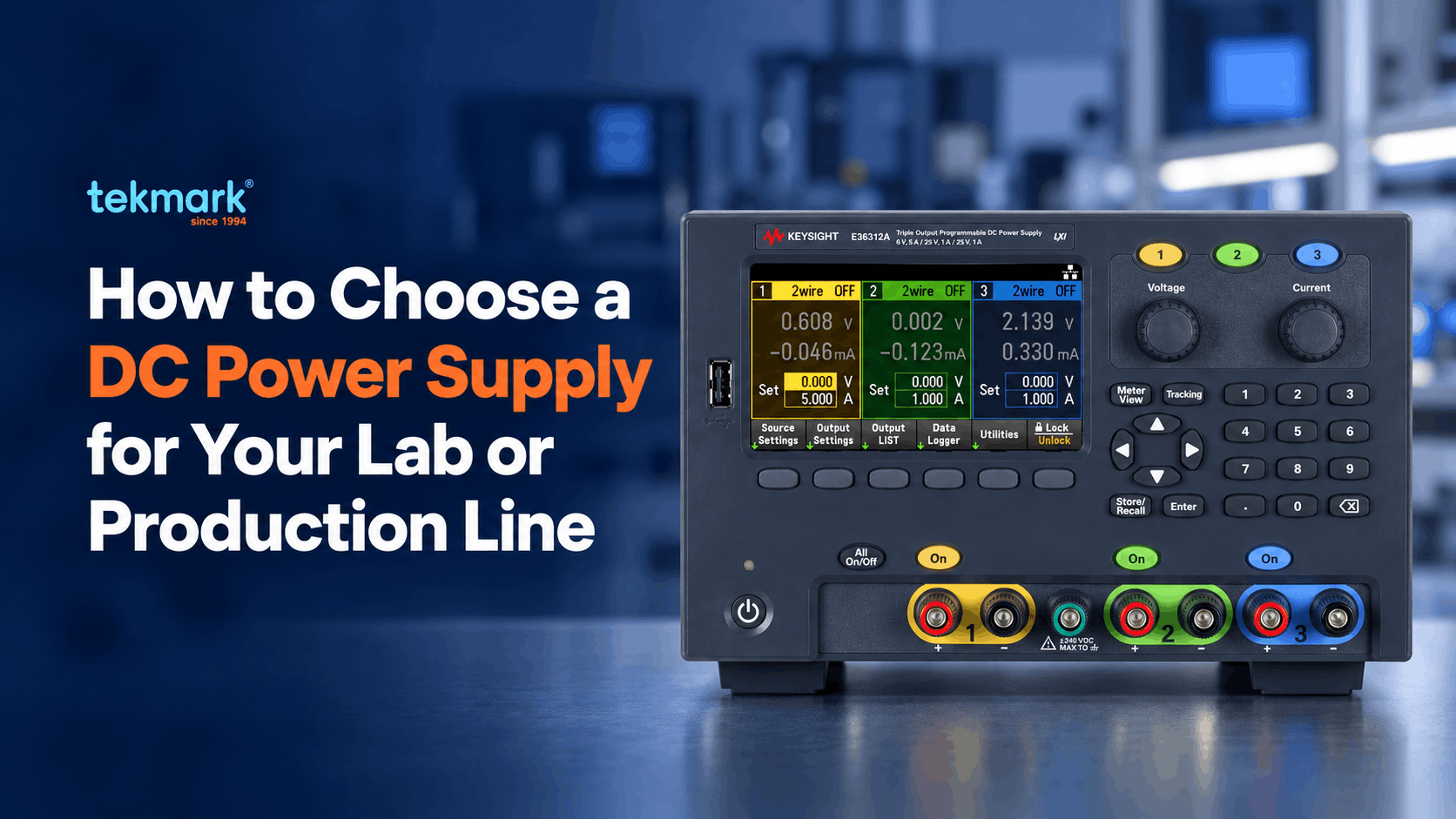
Choosing a DC power supply involves more than matching a voltage and current rating.
The right Keysight power instruments must deliver enough power for the device under test (DUT), maintain a stable output during load changes, meet your noise requirements and provide the control features needed for manual or automated testing.
This guide walks through the specifications that matter, shows where a bench supply, an ATE system supply, or a modular platform fits, and flags when the right instrument is actually an electronic load or a source measure unit (SMU).
Key Takeaways
- Voltage, current, and power define the envelope together. A supply may not deliver its maximum voltage and maximum current at the same operating point.
- Choose a bench supply when front-panel operation, DUT access, and one to three outputs are the main priorities.
- Choose an ATE or system supply, including a modular platform, when rack density, programmable throughput, or repeatable test sequencing drives the design.
- Compare ripple and noise, programming accuracy, transient response, readback, interfaces, and protection. Do not stop at the headline output rating.
- Use an electronic load for controlled current sinking. Use an SMU when the test needs tight sourcing plus precision measurement, current-voltage sweeps, or two-quadrant operation.
1. Start with the DUT’s voltage, current, and power requirements
Define the DUT’s normal operating voltage, its maximum permitted voltage, its steady-state current, and its peak or inrush current. Then check the supply’s output characteristic or autoranging curve.
The product of maximum voltage and maximum current can exceed the supply’s rated power, so both limits may not be available at the same operating point.
Allow a practical margin for startup current, load transients, and future test conditions, but don’t apply a fixed percentage to every design. Too little capacity causes current limiting or output collapse. Excessive capacity can reduce low-current resolution or add unnecessary cost.
2. Decide between a bench, ATE/system, or modular architecture
At the broadest level, the choice is between a benchtop supply, a rack-integrated ATE system supply, and a modular mainframe with plug-in modules. ATE/system solutions may use a fixed-output rack supply or a modular chassis with swappable power modules. The Keysight N6700 belongs to the modular group.
| Architecture | Best suited to | What to check |
| Bench DC power supply | R&D, education, troubleshooting, prototyping, light automation | Output count, front-panel usability, remote sense, data logging, sequencing, USB/LAN/GPIB |
| ATE/system power supply | Production test, high-power DUTs, scripted sequences | Command-processing time, output settling, rack density, power range, interfaces, cooling |
| Modular ATE platform (for example, N6700) | Multi-output systems that need mixed power or performance levels in one chassis | Mainframe power budget, module compatibility, slot count, synchronization, expansion path |
3. Evaluate the specifications that affect measurement quality
Ripple and noise
Power-supply ripple and noise can appear in DUT measurements or alter the behaviour of sensitive analog, RF, and sensor circuits. Compare specifications over the stated measurement bandwidth.
Do not mix RMS and peak-to-peak values. The acceptable level depends on the DUT’s power-supply rejection, local filtering, measurement bandwidth, and required signal-to-noise ratio, not simply on ADC resolution.
Programming and readback accuracy
Programming accuracy describes how closely the actual output matches the value you set. Readback accuracy describes the supply’s internal voltage and current measurement.
For low-current or precision work, also check the datasheet for range, resolution, offset terms, and temperature conditions.
Load regulation and transient response
Load regulation indicates how well the supply maintains its output as DUT current changes. Transient-response and settling specifications show how quickly the output recovers after a load step or a programmed voltage change.
These figures matter for processors, wireless devices, motor controls, and production tests with short dwell times.
Remote sensing and wiring
Four-wire remote sensing compensates for voltage drop in the test leads by measuring voltage at the DUT. It becomes important at higher current, with long cables, or when tight voltage accuracy is required. Observe the supply’s remote-sense limits and wiring guidance.
Protection and sequencing
Check overvoltage, overcurrent, and overtemperature protection, plus output-delay and sequencing functions for multi-rail DUTs. Verify protection behaviour and current-limit modes from the model’s data sheet rather than assuming they hold across a whole product family.
Read more: Choosing an oscilloscope alongside a bench supply for transient response and PSU validation is a parallel decision. Our guide on how to choose the right oscilloscope for your engineering work covers bandwidth, sample rate, and channel-count trade-offs.
4. Bench example: Keysight E36312A
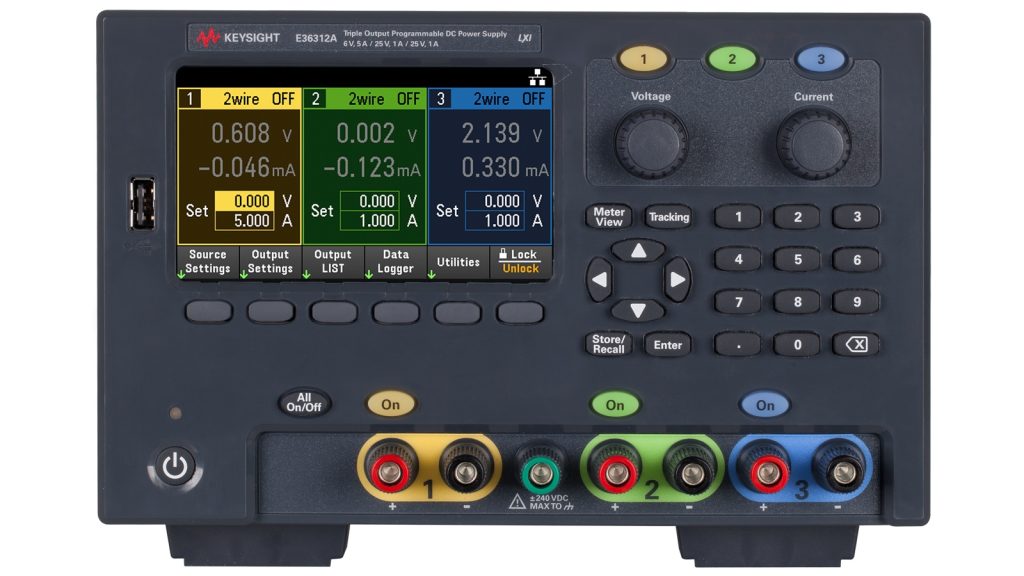
The Keysight E36312A is an 80 W triple-output programmable DC power supply. The outputs are rated at 6 V / 5 A and two channels of 25 V / 1 A. LAN and USB are standard, GPIB is optional.
Keysight specifies four-wire remote sensing and an approximately 11 ms up/down programming settling time.
This configuration suits mixed-signal boards that need a low-voltage digital rail plus two additional bias or analog rails.
Before selecting it, confirm the DUT’s combined channel demand stays within the supply’s total power rating, and that the accuracy, noise, and transient specifications meet the test requirement.
5. ATE system power supplies: Keysight DP5700 and RP5900 Series
For automated testing, Keysight offers dedicated ATE system power supplies designed for rack integration, programmable control, high power density, and repeatable system operation.
Keysight classifies the newer DP5700 and RP5900 Series as Expert ATE System Power Supplies. They serve different power-flow requirements.
DP5700 Series (unidirectional ATE power)
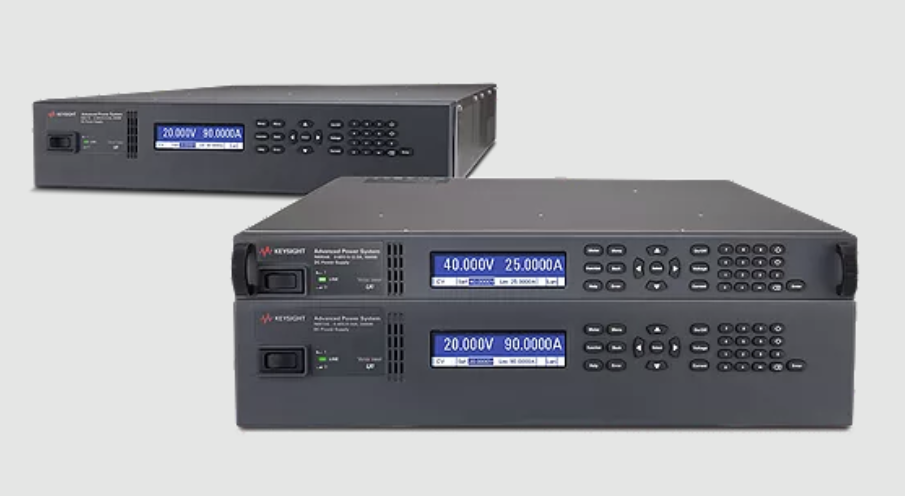
The Keysight DP5700 Series consists of single-output DC power supplies for applications that need reliable power delivery to the DUT. Models include LAN, USB, and GPIB connectivity, LXI compliance, built-in voltage and current measurement, protection functions, and analog control.
Similarly rated units can be combined where supported, to increase system voltage or current. Choose the DP5700 when the test mainly requires the supply to source power (production testing of power devices, communications equipment, automotive electronics, industrial controllers).
The exact output rating, AC input, and series/parallel limits depend on the selected model.
RP5900 Series (bidirectional regenerative ATE power)
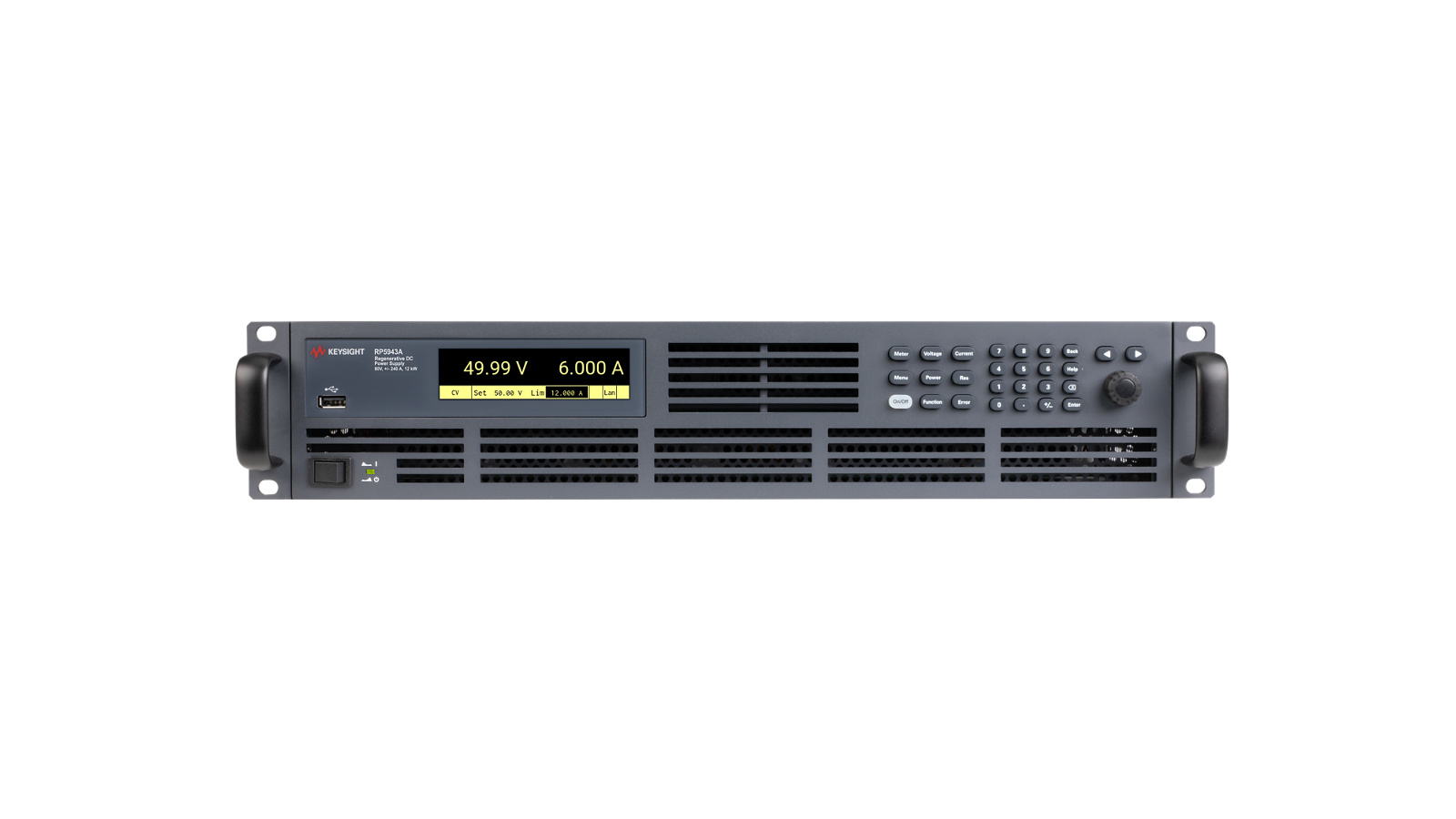
The Keysight RP5900 Series is a bidirectional, regenerative DC power platform. It sources power to the DUT and sinks power returned by the DUT, with recovered energy regenerated back to the facility’s AC supply.
This reduces the heat and wasted energy of dissipating returned power in a conventional load. The RP5900 suits batteries, energy-storage systems, DC-DC converters, onboard chargers, inverters, and other devices that operate with power flowing in both directions.
Its source-and-sink capability can also simplify a test rack by replacing separate sourcing and loading instruments in suitable applications.
Established Keysight N5700 and N8700 system supplies remain relevant fixed-output ATE options. The newer DP5700 and RP5900 Series provide stronger examples when presenting Keysight’s current Expert ATE portfolio.
When selecting an ATE supply, check the DUT’s complete voltage-current-power operating envelope, the direction of power flow, AC input requirements, command-processing and settling performance, rack cooling, interfaces, protection functions, regenerative capability, and series/parallel operating limits.
Matching all of these variables to the right supply is rarely a catalogue pick. Tell Tekmark’s application engineers what your device under test needs, and they will point you to the correct Keysight ATE supply before you commit to a configuration.
6. Modular ATE example: Keysight N6700 Series
The Keysight N6700 Low-Profile Modular Power System is a 1U platform with four module slots. The N6700, N6701, and N6702 mainframes provide total power capacities of 400 W, 600 W, and 1,200 W respectively.
Engineers can mix compatible modules with different voltage, current, power, and measurement capabilities, subject to the mainframe power budget.
The main benefit is configuration flexibility. A single chassis can combine basic DC power modules, higher-performance modules, and specialized modules.
For example, the N6781A is a two-quadrant SMU module designed for battery-drain analysis. It can both source and sink power, which is different from a standard source-only DC supply module.
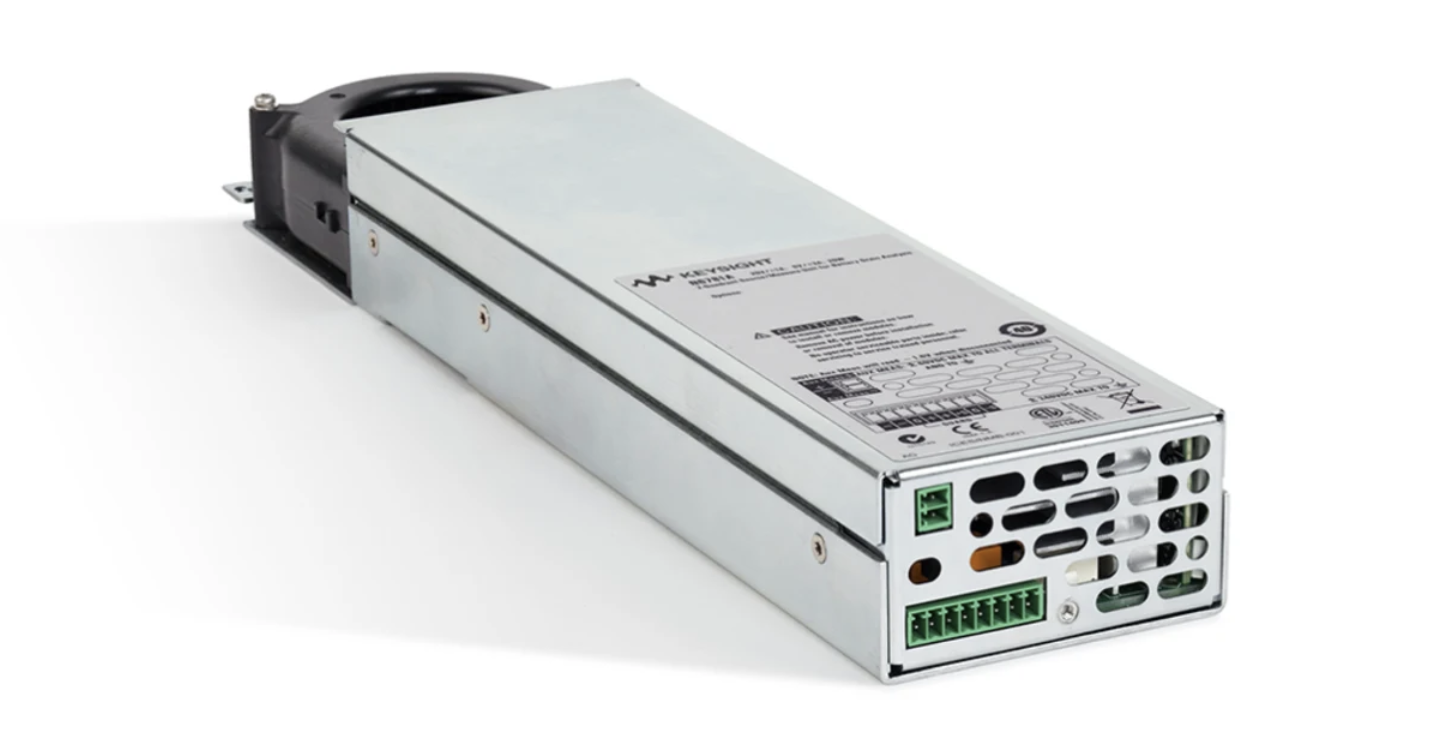
For production systems, verify the exact module specifications, mainframe capacity, output count, command speed, settling time, trigger behaviour, and interface requirements. An N6700 mainframe supports up to four installed modules. Additional channels need another mainframe or a different system architecture.
Configuring an N6700 needs careful consideration of the application, not an off-the-shelf pick. Share your DUT’s voltage and current requirements, required channel count, and measurement needs with our authorized Keysight distributor team. Our engineers recommend the appropriate mainframe and module configuration, then send the quote.
Read more: Building an automated test bench also needs the right signal source. Function generators, arbitrary waveform generators, and RF signal generators serve different testing requirements. Our guide on function generators vs signal generators covers the differences and points to the appropriate Keysight instrument for your application.
7. When a DC power supply is not the right instrument
Two application classes push the decision away from a DC power supply entirely.
Use an electronic load when the DUT is the power source
An electronic load draws controlled current from a battery, converter, power supply, or solar device. Typical applications include battery discharge, power-supply validation, DC-DC converter testing, and load-transient testing.
The Keysight EL30000 Series includes the EL33133A (single-input, 250 W), the EL34143A (single-input, 350 W), and the EL34243A (dual-input, 600 W).
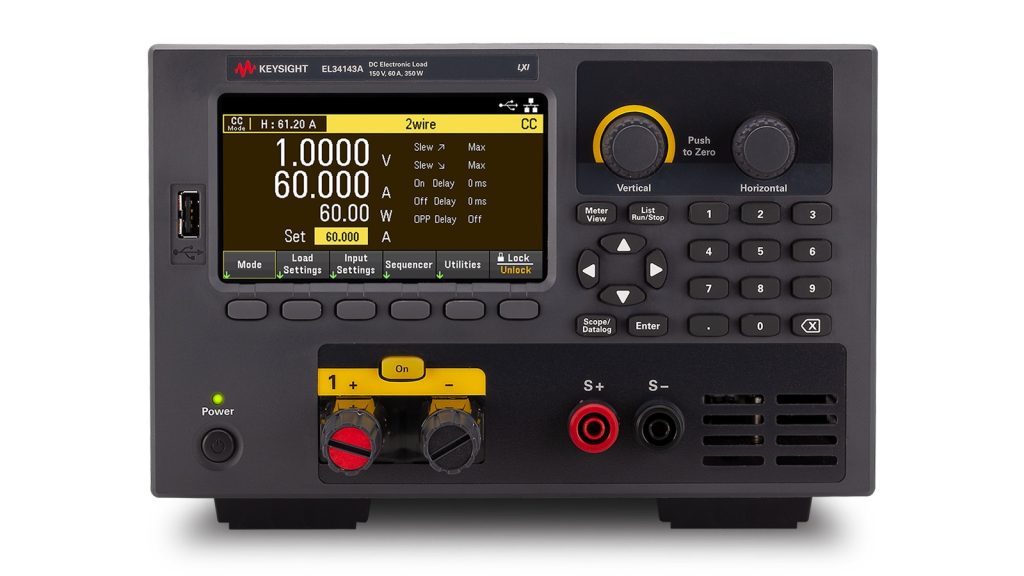
Constant-current mode on a conventional source-only supply is not the same as operating as an electronic load. In current-limit operation, the supply still delivers current to the DUT and reduces its output voltage when the programmed current limit is reached.
Current sinking needs an instrument designed for that quadrant of operation: an electronic load, a regenerative supply, or a suitable two-quadrant SMU.
Use an SMU for precision sourcing and measurement
An SMU combines a precision voltage or current source with measurement functions and programmable compliance. It suits semiconductor current-voltage (I-V) characterization, diode and LED testing, material research, and low-current device measurements.
The Keysight B2912B, for example, is a dual-channel precision SMU with up to 210 V, 3 A DC, and 10.5 A pulse output, plus 10 fA minimum current source and measurement resolution under specified conditions.
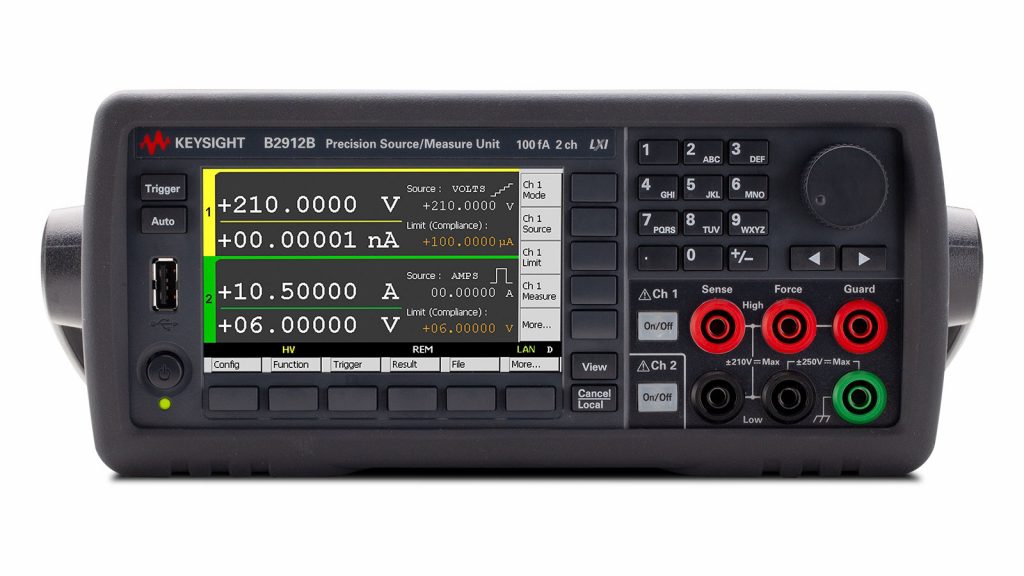
Do not use a universal current threshold such as “below 1 microamp means you need an SMU.” Some digital multimeters can measure below 1 microamp.
The right instrument depends on burden voltage, range, accuracy, speed, leakage, cabling, guarding, and whether the test needs a swept source and measurement in one instrument.
Read more: For teams selecting DMMs alongside power supplies, our guide on benchtop vs handheld digital multimeter explains when each is the right pick.
8. Practical DC power supply selection checklist
- Define normal, maximum, and transient voltage and current conditions.
- Confirm the required operating point lies within the voltage-current-power envelope.
- Select the number of isolated outputs and required sequencing behaviour.
- Compare ripple and noise using the same bandwidth and units.
- Check programming accuracy, readback accuracy, resolution, and regulation.
- Review transient response, programming speed, and command-processing time.
- Decide whether four-wire remote sensing is required.
- Confirm USB, LAN/LXI, GPIB, SCPI, triggering, and software requirements.
- Review protection limits, grounding, isolation, and safety requirements.
- Determine whether the application must sink power or perform precision I-V sweeps.
Application-to-instrument shortlist
| Application | Recommended instrument | Keysight example |
| General R&D, troubleshooting, prototyping | Programmable bench DC power supply | E36312A / E36300 Series |
| Production ATE requiring unidirectional high-power output | ATE system DC power supply | DP5700 Series (N5700/N8700 as established options) |
| Battery, converter, or energy-system test requiring source and sink | Bidirectional regenerative ATE power supply | RP5900 Series |
| Automated multi-output system | Modular DC power system | N6700 Series with application-matched modules |
| Battery discharge or PSU/load validation | DC electronic load | EL30000 Series |
| Battery-drain profiling with source/sink | Two-quadrant SMU module | N6781A in a compatible N6700/N6705 platform |
| Semiconductor I-V and precision low-current tests | Precision SMU | B2900B/B2900C Series |
Conclusion
Choosing a DC power supply comes down to matching the instrument to the DUT, not to the biggest headline rating.
Confirm the voltage, current, and power envelope the test actually needs, then decide whether a bench, ATE, or modular platform suits the workflow. Compare ripple, programming and readback accuracy, transient response, and protection against the real measurement, not the summary line on the data sheet.
When the DUT is itself a power source, the correct instrument is an electronic load or a regenerative supply, not a source-only supply run in current limit. When the test needs precise sourcing and measurement in one instrument, an SMU is the better fit than a general-purpose supply.
As an authorized Keysight distributor, Tekmark pairs the full Keysight power range with application engineers who size the instrument to your test, backed by local sales, calibration, and support across Malaysia, Singapore, and the Philippines.
Share your DUT’s voltage, current, and channel requirements and our team will recommend the right Keysight power supplies and send a quote.
FAQs
Start with the DUT’s operating voltage, steady-state current, and peak or inrush current. Confirm the required operating points fit within the supply’s voltage-current-power envelope, then allow appropriate engineering margin for transients and future test conditions.
A bench supply prioritises front-panel use and convenient access for lab work. A modular system uses a mainframe and plug-in modules, letting engineers combine different output and measurement capabilities in a compact automated-test platform.
No. On a conventional source-only supply, constant-current operation limits current delivered to the DUT. Sinking current needs an electronic load, a regenerative supply, or a suitable two-quadrant source/measure instrument.
Use the DUT’s sensitivity, power-supply rejection, filtering, and measurement bandwidth to set the limit. Compare RMS with RMS and peak-to-peak with peak-to-peak over the same stated bandwidth.
Choose an SMU when the test requires precision voltage or current sourcing together with accurate measurement, programmable compliance, low-current capability, I-V sweeps, or two-quadrant operation. For simply powering a prototype, a conventional DC supply is usually more economical.
Look beyond output ratings. Command-processing time, settling time, triggering, sequencing, readback speed, rack density, interfaces, software support, and protection behaviour all directly affect throughput and repeatability.
Related Articles