Function Generator vs Signal Generator: What’s the Difference and Which Do You Need?
Every purchase request that says “I need a signal generator” and nothing else creates the same problem. Procurement can’t quote it. The vendor can’t spec it. And the engineer who wrote it probably meant one of three different instruments.
The function generator vs signal generator question is not a binary. “Signal generator” is both an umbrella term (any instrument that produces test signals) and shorthand for “RF signal generator.” That double meaning turns a straightforward product category into a vocabulary trap.
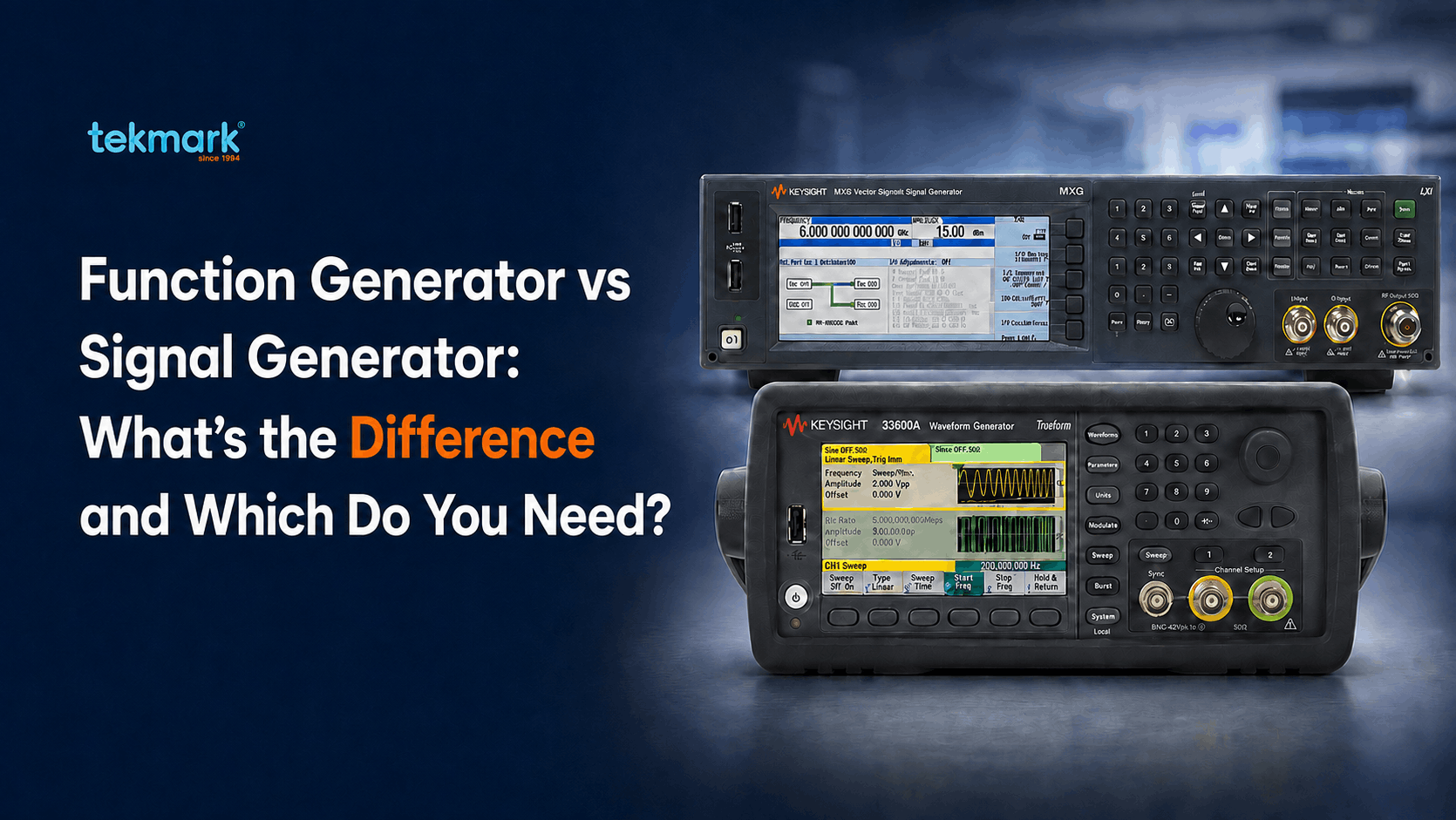
The signal source family has three distinct categories. Function generators produce standard periodic waveforms (sine, square, triangle) below roughly 120 MHz. Arbitrary waveform generators (AWGs) create custom, user-defined waveforms using architectures like Keysight’s Trueform for lower jitter and distortion. RF signal generators produce spectrally pure, calibrated signals at frequencies from kHz to tens of GHz for wireless and RF testing.
These are different instruments, built for different applications, evaluated by different specifications. This article maps each category to its applications and names the Keysight models available through Tekmark.
- Three categories, not two. Function generators, AWGs, and RF signal generators are subtypes of “signal generator,” each serving different applications.
- Function generators (Keysight EDU33210, 33500B, FG335xxA) handle most bench testing below ~120 MHz.
- Trueform AWGs (Keysight 33600A, M8100 series) produce custom waveforms with ~12x lower jitter than traditional DDS generators.
- RF signal generators (Keysight EXG, MXG, PSG, UXG) deliver spectrally pure signals at GHz frequencies. These are a different instrument category, not expensive function generators.
- Decision rule: Standard waveforms below 100 MHz → function generator. Custom waveforms → AWG. RF test or calibrated dBm output → RF signal generator.
| Function Generator / Waveform Generator | High Performance Arbitrary Waveform Generator | RF / Vector Signal Generator | |
| Produces | Generate standard waveforms such as sine, square, pulse, and arbitrary waveforms for general-purpose electronics testing. | Generate high-fidelity, user-defined waveforms for advanced R&D and high-speed digital applications. | Generate spectrally pure RF and microwave signals for wireless communications, radar, aerospace, and RF component testing. |
| Frequency Range | mHz to ~120 MHz (Keysight 33622A) | mHz to hundreds of MHz; M8196A reaches 32 GHz bandwidth | kHz to tens of GHz (MXG to 40 GHz; PSG to 67 GHz) |
| Key Specification | Waveform variety and channel count | Sample rate, memory depth, jitter, THD | Phase noise, SFDR, calibrated dBm output |
| Applications | General electronics, analog and embedded design, education | High-speed digital, aerospace & defense, radar, optical communications, 5G/6G R&D | RF, wireless communications, microwave, component and receiver testing |
| Keysight Series at Tekmark | EDU33211A / EDU33212A FG33531A / FG33532A 33500B Series 33600A Series |
M8100 Series (M8190A, M8192A, M8195A, M8196A) |
CXG, EXG, MXG, PSG, UXG |
Function generators cover most bench testing needs
A function generator produces standard periodic waveforms for the majority of general-purpose bench work: sine for frequency response, square for digital timing, triangle for linearity, and pulse for transient response. If your application involves analog circuit characterization, filter validation, or clock generation below ~100 MHz, a function generator is the right instrument.
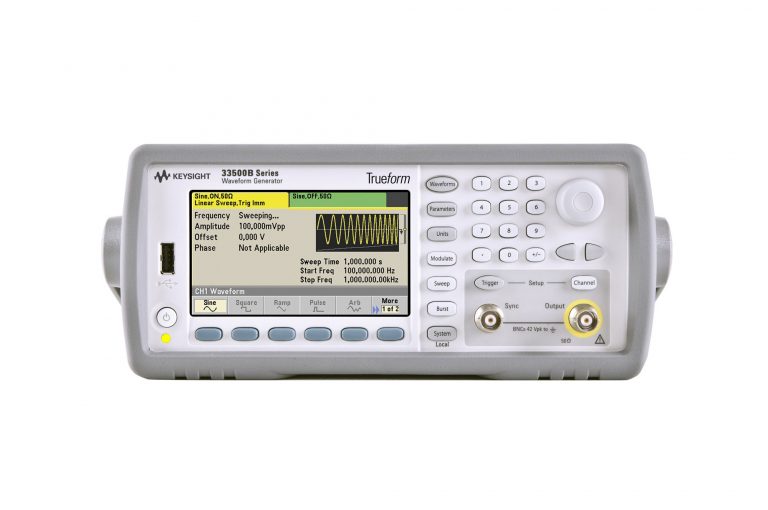
Keysight 33521B Trueform Waveform Generator, 30 MHz, 1-channel with arb. Source: Tekmark e-Shop
Tekmark offers a range of Keysight signal generation solutions, from entry-level Function Generators to advanced Trueform Waveform Generators. The EDU33211A/EDU33212A (20 MHz) provide an affordable entry point for education and training laboratories, while the FG33531A/FG33532A (100 MHz) deliver higher performance for general-purpose testing. For engineers requiring superior Waveform fidelity and Arbitrary Waveform generation, the Keysight 33500B and 33600A Trueform Waveform Generator series offer enhanced performance and flexibility.
Function Generators begin to reach their limits when applications require complex user-defined waveforms, higher waveform fidelity, wider analog bandwidth, or precisely calibrated RF output power.
If none of these applies, a function generator is all your bench needs. But if your function generator’s arb output looks noisier than expected on the oscilloscope, the problem may not be your DUT. It may be the signal generation architecture.
What separates Trueform from basic DDS?
Not all waveform generators produce signals in the same way. While most modern waveform generators can generate standard and arbitrary waveforms, the underlying signal generation technology has a significant impact on waveform fidelity, jitter, and distortion.
Traditional Direct Digital Synthesis (DDS) waveform generators create signals by storing waveform data in a lookup table and digitally reconstructing the waveform. DDS technology offers excellent frequency resolution and is widely used because it is cost-effective and reliable. However, as output frequencies increase, conventional DDS architectures may introduce higher jitter and harmonic distortion, reducing signal fidelity for more demanding applications.
Keysight’s Trueform Waveform Generators (33500B and 33600A Series) use a different waveform generation architecture designed to deliver higher-quality signals. Rather than relying solely on conventional DDS techniques, Trueform technology maintains waveform integrity across the entire frequency range, resulting in lower jitter, lower harmonic distortion, and more accurate waveform reproduction.
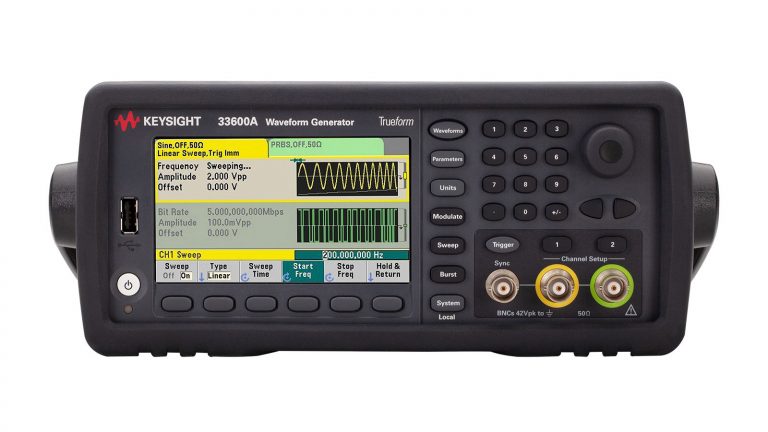
Keysight 33622A Trueform Waveform Generator, 120 MHz, 2-channel. Source: Tekmark e-Shop
Keysight’s Trueform technology calculates every waveform sample point individually. No lookup table, no skipped points, no interpolation gaps. The performance difference is quantified in Keysight’s published specifications:
| Specification | Traditional DDS | Keysight Trueform (33500B / 33600A) |
| Waveform Fidelity | Reduced at higher frequencies | Consistent across the frequency range |
| Edge Jitter (typical) | ~500 ps | ~40 ps (approx. 12x improvement) |
| Total Harmonic Distortion | ~0.2% | ~0.04% (approx. 5x improvement) |
| Anti-alias filtering | Basic or none | Integrated |
The bench-grade 33600A Trueform series (33611A through 33622A) covers 80 MHz and 120 MHz. For high-performance applications, the M8100 series AWGs (M8190A at 12 GSa/s, M8195A at 65 GSa/s, M8196A at 92 GSa/s) serve R&D and aerospace requirements.
Does “arb mode” on a DDS function generator count as an AWG? Same button label, different output quality. If the arb waveform looks noisy on the oscilloscope and the DUT is not the cause, the architecture is the limiting factor.
RF signal generators are not expensive function generators
An RF signal generator produces spectrally pure, calibrated sine wave signals at frequencies from kilohertz to tens of gigahertz. The defining specs are completely different from function generator specs: phase noise (dBc/Hz), spurious suppression (SFDR), and calibrated output power in dBm.
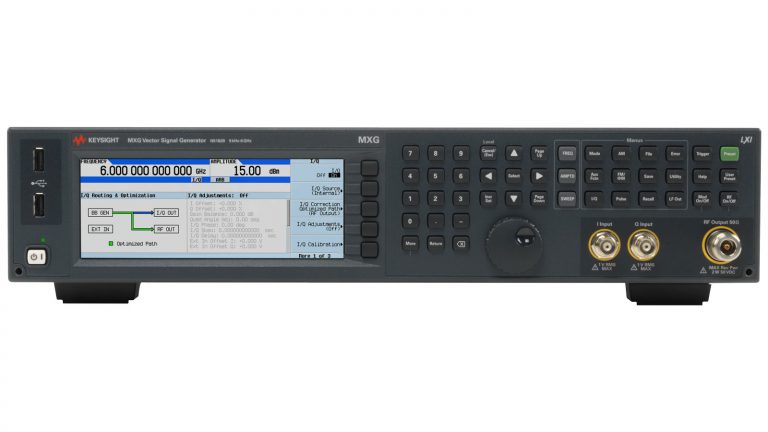
Keysight N5182B MXG X-Series RF Vector Signal Generator, 9 kHz to 6 GHz. Source: Tekmark e-Shop
The Keysight 33622A function generator and the EXG N5171B RF signal generator both cover 120 MHz. At that frequency, the signal quality is fundamentally different. The function generator’s output has uncalibrated power and high harmonic content. The RF generator delivers specified phase noise, calibrated dBm output, and suppressed sub-harmonics. Try finding a phase noise specification on the 33500B datasheet. It is not there.
Vector signal generators like the MXG N5182B and PSG E8267D add IQ modulation for 5G NR, LTE, Wi-Fi, and Bluetooth testing. The claim that signal generators only produce sine waves is incorrect for any vector instrument.
Tekmark carries five Keysight RF signal generator families: CXG N5166B (economy, to 6 GHz), EXG N5171B/N5172B (mid-range, to 6/40 GHz), MXG N5181B/N5182B/N5183B (performance, to 6/40 GHz), PSG E8257D/E8267D (high-end, to 44/67 GHz), and UXG N5193A/N5194A (agile, to 40 GHz).
When procurement asks why two “signal generators” carry dramatically different investment levels, the answer is category difference. A function generator and an RF signal generator are as different as a digital multimeter and a spectrum analyzer.
Which signal source does your application need?
The right signal source depends on the test, not the budget.
Analog circuit stimulus (amplifier testing, filter characterization, clock generation) → Function generator. Keysight 33500B Trueform or FG33531A/FG33532A.
Embedded and serial protocol testing (custom data patterns, bus simulation) → AWG or Trueform AFG. Keysight 33600A series. M8190A/M8195A for high-speed digital.
Sensor simulation (strain gauge, thermocouple, pressure sensor replication) → Trueform AFG with arb: Keysight 33511B or 33521B. Waveform fidelity matters more than bandwidth here.
RF receiver testing (sensitivity, selectivity, blocking) → RF signal generator. Keysight EXG N5171B or MXG N5181B.
Wireless device validation (5G NR, LTE, Wi-Fi, Bluetooth) → Vector signal generator. Keysight MXG N5182B or PSG E8267D.
Education and training labs → Keysight EDU33211A/EDU33212A at 20 MHz.
A note for engineers writing purchase requests. Specify the instrument category, not just “signal generator.” Include the application, frequency range, and critical specs. “2-channel, 30 MHz Trueform function generator with arb” tells procurement exactly what to quote. “Signal generator” tells them nothing.
For boundary cases, Tekmark’s technical team can match the instrument to your requirements. As a Keysight distributor with 30+ years of experience, Tekmark covers the full signal source portfolio.
For signal analysis rather than generation, Tekmark’s guide to RF testing covers that side. Engineers evaluating oscilloscopes will find a separate buyer’s guide on the blog.
Why Tekmark?
Tekmark is the authorized Keysight distributor with strategic coverage across Southeast Asia, operating through direct offices in Malaysia, Singapore, and the Philippines.
- Over 30 years of expertise as a regional electronic test and measurement solutions provider
- Established presence across Southeast Asia, supporting customers through an extensive regional network.
- In-house R&D engineering expertise for application support and system integration.
- Value-added services, including calibration, professional training, and technical consultation.
- Dedicated local technical support before, during, and after your purchase.
Frequently Asked Questions
Yes. “Signal generator” is the umbrella term for any instrument that produces electrical test signals. Function generators, arbitrary waveform generators, and RF signal generators are all subtypes. The confusion arises from “signal generator” also being used as shorthand for “RF signal generator.”
An AWG generates user-defined waveforms of any shape, not just the standard sine, square, and triangle a function generator produces. AWGs use point-by-point or Trueform architecture to maintain waveform fidelity across the full frequency range.
For standard waveforms, yes. For custom waveforms requiring high fidelity, not reliably. DDS-based function generators with arb mode skip sample points at higher frequencies, increasing jitter and distortion. Keysight Trueform instruments (33500B/33600A) provide 100% point coverage with approximately 12x lower jitter.
Generally, no. Function generators lack spectral purity, calibrated dBm output, and modulation capabilities. Even at overlapping frequencies, signal quality differs fundamentally. Function generators do not specify phase noise, which is the defining parameter for RF signal generators.
Trueform is Keysight’s proprietary signal generation architecture in the 33500B and 33600A series. Unlike DDS, Trueform calculates every sample point individually with no lookup table and no skipped points. Published results: approximately 40 ps jitter (vs 500 ps for DDS) and 0.04% THD (vs 0.2%).
Direct digital synthesis (DDS) generates waveforms by stepping through a digital lookup table and converting the output through a DAC. DDS delivers excellent frequency resolution at low cost. At higher output frequencies, DDS skips sample points, increasing jitter and distortion.
Tekmark carries the full Keysight signal source portfolio: EDU33210 (education), 33500B Trueform (20-30 MHz), FG335xxA (100 MHz), 33600A Trueform (80-120 MHz), and M8100 AWGs (12-92 GSa/s). RF signal generators include CXG, EXG, MXG, PSG, and UXG families from 9 kHz to 67 GHz. Browse the Tekmark e-shop or contact Tekmark for recommendations.
Related Articles