Vector Network Analyzer vs Spectrum Analyzer: Key Differences and Applications
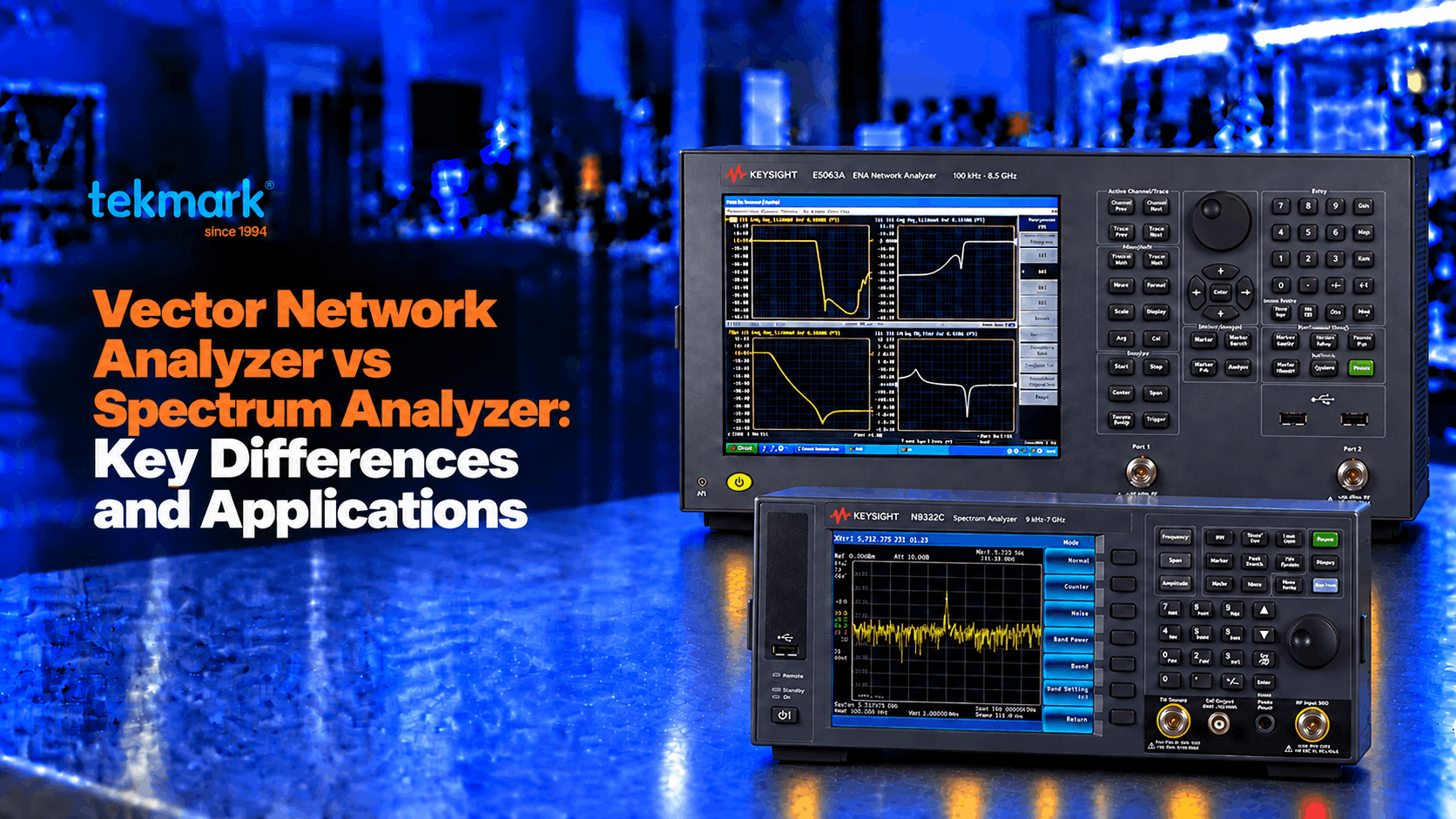
A vector network analyzer (VNA) and a spectrum analyzer are both used in radio frequency (RF) testing, but they serve different purposes.
Choosing between them depends primarily on what you need to measure. For some applications, both types of measurements are necessary. Certain Keysight network analyzers support optional spectrum analysis, while suitably configured Keysight FieldFox combination analyzers bring multiple RF test functions into one portable instrument.
At Tekmark, we help engineers and procurement teams select a Keysight network analyzer or spectrum analyzer for RF component characterization, signal analysis, production test and field maintenance. This guide explains the differences, typical applications and practical considerations for selecting the right RF analyzer.
Key Takeaways
- Different measurement purposes: A VNA characterizes RF components and networks, while a spectrum analyzer evaluates RF signal power and frequency content.
- Application-based selection: Choose the instrument based on the required measurements, frequency range and testing environment.
- VNA measurements and calibration: A VNA measures S-parameters in magnitude and phase, and its accuracy depends on an appropriate calibration procedure and test setup.
- Multifunction capabilities: Certain Keysight VNAs support optional spectrum analysis, while some spectrum analyzers offer basic scalar network measurements with a tracking generator.
- Portable RF testing: Keysight FieldFox combination analyzers can integrate VNA, spectrum analysis and cable and antenna testing functions, depending on configuration.
- Performance matters: Multifunction capabilities should be evaluated against the measurement accuracy and performance required for the application.
What Is the Difference Between a Vector Network Analyzer and a Spectrum Analyzer?
The key distinction is the measurement objective. A VNA uses a test signal to measure the response of a device under test (DUT), including signal reflection and transmission. It then takes ratio measurements between the input and output signals to characterize the DUT.
A spectrum analyzer examines the frequency content and power of signals presented at its input. A conventional spectrum analyzer does not need to generate the signal it measures. It displays the magnitude of the input signal as a function of frequency.
The following table summarizes which instrument suits common RF testing applications.
| Testing application | Recommended instrument | Purpose |
| Antenna testing | VNA | Evaluate impedance matching and return loss. |
| RF filter testing | VNA | Measure insertion loss and frequency response. |
| RF amplifier testing | VNA | Measure gain and input/output matching. |
| Harmonics and spurious emissions testing | Spectrum analyzer | Detect unwanted frequency components. |
| RF interference troubleshooting | Spectrum analyzer | Identify and analyze interfering signals. |
| Wireless transmitter testing | Spectrum analyzer | Measure channel power and unwanted emissions. |
| RF amplifier performance evaluation | VNA and spectrum analyzer | Evaluate gain, matching and harmonic distortion. |
| On-site antenna and RF troubleshooting | FieldFox combination analyzer | Perform network and spectrum measurements using one portable instrument, depending on configuration. |
Neither instrument is universally better, because the correct choice follows the application, test objective, required measurement accuracy and operating environment.
What Does a Vector Network Analyzer Measure?
A VNA measures scattering parameters, commonly called S-parameters, to describe how RF signals are reflected and transmitted through a device.
For a two-port device, S11 describes input reflection and S21 describes forward transmission; other S-parameters characterize output reflection and reverse transmission. These measurements help engineers evaluate insertion loss, return loss, impedance matching, gain and phase response.
Accurate VNA measurements require an appropriate calibration procedure and test setup. Calibration should be repeated whenever changes to the test setup, such as replacing cables or connectors, modifying the frequency range or IF bandwidth, or significant temperature variations, may affect measurement accuracy.
Tekmark offers a range of Keysight benchtop vector network analyzers, including:
- Keysight E5063A vector network analyzer: Essential-grade, 2-port VNA with selectable frequency ranges from 100 kHz up to a maximum of 18 GHz, depending on the selected option. It is designed for passive devices such as antennas, filters, cables and connectors. More Info: data sheet | product page
- Keysight E5061B vector network analyzer: General-purpose 2-port VNA available in different frequency configurations, with selected options supporting measurements from as low as 5 Hz up to 3 GHz. It suits electronic component and circuit measurements in wireless communications, automotive, medical, and aerospace and defense applications. More Info: data sheet | product page
Tekmark also offers Keysight Streamline USB vector network analyzers (P937x and P938x), which operate with a host PC.
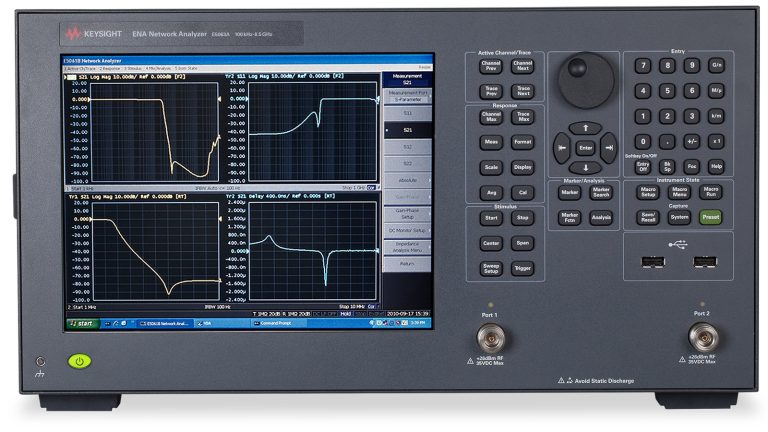
Keysight E5063A
Read more: S-parameters are one of several things an RF test plan measures. Our guide to what RF testing is covers the others, and the tools commonly used in RF testing.
What Does a Spectrum Analyzer Measure?
A spectrum analyzer displays signal amplitude or power as a function of frequency. It is particularly useful when engineers need to identify which frequencies are present, how strong the signals are, and whether unwanted signals appear outside the intended operating band.
Important selection factors include frequency coverage, displayed average noise level (DANL), dynamic range, phase-noise performance and available analysis bandwidth. Their relevance depends on the signals and test method.
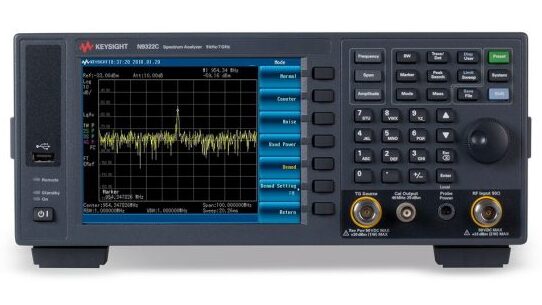
Keysight N9322C
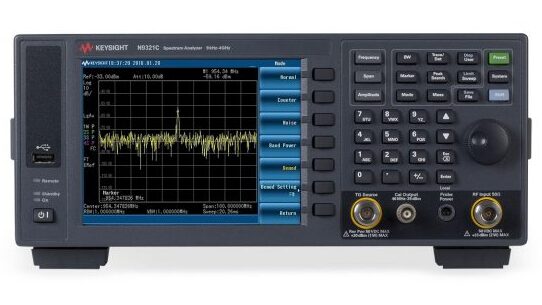
Keysight N9321C
Tekmark offers a range of Keysight RF spectrum analyzer models, including:
- Basic Spectrum Analyzer (BSA) series: General-purpose spectrum analyzers with frequency coverage from 9 kHz up to 20 GHz, depending on the model, suitable for RF signal measurements, harmonic analysis, interference troubleshooting and other routine RF testing applications.
- Keysight N9321C spectrum analyzer: BSA model covering 9 kHz to 4 GHz. More Info: data sheet | product page
- Keysight N9322C spectrum analyzer: BSA model covering 9 kHz to 7 GHz. More Info: data sheet | product page
- Keysight N9323C spectrum analyzer: BSA model covering 1 MHz to 13.6 GHz. More Info: data sheet | product page
- Keysight N9324C spectrum analyzer: BSA model covering 1 MHz to 20 GHz. More Info: data sheet | product page
Tekmark also offers the Keysight N9000B signal analyzer, an X-Series model supporting higher frequencies up to 26.5 GHz, depending on configuration. It provides additional signal analysis capabilities for RF and wireless communication testing, including measurements of signal power, harmonics and spurious emissions. More Info: data sheet | product page
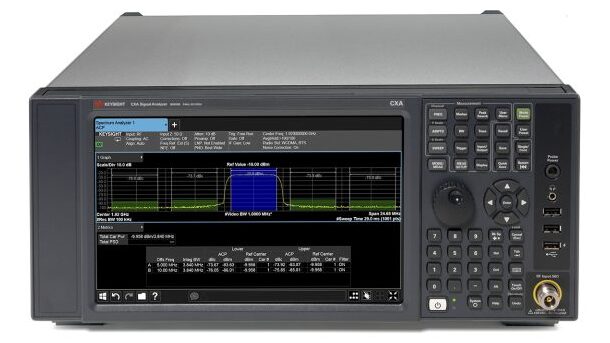
Keysight N9000B
Read more: Keysight’s X-Series instruments, such as the N9000B, are categorized as signal analyzers. To better understand the differences between these instruments and oscilloscopes, read our guide on spectrum analyzer vs oscilloscope.
Vector Network Analyzer vs Spectrum Analyzer: Technical Differences and Measurement Capabilities
The comparison below summarizes the technical differences between a VNA and a spectrum analyzer, from the measurement principle to the preparation before a measurement.
| Comparison | Vector network analyzer (VNA) | Spectrum analyzer |
| Primary purpose | Measures how an RF device responds to a known test signal. | Analyzes the power and frequency characteristics of RF signals. |
| Signal source | Uses a built-in signal source to stimulate the device under test (DUT). | Typically measures incoming signals without generating a test signal. Some models support an optional tracking generator. |
| Measurement principle | Measures incident, reflected and transmitted signals to determine the DUT’s response. | Measures the power of received signals across a selected frequency range. |
| Measurement results | Displays S-parameters, including magnitude (typically in dB) and phase (in degrees). | Displays signal power (typically in dBm) against frequency. |
| Typical measurements | Gain, insertion loss, return loss, impedance matching and phase response. | Signal power, harmonics, spurious emissions, RF interference and channel power. |
| Measurement accuracy | Depends on proper calibration, instrument performance and test setup. Common calibration methods include SOLT and TRL. | Depends on amplitude accuracy, instrument settings, noise performance and measurement conditions. |
| Measurement preparation | Perform calibration and recalibrate when changes to the test setup or measurement settings affect calibration validity. | Configure frequency range, reference level, input attenuation and resolution bandwidth according to the signal being measured. |
| Key specifications | Frequency range, number of test ports, dynamic range and measurement accuracy. | Frequency range, displayed average noise level (DANL), phase noise, analysis bandwidth and amplitude accuracy. |
| Additional capabilities | Certain models support spectrum analysis with the appropriate installed options; in this guide, suitably configured FieldFox combination analyzers. | Certain models support basic scalar network measurements, such as insertion loss and return loss, using a tracking generator and suitable accessories. |
Our technical engineers can recommend a suitable instrument and configuration based on your test specification, frequency range and operating environment.
Can a Vector Network Analyzer Perform Spectrum Analysis?
Certain Keysight VNAs offer integrated spectrum analysis capabilities in addition to conventional network measurements. Among the models in this guide, this combination is available on suitably configured FieldFox combination analyzers, described in the next section.
However, not all VNAs include this capability. The Keysight E5063A and E5061B benchtop analyzers do not offer a spectrum analysis function, and neither do the Streamline P937x and P938x USB analyzers. A separate spectrum analyzer is therefore required for signal-spectrum measurements with these instruments.
A spectrum analyzer can also provide limited network measurements when equipped with a tracking generator and suitable accessories. Such measurements are generally scalar (magnitude-based), whereas a VNA provides vector measurements, including phase, and supports appropriate vector error correction.
Keysight FieldFox: VNA and Spectrum Analysis in One Portable Instrument
Unlike dedicated benchtop VNAs and spectrum analyzers, certain Keysight FieldFox combination analyzers integrate multiple RF measurement functions into a single portable instrument.
Depending on the model and installed options, engineers can perform cable and antenna testing, vector network analysis and spectrum analysis, making FieldFox particularly suitable for field installation, maintenance and troubleshooting in telecommunications, aerospace, defense and government applications.
It is important to distinguish between FieldFox combination analyzers and FieldFox models configured primarily as spectrum analyzers. Available functions vary by model and installed options.
In the C-Series, the Keysight N9913C, N9914C and N9915C combination analyzers support additional network and spectrum capabilities through specific options, while the Keysight N9933C, N9934C and N9935C are spectrum analyzer models rather than equivalent VNA-and-spectrum combinations.
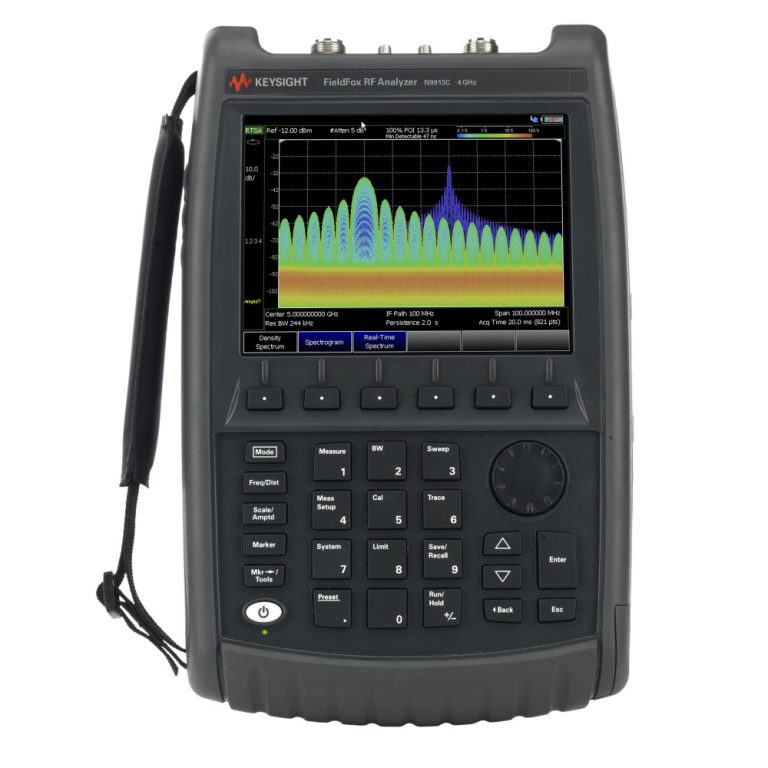
Keysight N9913C
The Keysight N9912C is a software-defined C-Series analyzer in which the cable and antenna, network analysis and spectrum analysis functions are each selected and licensed separately at 4, 6.5 or 10 GHz.
For measurements above the C-Series maximum of 10 GHz, the microwave A-Series combination analyzers provide the same functions, depending on the model and installed options.
Their maximum frequencies range from 14 GHz on the Keysight N9916A to 50 GHz on the Keysight N9952A. The Keysight N9936A to N9938A and N9960A to N9962A are the corresponding A-Series spectrum analyzer models.
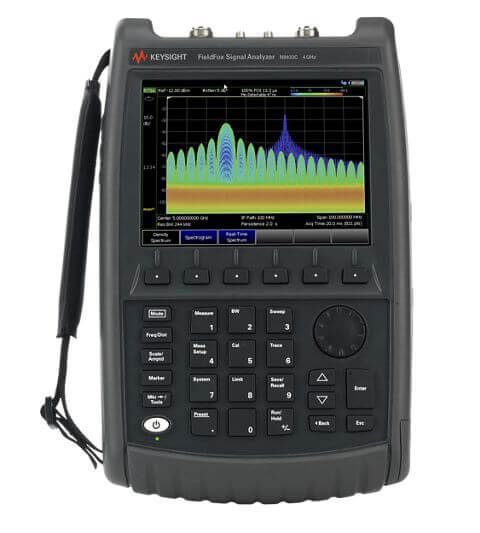
Keysight N9933C
Key Factors to Consider When Selecting an RF Analyzer
The factors below help determine whether a VNA, a spectrum analyzer or a multifunction analyzer best suits the application.
| Key factor | What to consider |
| Measurement requirements | Determine whether you need network analysis, spectrum analysis or both. |
| Frequency range | Ensure the instrument covers the required operating frequencies, harmonics and additional frequency bands. |
| Measurement performance | Evaluate accuracy, dynamic range, sensitivity, phase performance and analysis bandwidth, as applicable. |
| Instrument configuration | Check the required ports, measurement options, software and calibration accessories. |
| Testing environment | Consider whether the instrument will be used in a laboratory, production facility or on-site. |
| Budget and flexibility | Compare the total cost, including accessories, and assess whether a multifunction analyzer can meet your testing needs. |
Conclusion
Choosing between a vector network analyzer and a spectrum analyzer depends on your specific testing requirements, as each instrument serves different measurement applications.
A VNA suits antenna matching, filter insertion loss, and amplifier gain and matching measurements. A spectrum analyzer suits harmonic, spurious emission and interference measurements.
For applications requiring both capabilities, a suitably configured Keysight FieldFox combination analyzer offers a multifunction alternative to two dedicated instruments, providing greater flexibility and efficiency in RF testing. Multifunction instruments should be evaluated against the required measurement performance. Our technical engineers can recommend a vector network analyzer, spectrum analyzer or FieldFox configuration.
Why Tekmark?
Tekmark is the authorized Keysight distributor with strategic coverage across Southeast Asia, operating through direct offices in Malaysia, Singapore, and the Philippines.
- Over 30 years of expertise in electronic test and measurement solutions, as an electronics test equipment supplier in Malaysia and across Southeast Asia.
- Established presence across Southeast Asia, supporting customers through an extensive regional network.
- In-house R&D engineering expertise for application support and system integration.
- Value-added services, including calibration, professional training, and technical consultation.
- Dedicated local technical support before, during, and after your purchase.
Frequently Asked Questions
Not for all measurements. A spectrum analyzer with a tracking generator can support certain magnitude-only transmission or reflection tests, but applications requiring phase information and vector-corrected S-parameter measurements generally call for a VNA. On the BSA series, the tracking generator is a 4 or 7 GHz option, and reflection measurement is a further option on the N9321C and N9322C.
Some VNAs support spectrum analysis through dedicated hardware and/or software options. Whether a specific model is suitable for harmonic or spur measurements depends on its supported functions and performance specifications. The E5063A and E5061B do not include spectrum analysis, so these measurements call for a spectrum analyzer or a suitably configured FieldFox combination analyzer.
Calibration corrects systematic errors in the test setup and moves the reference plane from the analyzer’s test ports to the DUT. This removes the effects of test cables and connectors from the measurement result. Common calibration methods include SOLT and TRL, and calibration should be repeated when changes to the setup or settings may affect accuracy.
FieldFox is a family of portable RF instruments. Certain combination analyzers can support both VNA and spectrum analysis functions, while other models focus on spectrum analysis or cable and antenna testing. Always check the model and installed options: the N9913C to N9915C add vector network analysis and spectrum analysis through options, while the N9933C to N9935C are spectrum analyzers.
A VNA or cable and antenna tester is suitable for measurements such as return loss and matching. A spectrum analyzer is useful for investigating interference affecting antenna systems. Some FieldFox combination analyzers can support both tasks, depending on the installed options, so they suit antenna installation and maintenance on site.
You may need both measurement functions if your test plan includes network characterization and signal-spectrum analysis. Depending on performance requirements, this may mean two dedicated instruments or one appropriately configured multifunction analyzer. Among the models in this guide, the multifunction choice for vector network and spectrum measurements is a suitably configured FieldFox combination analyzer, with frequency coverage up to 50 GHz on the N9952A.
References
- Network analysis fundamentals
- Spectrum Analysis Basics, Part 1
- Fundamental Principles of Vector Network Analysis
- Applying Error Correction to VNA Measurements
- E5063A ENA product page
- E5061B ENA product page
- BSA series technical overview
- BSA configuration guide
- N9000B CXA technical specifications
- Streamline A-models configuration guide
- Streamline B-models configuration guide
- FieldFox C-Series data sheet
- FieldFox C-Series configuration guide
- FieldFox A-Series configuration guide
- FieldFox N9952A product page
Related Articles