What Drives the Price of a Vector Network Analyzer
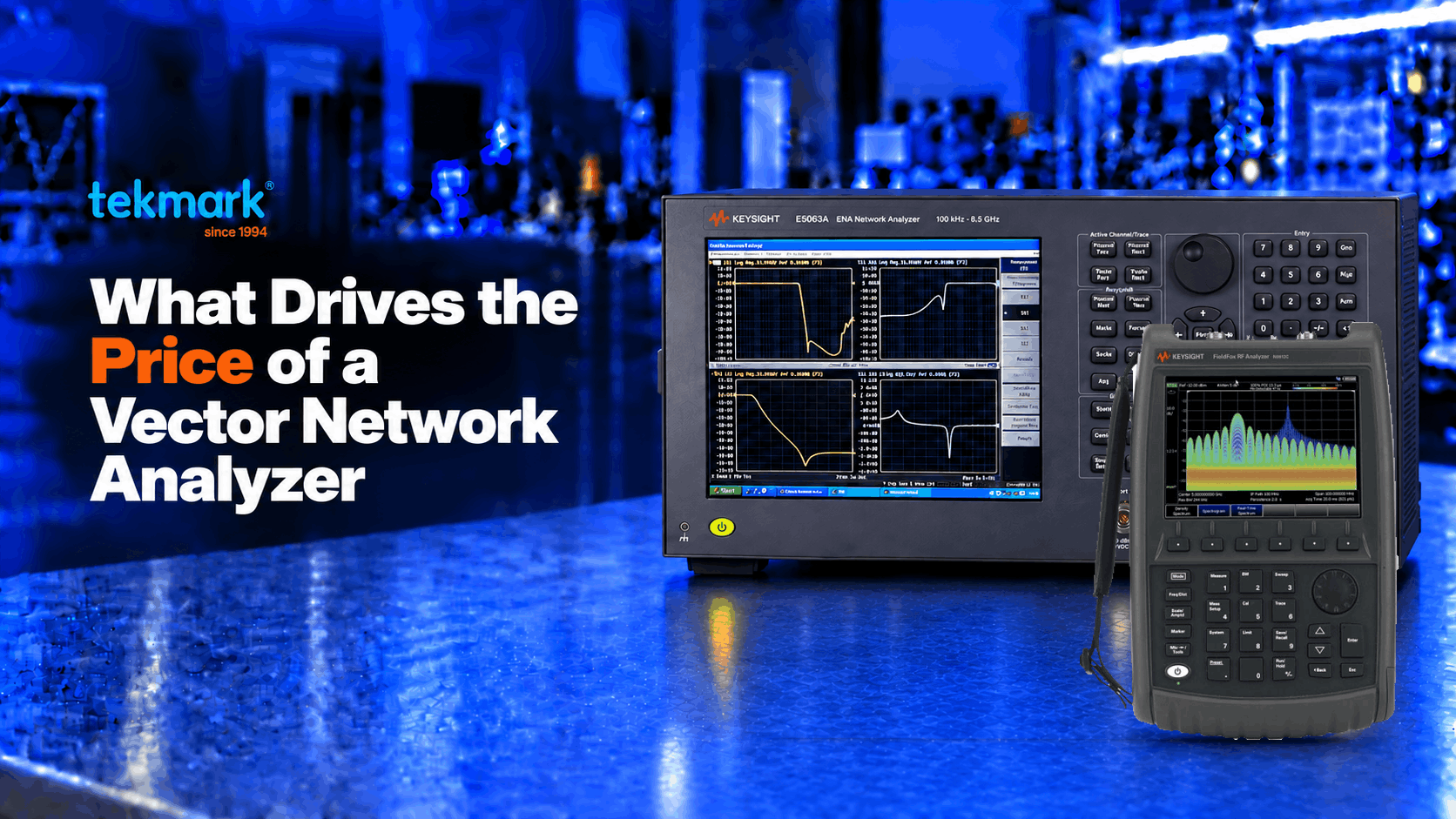
Vector network analyzer prices depend on each instrument’s measurement capabilities, hardware configuration and intended application. Frequency range, test-port configuration, dynamic range, measurement speed and software options can all affect the total investment. Calibration standards, test accessories and integration requirements should also be considered when planning a complete measurement setup.
At Tekmark, we help engineers and procurement teams select Keysight vector network analyzers (VNAs) for RF component characterization, product development, manufacturing test and field maintenance. This guide explains the main cost considerations and compares benchtop, USB and handheld instruments according to their applications.
Key Takeaways
- Configuration sets the price: A vector network analyzer is quoted by model and configuration, so frequency range, test ports, measurement performance and software options determine the final figure.
- Frequency range: Coverage should match the complete measurement band in the test specification, because higher-frequency operation generally requires more demanding RF hardware and connectors.
- Test ports and dynamic range: Two-port instruments suit many RF component measurements, while four-port configurations serve multiport devices and higher dynamic range serves high-rejection filters.
- Form factor by application: Benchtop ENA analyzers suit laboratory characterization, Streamline USB analyzers suit PC-integrated and automated test, and FieldFox handheld analyzers suit field installation and maintenance.
- Additional costs: Calibration standards or ECal modules, test cables, adapters, fixtures, software and integration effort all add to the total test-system cost.
- Quotation preparation: Specifying the DUT, frequency range, measurement requirements, ports, operating environment and calibration method allows Tekmark to recommend a suitable configuration.
How Much Does a Vector Network Analyzer Cost?
There is no single price applicable to every vector network analyzer. An instrument configured for routine S-parameter measurements on RF filters and cables has different requirements from a high-frequency system used for complex multiport characterization or automated production testing. The selected frequency range, hardware and software options determine the actual price of a VNA.
For an accurate quotation, specify the device under test (DUT), required frequency coverage, S-parameters, number of test ports, dynamic range, test environment and any automation requirements.
Read more: Configuration-based pricing also applies to other Keysight measurement instruments. Our guide to LCR meter price explains the requirements that shape an LCR meter configuration and its price.
What Determines the Price of a Vector Network Analyzer?
The factors below influence the configuration, and therefore the price, of a vector network analyzer.
1. Frequency range
The required frequency range is a major consideration because higher-frequency operation generally requires more demanding RF hardware and connectors. Select an instrument that covers the complete measurement band specified for the DUT, including relevant passband and stopband frequencies. For example, a 6 GHz filter does not automatically require an 18 GHz VNA; 18 GHz coverage is necessary only if the test specification calls for measurements at that frequency.
2. Test-port configuration
Two-port VNAs are widely used to measure reflection and transmission characteristics, including S11, S21, S12 and S22, of filters, amplifiers, cables and other RF components. Four-port configurations simplify characterization of differential and multiport devices, such as couplers and duplexers, and can reduce reconnections in repeated test procedures. Port count should be selected according to the DUT topology and required measurement workflow.
3. Dynamic range and measurement performance
Dynamic range is particularly important for high-rejection filters and low-level transmission measurements. Evaluate the specified performance at the relevant frequencies and IF bandwidth settings.
Trace noise, measurement speed, source power and receiver performance may also influence instrument selection, particularly for production test or demanding R&D measurements. Published maximum figures should not be treated as performance guaranteed under every configuration.
4. Instrument form factor
Benchtop, USB and handheld VNAs serve different operating environments. The appropriate choice depends on where measurements are performed, whether the instrument must be integrated into an automated system and which measurement functions are required. Form factor alone does not establish measurement accuracy or price.
5. Calibration, software and accessories
A complete VNA setup may require mechanical calibration standards or an electronic calibration (ECal) module, suitable test cables, adapters, fixtures and software applications. Measurement calibration corrects systematic errors and establishes the reference plane; periodic instrument calibration and service are separate considerations. Check calibration compatibility with the test-port connectors, frequency range and required procedure.
Benchtop vs USB vs Handheld VNAs: Which Suits Your Application?
Keysight vector network analyzers are available in benchtop, modular, USB and handheld form factors. These categories address different measurement environments and system-integration requirements.
The following comparison covers the benchtop, Streamline USB and FieldFox handheld instruments that Tekmark offers, organized by measurement environment and intended engineering application.
| Type | Typical applications | Common industries / environments | Selection considerations |
| Benchtop ENA | Passive RF component characterization; filter, cable, antenna and connector testing; low-frequency and power integrity measurements; impedance analysis (E5061B LF-RF configurations) | Electronics and semiconductor R&D; wireless communications; aerospace and defense laboratories; PCB and component test | Frequency option, port impedance, software options and standalone operation |
| Streamline USB / PC-controlled | PC-integrated S-parameter testing; compact engineering benches; automated component validation | Electronics design labs; manufacturing test stations; space-constrained laboratories | Host-PC compatibility, ports, software and automation integration |
| Handheld FieldFox | Cable and antenna testing; field S-parameter measurements (VNA option); installation, maintenance and troubleshooting; optional spectrum and power measurements | Telecommunications; aerospace and defense; government and public-sector technical operations; field service | Portability, battery operation, environmental conditions and installed measurement options |
Our technical engineers can recommend a suitable form factor and configuration based on your test specification and operating environment.
Choosing a Keysight Benchtop Vector Network Analyzer
Keysight benchtop vector network analyzers are offered in Essential, Expert and Pro performance grades. These grades are useful for understanding application complexity. Tekmark offers the following Essential and Expert-grade ENA models for fundamental S-parameter measurements, passive components, cables, filters, impedance-related applications and active-device characterization.
- Keysight E5061B vector network analyzer: Essential-grade, 2-port ENA with a frequency range from 5 Hz with an LF-RF option, or from 100 kHz with 50 Ω or 75 Ω test sets, up to a maximum of 3 GHz, depending on the selected option. LF-RF configurations suit low-frequency and power integrity applications and can add impedance analysis as a further option.
- Keysight E5063A vector network analyzer: Essential-grade, 2-port, 50 Ω VNA with selectable frequency ranges from 100 kHz up to a maximum of 18 GHz, depending on the selected option. It is designed for passive devices such as antennas, filters, cables and connectors, and its frequency options can be upgraded after purchase. More Info: product page
- Keysight E5080B vector network analyzer: Expert-grade ENA with a frequency range from 9 kHz up to 4.5, 6.5, 9, 14 or 20 GHz, or from 100 kHz up to a maximum of 53 GHz, depending on the selected option, in 2-port or 4-port configurations. It supports characterization of passive components, amplifiers, mixers and frequency converters, with mixer measurements available as software applications. More Info: product page
Select the E5061B with an LF-RF option where measurements extend below 100 kHz or require impedance analysis, and the E5063A where passive-component testing up to 18 GHz is the main requirement. Select the E5080B for benchtop measurements above 18 GHz, four-port configurations or active-device characterization, including amplifiers and mixers.
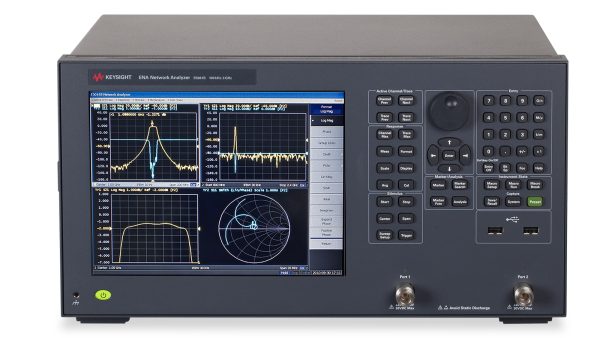
Keysight E5061B
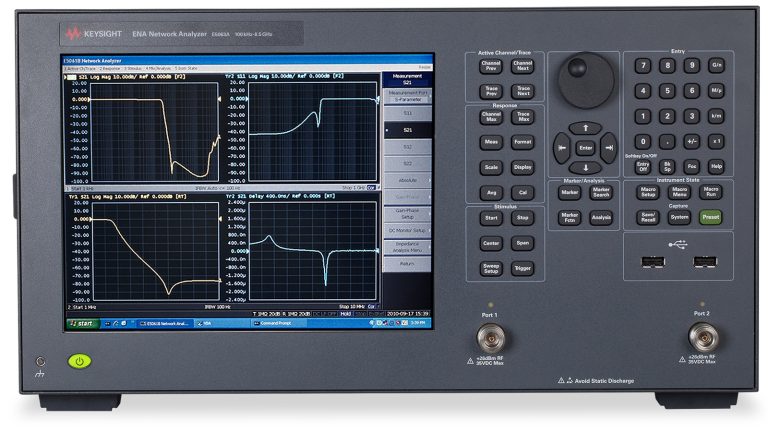
Keysight E5063A
Choosing a Keysight Streamline USB and PC-Controlled Vector Network Analyzer
Keysight Streamline USB VNAs are compact, PC-controlled instruments that use a host computer for instrument control, measurement setup and data analysis. They are suitable for engineering laboratories and production test stations that need network-analysis capabilities without allocating space for a conventional benchtop analyzer. Selected configurations support multiport measurements and automated test workflows.
The main differences across Streamline models are frequency coverage, number of test ports and available measurement features. The P937xA family provides two-port configurations from 300 kHz, while P937xB models start at 9 kHz on models up to 20 GHz and extend coverage to 44 GHz with the Keysight P9377B. P938xB models, such as the Keysight P9384B, provide four-port configurations for applications involving multiple connections or differential devices.
| Models | Frequency coverage / configuration | Typical applications |
| P9370A to P9375A | P937xA Streamline USB VNAs; 2-port, from 300 kHz up to 4.5, 6.5, 9, 14, 20 or 26.5 GHz by model | Two-port S-parameter characterization and automated component validation |
| P9370B / P9371B / P9372B | 4.5 / 6.5 / 9 GHz maximum, from 9 kHz; 2-port | Two-port S-parameter characterization and automated component validation |
| P9373B / P9374B / P9375B | 14 / 20 / 26.5 GHz maximum; 2-port; from 9 kHz, or 100 kHz on the P9375B | Two-port S-parameter characterization and automated component validation |
| P9377B | 100 kHz to 44 GHz; 2-port | Two-port measurements on microwave and millimeter-wave components |
| P9382B | 9 kHz to 9 GHz; 4-port | Differential and multiport devices such as couplers and duplexers |
| P9384B | 9 kHz to 20 GHz; 4-port | Differential and multiport devices such as couplers and duplexers |
Streamline models should be selected according to the highest test frequency and the number of ports the DUT requires. The host-PC and automation environment in which the analyzer will operate should also be confirmed.
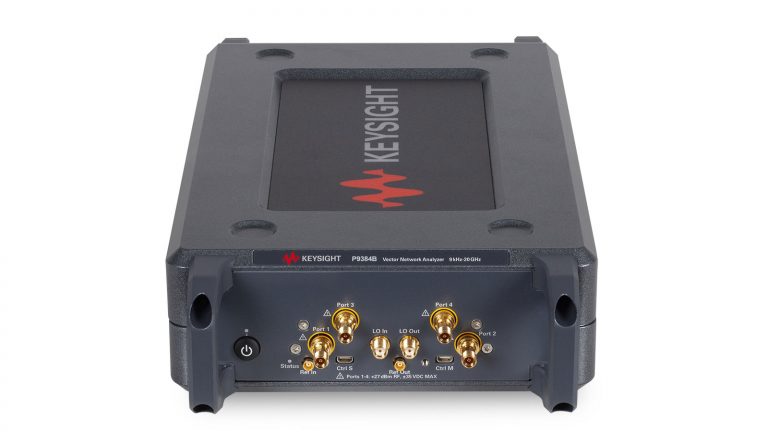
Keysight P9384B
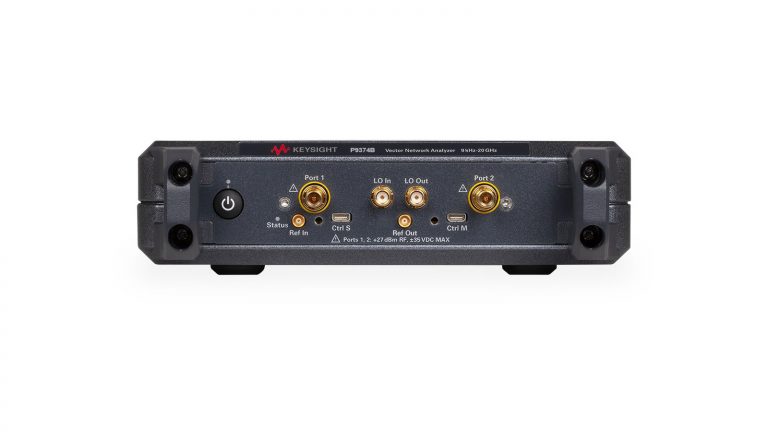
Keysight P9377B
Read more: Because Streamline analyzers are controlled from a host PC, they can be programmed as part of an automated test system. Our guide to automated test equipment with SCPI explains how Keysight instruments are programmed with SCPI commands and sequenced in an automated test.
Choosing a Keysight FieldFox for Field Measurement Applications
Keysight FieldFox handheld analyzers provide portable RF and microwave measurements for field applications. Depending on the model and configuration, they support cable and antenna testing, vector network analysis, spectrum analysis and interference troubleshooting. They are ideal for telecommunications, aerospace, defense and government applications requiring reliable on-site testing.
| Models | Maximum frequency | Application notes |
| N9912C | 4, 6.5 or 10 GHz, depending on the licensed functions | Software-defined C-Series analyzer configured with cable and antenna, vector network analysis and/or spectrum analysis functions, each licensed at 4, 6.5 or 10 GHz. Suitable for installation and maintenance work where measurement requirements may change. |
| N9913C / N9914C / N9915C | 4 / 6.5 / 10 GHz | C-Series combination analyzers for cable and antenna testing, vector network analysis and spectrum analysis, depending on configuration. Suitable for telecommunications installation and maintenance, wireless infrastructure testing and field troubleshooting. |
| N9916A / N9917A / N9918A | 14 / 18 / 26.5 GHz | Combination analyzers supporting cable and antenna testing, vector network analysis and spectrum analysis, depending on installed options. Suitable for telecommunications infrastructure testing, RF troubleshooting, and aerospace and defense applications. |
| N9950A / N9951A / N9952A | 32 / 44 / 50 GHz | Higher-frequency combination analyzers for microwave and millimeter-wave measurements. Suitable for radar systems, satellite communications, aerospace and defense testing, and high-frequency component characterization. VNA functionality depends on installed options. |
Maximum frequency ranges from 4 GHz on the C-Series to 50 GHz on the Keysight N9952A. FieldFox models should be selected according to the maximum test frequency and the measurements required on site. Vector network analysis depends on the installed options and is not available on spectrum-analyzer-only FieldFox models.
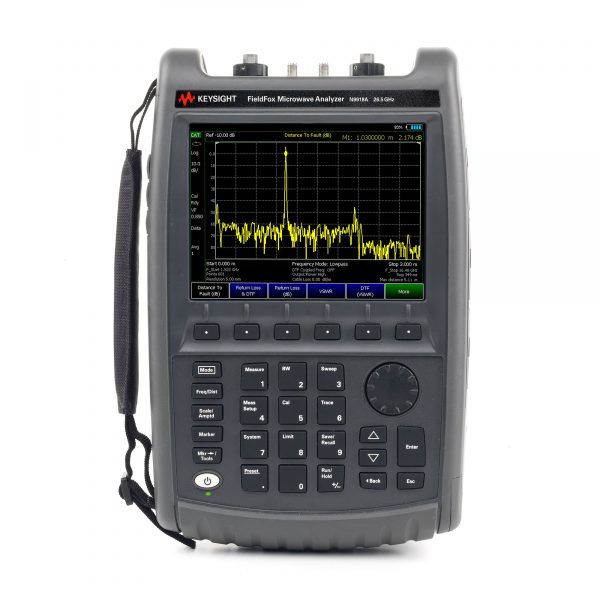
Keysight N9918A
Which Network Analyzer Fits Your Testing Requirements?
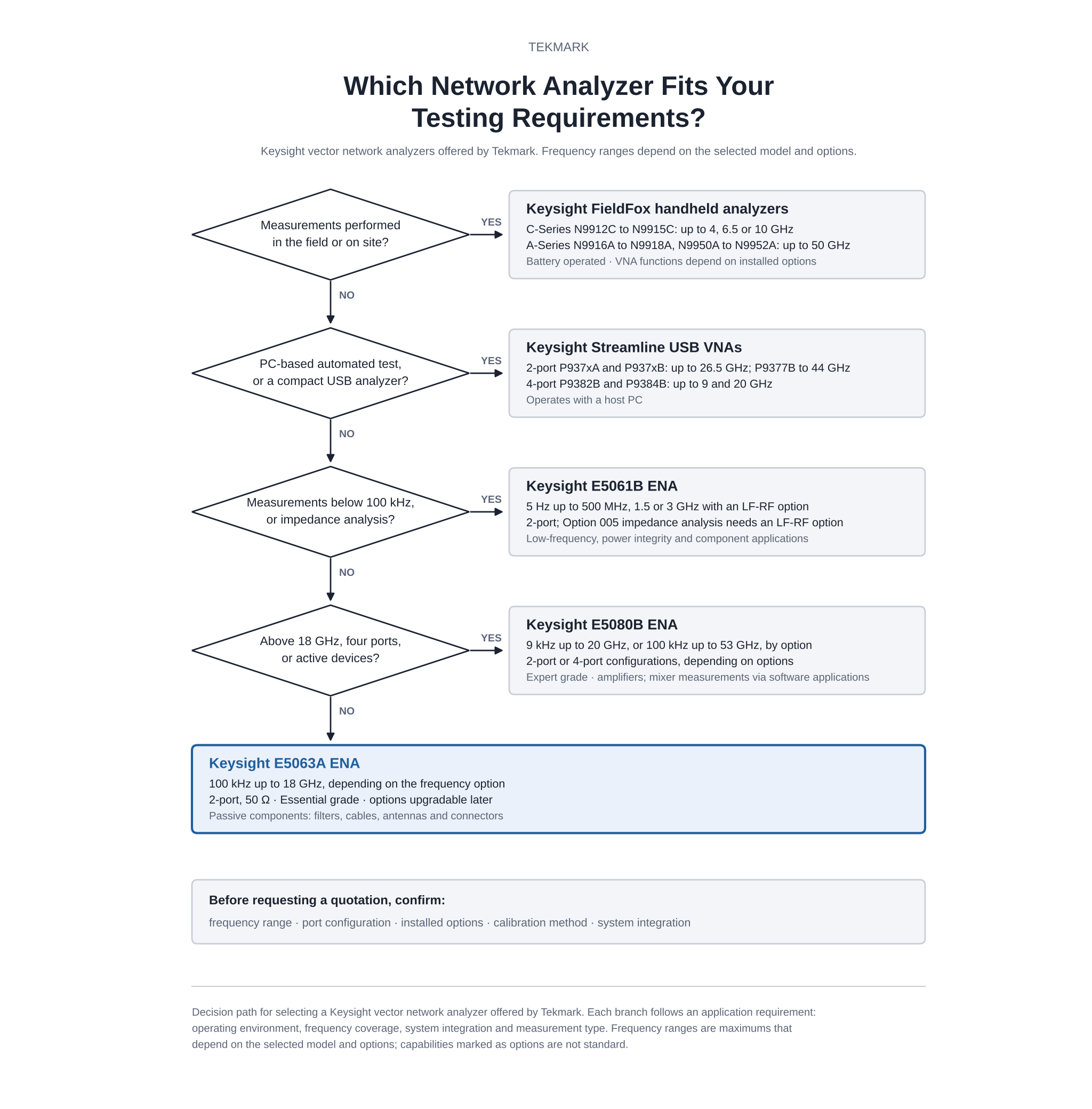
The appropriate instrument depends first on the application requirement, then on frequency coverage and configuration. A FieldFox handheld analyzer is suited to field installation and maintenance. A Streamline USB model is suited to PC-based automated test.
For laboratory component characterization, select the E5061B with an LF-RF option for measurements below 100 kHz or impedance analysis, and the E5063A for passive components up to 18 GHz. Select the E5080B for benchtop measurements above 18 GHz, four-port configurations or active-device characterization; its maximum frequency is 53 GHz, depending on the frequency option.
For PC-integrated and automated test, Streamline models have a maximum frequency of 44 GHz in two-port configurations and 20 GHz in four-port configurations. For field installation and maintenance, the FieldFox N9952A has a maximum frequency of 50 GHz. Our technical engineers can confirm the available port and frequency configurations for each requirement, including requirements above 53 GHz.
The decision path below summarizes these selection steps.
Additional Costs to Consider: Calibration Kits, ECal Modules and Accessories
Beyond the instrument, budget for calibration kits or ECal modules, phase-stable RF cables, connector adapters, fixtures, software licenses and any required automation interfaces. For production applications, include integration effort, test development, throughput requirements and ongoing maintenance. A lower instrument price does not necessarily produce the lowest overall test-system cost.
Tekmark can supply Keysight ECal modules, calibration standards, cables and adapters as part of a configured quotation. Calibration hardware should match the test-port connector type, impedance and frequency range of the selected analyzer.
What to Confirm Before Requesting a VNA Quotation?
The following information allows Tekmark to recommend a suitable configuration and prepare an accurate quotation.
| Requirement | Information to provide |
| Application and DUT | Filter, amplifier, antenna, cable, RF module or multiport device |
| Frequency range | Minimum and maximum test frequencies from the measurement specification |
| Measurement requirements | S-parameters, insertion loss, return loss, rejection, dynamic range and accuracy |
| Ports and connectors | Number of simultaneous ports, connector type and impedance |
| Operating environment | R&D bench, automated production station or field maintenance |
| Calibration | Calibration method, reference plane, test cables and fixtures |
| System integration | Host PC, software, remote-control interface and test automation requirements |
Conclusion
The price of a vector network analyzer follows its configuration: frequency range, test ports, measurement performance, software options and calibration requirements. ENA benchtop analyzers suit laboratory component characterization, Streamline USB analyzers suit PC-integrated and automated test, and FieldFox handheld analyzers suit field installation and maintenance.
Tekmark offers Keysight network analyzers and handheld combination analyzers, and our technical engineers can match a Keysight network analyzer to your test specification and prepare a configured quotation.
Why Tekmark?
Tekmark is the authorized Keysight distributor with strategic coverage across Southeast Asia, operating through direct offices in Malaysia, Singapore, and the Philippines.
- Over 30 years of expertise in electronic test and measurement solutions, as an electronics test equipment supplier in Malaysia and across Southeast Asia.
- Established presence across Southeast Asia, supporting customers through an extensive regional network.
- In-house R&D engineering expertise for application support and system integration.
- Value-added services, including calibration, professional training, and technical consultation.
- Dedicated local technical support before, during, and after your purchase.
Frequently Asked Questions
Frequency range, test-port configuration, measurement performance, software options and accessories are key factors. The final quotation depends on the selected model and configuration, including calibration standards, test cables and any system-integration requirements. Higher-frequency coverage generally requires more demanding RF hardware and connectors, so the required test band is the first specification to confirm.
A two-port VNA supports many standard reflection and transmission measurements, including S11, S21, S12 and S22 on filters, amplifiers and cables. A four-port VNA is advantageous for differential or multiport DUTs and applications requiring fewer reconnections. Tekmark offers four-port configurations on the E5080B benchtop analyzer, depending on the selected options, and in the Streamline USB range with the P9382B and P9384B.
A PC-controlled VNA can be a suitable choice for compact engineering workstations and automated test systems. Evaluate the measurement specifications, host-PC requirements, control software and integration needs. Streamline USB analyzers rely on a host computer for control and data analysis, so the computer and software belong in the total test-system cost.
Yes, on FieldFox models configured with the required VNA capabilities. Verify the model, installed options, frequency range and measurement specifications before selecting it for field testing. On combination analyzers such as the N9913C and N9952A, the standard configuration provides cable and antenna analysis, and vector network analysis is added through specific options.
Accurate S-parameter measurements generally require an appropriate calibration procedure and compatible standards. The method depends on the connectors, frequency range, measurement plane and test setup. Mechanical calibration kits and ECal modules both correct systematic errors; the choice depends on how often calibration is performed, the connector types and the port count.
As general practice, dynamic range at the selected settings should exceed the deepest rejection or lowest transmission level in the test specification, with margin. High-rejection filters and low-level transmission measurements place the greatest demand on dynamic range. Evaluate the specified figure for the exact model and configuration, because published maximum figures do not apply under every setting.
Tekmark offers Keysight E5061B, E5063A and E5080B ENA benchtop analyzers, Streamline USB analyzers from the P937xA, P937xB and P938xB families, and FieldFox C-Series and A-Series handheld combination analyzers. Frequency coverage extends from 5 Hz on the E5061B, depending on the option, up to 53 GHz on the E5080B. Our engineers can recommend a configuration for your application.
References
- E5063A ENA product page
- E5061B options
- E5080B ENA product page
- Keysight VNA portfolio
- USB VNA overview
- P9375A Streamline product page
- P9377B Streamline product page
- P9384B Streamline product page
- FieldFox C-Series configuration guide
- FieldFox A-Series configuration guide
- FieldFox N9952A product page
- Applying Error Correction to VNA Measurements
- Specifying Calibration Standards and Kits
- N7551A ECal module product page
Related Articles