How Much Does an LCR Meter Cost? A Buyer’s Guide
An LCR meter price depends on the measurement capability and the complete configuration you purchase.
As a guide, the starting price for Keysight handheld LCR meters is RM1,979* and the price for benchtop & RF models starts from RM30,280* before options, fixtures and commercial terms.
Note: *Starting price indicated above is correct at the time of writing and without duty & tax. Please contact Tekmark for a personalized quote based on your requirements
For portable component checks, a handheld LCR meter may be sufficient. For controlled laboratory or production testing, a benchtop LCR meter may be needed. High-frequency passive-component testing requires a model designed for that frequency range.
The useful comparison is the cost of meeting your test requirements, including the instrument, options and fixture.
This guide explains what affects an LCR meter price, compares representative Keysight LCR meters and helps you prepare a quotation request. Exact local prices depend on the selected configuration and current commercial terms.
Key Takeaways
- Compare the complete configuration, not just the base price. Include required options, fixtures, calibration documentation and integration costs.
- Match the meter to your DUT and test conditions. Capacitors, inductors and resistors can require different frequencies, signal levels and bias arrangements.
- Check accuracy under your actual measurement conditions. Headline basic accuracy and display resolution alone do not establish suitability.
- Choose the Keysight model by capability. Handheld models support portable checks; E4980BL and E4980B support precision bench testing; E4982A addresses high-frequency passive-component tests.
- Check signal and bias capabilities separately from frequency coverage. E4980BL provides fixed 1.5 V/2 V bias, while E4980B supports enhanced drive and bias through Option 001.
- Request a quotation against a defined test requirement. Share your component specifications, measurement parameters, frequency range, bias needs and throughput requirements.
What Does an LCR Meter Measure?
An LCR meter measures a component’s impedance using an AC test signal and reports parameters such as inductance (L), capacitance (C) and resistance (R). Depending on the model and measurement function, it can also report quality factor (Q), dissipation factor (D), equivalent series resistance (ESR) and impedance magnitude and phase.
These measurements support component checks, incoming inspection, design evaluation and manufacturing tests. Capacitors, inductors and resistors have different measurement requirements, so choosing a meter starts with the device under test (DUT) and its specified test conditions.
What Affects an LCR Meter Price?
Four requirements shape the configuration you buy, and therefore the price. The factors are frequency coverage, accuracy at your measurement conditions, AC signal level and DC bias, and fixtures and automation.
(A) Frequency Coverage
Choose a meter that reaches the frequencies specified in your test procedure:
- Handheld meters offer selected spot frequencies
- Precision benchtop models provide adjustable frequency coverage
- RF LCR meters address higher-frequency component tests
A higher maximum frequency does not automatically improve a measurement performed at a much lower frequency.
Test frequency matters because impedance changes with it. Using the reactance formula in Keysight’s Impedance Measurement Handbook, Xc = 1 / (2πfC), an illustrative 100 nF capacitor measures about 1,592 Ω at 1 kHz and about 15.9 Ω at 100 kHz.
The same part presents a 100-fold different impedance at the two frequencies, so a result is only comparable at the frequency your specification states.
Some models offer frequency configurations and upgrades, an approach Keysight’s LCR meter and fixture selection guide describes as choosing what you require today and upgrading later. This can help you avoid buying coverage you do not currently need, but confirm the available upgrade and its cost before planning a future expansion.
(B) Accuracy at Your Measurement Conditions
A headline basic accuracy figure is a starting point for comparison. Actual measurement error depends on conditions such as frequency, impedance, signal level and measurement speed, together with the fixture and environment.
Always check the data sheet at your expected component values rather than comparing percentages alone.
For pass/fail testing, the complete measurement uncertainty must be suitable for the component tolerance and acceptance limits. A high-resolution display does not, by itself, establish that the instrument is accurate enough.
(C) AC Signal Level and DC Bias
The applied AC voltage or current can affect the result for some components. Select a meter that can reproduce the signal level required by the component specification. Higher drive is useful only when the test requires it.
DC bias is another application-dependent requirement. Capacitor characterization may require DC voltage bias, while inductor evaluation under load may require DC current bias and compatible accessories. Confirm the needed bias range and supported setup. Do not assume that every meter with a bias feature provides the same capability.
(D) Fixtures and Automation
Fixtures, cables and adapters must match the component package and measurement method.
A suitable connection helps control parasitic effects and improves measurement consistency, particularly for small surface-mount parts or low-impedance components.
For production testing, measurement speed, handling interfaces, remote control and data collection can affect the configuration and total project cost. Compare the complete setup rather than the base instrument alone.
Read more: If your production test will run the meter under remote control, the interface and command set come first. Our guide to building automated test equipment with Keysight instruments and SCPI shows how SCPI commands and LAN, USB or GPIB connections are used to control instruments and log measurements.
How Does Your DUT Affect LCR Meter Selection?
Use the component specification to establish what must be measured and under which conditions. The examples below show how different DUTs influence the configuration you should quote.
| DUT | Typical measurements | Requirements to check |
| Capacitors | Capacitance, D and ESR | Frequency, AC signal level, package and DC voltage bias if specified |
| Inductors and coils | Inductance, Q and resistance | Frequency, impedance range, fixture and DC current bias if required |
| Resistors | Resistance and AC impedance | Resistance range, accuracy, frequency and connection method |
Not every measurement function or bias arrangement is available on every model.
For example, assessing how a ceramic capacitor’s capacitance changes under applied DC voltage needs a suitable bias setup.
A routine incoming check should follow the supplier’s prescribed test conditions. This is one example of a configuration requirement, rather than the main purpose of an LCR meter.
Which Keysight LCR Meter Fits Your Requirements?
Keysight’s LCR meters range from handheld models for portable component checks to benchtop models for precision and high-frequency testing.
The Keysight E4981B sits outside this comparison, because it is a dedicated capacitance meter for production capacitance testing rather than a full LCR meter.
(i) Handheld LCR Meters for Portable Component Checks
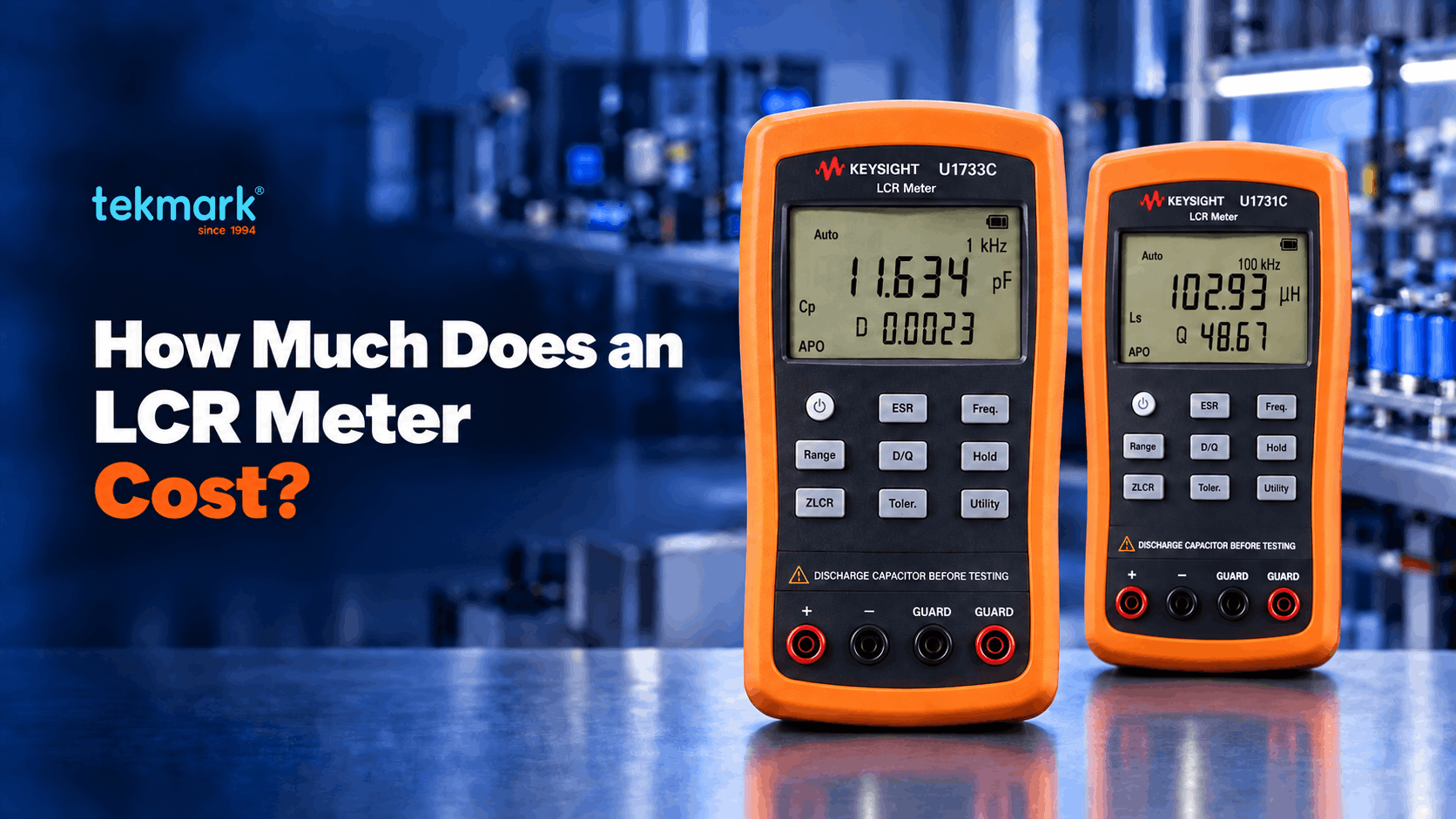
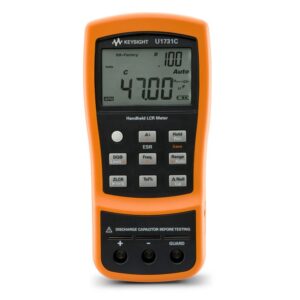
The Keysight U1731C, U1732C and U1733C provide portable LCR measurements with a 20,000-count display and 0.2% headline basic accuracy under specified conditions.
The Keysight U1731C offers 100 Hz, 120 Hz and 1 kHz. The Keysight U1732C adds 10 kHz, and the Keysight U1733C also offers 100 kHz. For full specifications, refer to the U1730C Series data sheet.
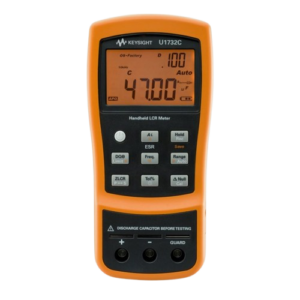
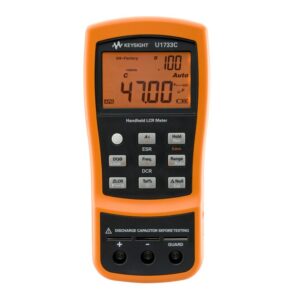
Keysight U1731C, U1732C & U1733C
These models are worth considering for service work, troubleshooting and preliminary component checks when their frequencies and specified performance meet the task.
Their full measurement ranges and accuracy limits vary with frequency; maximum range figures should not be treated as equally usable at every setting.
A handheld digital multimeter with a capacitance function may suffice for a simple capacitance check.
Choose a dedicated handheld LCR meter when you also need inductance or component measurements at selectable AC test frequencies. You can see the range on the handheld LCR meter e-shop page.
Read more: If a digital multimeter may cover your simple capacitance checks, the next choice is the DMM format. Our guide on benchtop vs handheld digital multimeter compares the two formats on accuracy, portability and typical use.
(ii) Keysight E4980BL for Precision Testing Within a Configured Frequency Range
The Keysight E4980BL covers 20 Hz to 300 kHz, 500 kHz or 1 MHz, depending on the frequency option, with 0.05% basic accuracy under specified conditions.
It provides an adjustable AC test signal up to 2 Vrms and fixed 1.5 V or 2 V DC bias. Both are listed on the Keysight E4980BL product page.
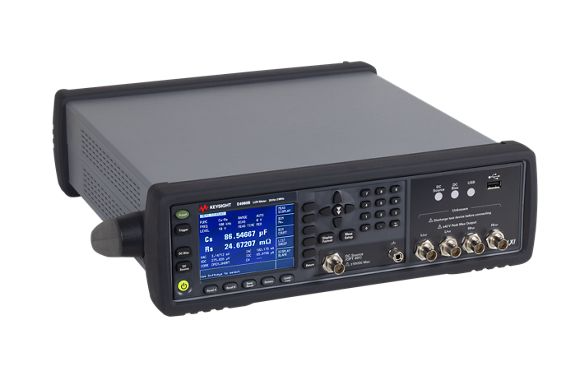
Keysight E4980BL
It is a configuration to consider for laboratory and manufacturing tests that fit those limits. Frequency upgradability offers flexibility, but it does not give the BL the enhanced drive and variable-bias capability of the E4980B.
Power and DC bias enhancement Option 001 is not installable on the E4980BL.
(iii) Keysight E4980B for Wider Coverage and Optional Enhanced Drive and Bias
The Keysight E4980B covers 20 Hz to 2 MHz and specifies 0.05% basic accuracy. Option 001 provides enhanced capabilities including an AC test signal up to 20 Vrms and DC bias up to 40 V, subject to the instrument’s operating limits.
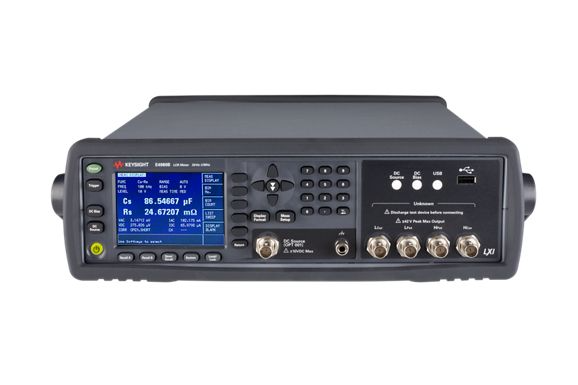
Keysight E4980B
Compare this model with the E4980BL when you need the wider frequency range or enhanced drive and bias. If your procedure does not need those capabilities, compare quotations for both against the same fixture, interface and calibration requirements. Both models are on the bench LCR meter e-shop page.
(iv) Keysight E4982A for High-Frequency Passive Component Testing
The Keysight E4982A starts at 1 MHz and offers upper-frequency options of 300 MHz, 500 MHz, 1 GHz or 3 GHz. It specifies 0.8% basic accuracy and addresses high-frequency passive-component tests, including SMD inductors and EMI filters.
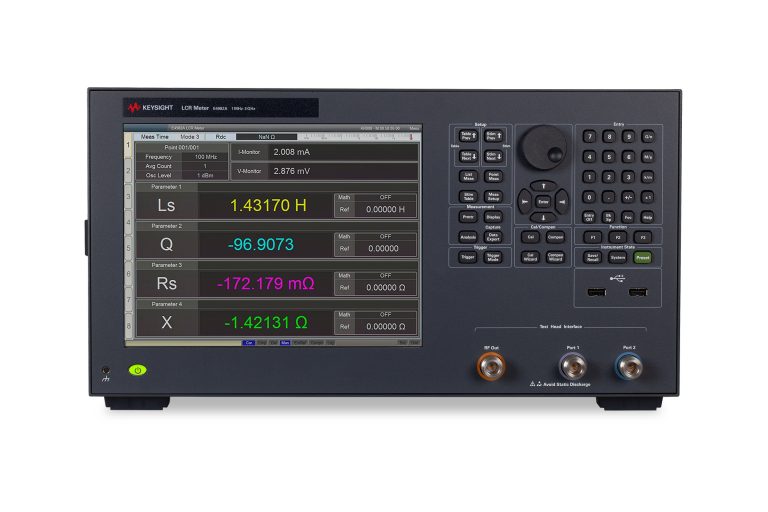
Keysight E4982A
Its purpose is different from a low-frequency precision bench meter. It cannot perform a 1 kHz test, and its RF accuracy figure should not be interpreted as a universal comparison with the E4980B or E4980BL.
Select it when your required measurement frequency and DUT call for an RF instrument. Full specifications are in the E4982A data sheet.
How Do These Keysight LCR Meters Compare?
The table below summarizes the frequency coverage, headline basic accuracy and main selection point for each model. Accuracy figures apply under specified conditions, so check the data sheet at your own test settings.
| Type | Model | Frequency coverage | Basic accuracy | Key selection point |
| Handheld | U1731C / U1732C / U1733C | Spot frequencies to 1 / 10 / 100 kHz respectively | 0.2% | Portable checks at supported frequencies |
| Precision benchtop | E4980BL | 20 Hz to 300 kHz / 500 kHz / 1 MHz | 0.05% | AC drive to 2 Vrms; fixed 1.5 / 2 V bias |
| Precision benchtop | E4980B | 20 Hz to 2 MHz | 0.05% | Optional enhanced drive and bias with Option 001 |
| RF | E4982A | 1 MHz to 300 MHz / 500 MHz / 1 GHz / 3 GHz | 0.8% | High-frequency passive-component tests |
If you are unsure which configuration fits your DUT, share your component specifications and test conditions and Tekmark will recommend a suitable Keysight LCR meter.
How Much Do Keysight LCR Meters Cost?
The price of a Keysight LCR meter depends on the model, the frequency option and any enhancement option you add.
The table below gives indicative prices for the models in this guide. Prices exclude fixtures, accessories, calibration documentation, taxes and delivery, and the final figure is confirmed in a quotation.
| Model | Configuration | Price Starting From |
| U1731C – U1733C | 100 Hz/ 120 Hz/ 1 kHz/ 10kHz/ 100 kHz | RM 1,979* |
| E4980BL | 20 Hz to 300 kHz/ 500 kHz/ 1MHz | RM 30,280* |
| E4980B | 20 Hz to 2 MHz, standard | RM 124,305* |
| E4982A | 1 MHz to 300 MHz/ 500 MHz/ 1 GHz/ 3 GHz | RM 119,712* |
*Starting price indicated above is correct at the time of writing and without duty & tax. Please contact Tekmark for a personalized quote based on your requirements.
LCR Meter Selection Checklist
Before requesting an LCR meter quotation, define your component and measurement requirements. The six points below help identify a suitable instrument, configuration and accessories.
| What to confirm | Why it matters | How to specify it |
| Test frequency range | Impedance depends on frequency, so the meter must measure at your part’s test frequency | State your lowest and highest test frequency; pick handheld spot frequencies, bench to 2 MHz, or RF to 3 GHz |
| Accuracy at your test conditions | Pass/fail limits need measurement uncertainty suited to your tolerance, under matching conditions | State your part tolerance and acceptance limits; check the data sheet accuracy at your test frequency and component value |
| Test signal level | Level-dependent parts must be measured at their working drive level | State the required test voltage or current; on the E4980B, add Option 001 if you need higher drive |
| DC bias | Bias-dependent parts, such as Class II MLCCs, change value under DC bias | State whether you test under DC bias and at what voltage; on the E4980B, add Option 001 if required (the E4980BL provides fixed 1.5 V or 2 V bias) |
| Fixturing and accessories | The fixture and cabling set the real connection to the DUT and its repeatability | State your part package and lead type; match the Keysight fixture and calibration standards |
| Options and upgrade path | The frequency range and features are optioned, so future needs affect today’s choice | State whether you may need higher frequency later; confirm the model offers a frequency upgrade |
Sources for these criteria: Keysight Impedance Measurement Handbook, the LCR meter and fixture selection guide, and the E4980B Option 001 product page.
Conclusion
Choosing an LCR meter starts with understanding your component and test requirements. Frequency coverage, measurement accuracy, AC signal level, DC bias and fixtures all influence the configuration you need, and the total price.
Compare quotations for a complete setup that meets those requirements. A handheld meter may be sufficient for portable checks, while precision benchtop or RF models serve more demanding measurement needs.
Share your component specifications and test conditions with Tekmark to identify a suitable Keysight LCR meter and request a quotation covering the required options and accessories.
Why Tekmark?
Tekmark is the authorized Keysight distributor with strategic coverage across Southeast Asia, operating through direct offices in Malaysia, Singapore, and the Philippines.
- Over 30 years of expertise in electronic test and measurement solutions, as an electronics test equipment supplier in Malaysia and across Southeast Asia.
- Established presence across Southeast Asia, supporting customers through an extensive regional network.
- In-house R&D engineering expertise for application support and system integration.
- Value-added services, including calibration, professional training, and technical consultation.
- Dedicated local technical support before, during, and after your purchase.
Frequently Asked Questions
The price varies by model, options, accessories and commercial terms. As a guide, the starting price for Keysight handheld LCR meters is RM 1,979* and for benchtop and RF models is RM 30,280* before options, fixtures and commercial terms. Request a current local quotation for a defined configuration, since base prices alone may overlook the fixture or features your test needs.
*The starting price indicated above is correct at the time of writing and without duty & tax. Please contact Tekmark for a personalized quote based on your requirements.
A handheld model may be sufficient when its available test frequencies, signal conditions and specified accuracy meet your component-checking requirements. Controlled signal levels, tighter uncertainty or automated production testing may require a benchtop configuration.
No. Bias is required only when the test procedure or characterization objective calls for it. Specify the needed voltage or current and confirm that the instrument and accessories support the requirement.
Use the test frequency stated in the capacitor’s specification or the supplier’s prescribed test conditions. Impedance changes with frequency, so a result taken at a different frequency is not directly comparable. Then confirm the meter offers that frequency, for example 1 kHz on the U1700 handheld models or up to 2 MHz on the E4980B.
No. A digital multimeter’s capacitance function may suffice for a simple capacitance check. Choose an LCR meter when you also need inductance, Q, D or measurements at selectable AC test frequencies.
Keysight lists frequency upgrades for the E4980BL and E4982A. Confirm eligibility, the available range, installation requirements and cost for the specific instrument. Upgrade support should not be assumed for every model.
Related Articles