How to Choose the Right Oscilloscope for Your Engineering Work
You are looking at two oscilloscopes with identical bandwidth ratings. One costs significantly more than the other. The datasheet for both shows the same maximum sampling rate.
You are not sure which specification actually matters for your application, and what justifies the price difference.
Selecting the right oscilloscope requires understanding how key specifications work together to determine real-world measurement performance. While bandwidth and sampling rate are the most commonly compared specifications, memory depth, channel count and probe selection are equally important factors that directly influence measurement accuracy and debugging efficiency.
This article explains the four key specifications engineers should evaluate when selecting an oscilloscope—bandwidth, sampling rate, memory depth and channel count; and provides guidance to you on choosing the appropriate Keysight oscilloscope family for different engineering applications.
Bandwidth and Sampling Rate: Getting the Specifications Right
Bandwidth is often the first specification engineers compare, but it should not be the only consideration. An oscilloscope’s bandwidth defines the highest frequency at which the instrument can accurately measure a signal. By industry convention, bandwidth is specified at the –3 dB point, where the measured signal amplitude is approximately 70.7% of its actual value.
For any signal you need to measure accurately, oscilloscope bandwidth should be at least 3x-5x the highest frequency component of that signal. Some practical benchmarks:
- General bench debugging (clocks up to 40 MHz): 200 MHz minimum
- SMPS and motor drive circuits (fast switching edges, 10 ns rise times): 200 MHz minimum — edge speed drives the harmonic content, not switching frequency
- Embedded systems and high-speed digital interfaces (DDR, PCIe, USB 3.x): 1 GHz and above
- Serial bus compliance testing: 6–33 GHz depending on the communication standards
An eepower technical analysis of DSO selection parameters confirms this: for SMPS and motor drive circuits, bandwidth of at least 200 MHz is the practical floor, paired with acquisition memory of at least 1 MB to maintain sampling rate through longer captures.
Sampling Rate: Why This Specification Is Not The Only Consideration
This is where engineers most commonly draw the wrong conclusion from a datasheet.
Two oscilloscopes may both advertise a maximum sampling rate of 2 GSa/s, yet deliver very different measurement performance during real-world testing. The key differentiator is memory depth.
A real-time oscilloscope captures a waveform by sampling continuously into acquisition memory until that memory is full. The relationship between memory depth, acquisition window length, and sustained sample rate is fixed: sample rate equals memory depth divided by the acquisition window length.
A scope with 1 MB of memory running at 1 GSa/s can sustain that rate for 1 ms. Extend the acquisition window to 10 ms (routine when capturing multiple switching cycles or debugging intermittent faults) and the scope must reduce its sample rate tenfold to fill that window within available memory.
EDN documented this failure mode: for an acquisition memory of 10 ksamples, sample rate falls to 2 GSa/s at 50 ns/division, but with 100 ksamples of memory the oscilloscope can maintain that rate to 5 µs/division. The longer the acquisition memory, the less chance of aliasing during extended captures.
The implication for oscilloscope selection: when your application involves capturing multiple switching cycles, long bus transactions, or intermittent fault events, memory depth matters as much as bandwidth.
A scope advertised at 2 GSa/s with 1 MB of memory will operate well below that rate for most production test and validation workflows. Keysight’s InfiniiVision 3000 X-Series, which carries 4 Mpts standard with Keysight’s MegaZoom IV technology, enables an uncompromised waveform update rate together with deep memory.
Keysight application note also demonstrates that sampling fidelity is often more important than simply increasing the maximum sampling rate. Once an adequate sample-rate-to-bandwidth ratio is achieved, additional improvements in waveform accuracy depend more on acquisition architecture, ADC implementation and memory depth than on increasing the peak sampling rate specification alone.
The practical takeaway: check the sustained sample rate at your required acquisition window length, not the maximum rate on the datasheet.
Memory Depth, Channel Count, and Probe Selection
Bandwidth and sampling rate are often the first specifications engineers compare, but memory depth and probe selection frequently determine the quality of measurements during day-to-day debugging.
Memory depth determines your practical acquisition window at a given sample rate. Sample rate equals memory depth divided by acquisition window length.
A scope with 1 Mpts running at 1 GSa/s gives you 1 ms of acquisition at full rate. Push the time base to capture a longer event (a 5 ms CAN bus transaction or a multi-cycle SMPS startup sequence) and without increasing memory depth, the scope will reduce its sampling rate without alerting you.
Oscilloscopes provide no notifications when the sample rate is inadequate for the rated bandwidth, making undersampling and aliasing difficult to detect without knowing the instrument’s memory depth behavior.
Channel count maps directly to application type. The right number of channels depends on what signals you need to correlate simultaneously:
- 2 analog channels: General-purpose bench measurements, comparing clock and data signals, or analysing differential measurements.
- 4 analog channels: Power electronics, motor control, mixed analog systems and simultaneous measurement of multiple signals.
- MSO (mixed-signal oscilloscope): adds 16 digital channels for embedded systems work, allowing firmware behavior, I2C or SPI bus traffic, and analog supply rails to be correlated on a single trigger without a separate logic analyzer
An MSO captures both analog and digital signals simultaneously, making it the preferred instrument for debugging embedded bus protocols.
Probe bandwidth must match or exceed oscilloscope bandwidth. A 500 MHz oscilloscope connected to a 200 MHz passive probe will not deliver 500 MHz measurements.
The probe becomes the bandwidth ceiling. At higher frequencies, probe loading—including input capacitance, input impedance and connection quality—can significantly influence measurement accuracy.
Keysight offers a comprehensive range of passive, active, differential and current probes designed to complement different oscilloscope families and applications. Selecting a probe with appropriate bandwidth, loading characteristics and measurement capability is essential for achieving the oscilloscope’s specified performance.
When purchasing a Keysight oscilloscope through Tekmark, engineers can also receive guidance on selecting the most suitable probe for their measurement application.
Keysight InfiniiVision vs Infiniium: Matching the Series to Your Work
Both series are available through Tekmark, and the price difference between an entry InfiniiVision and an upper-tier Infiniium is substantial. The decision should be based on your measurement requirements, not about budget alone. Selecting the right oscilloscope means choosing an instrument with the bandwidth, performance, analysis capabilities and measurement accuracy required for your application—without paying for features you don’t need.
Whether you are performing general-purpose debugging, embedded system development, power electronics testing or high-speed serial compliance validation, Keysight offers an oscilloscope family designed for your workflow.
Browse the full range of Keysight oscilloscope range on the Tekmark e-shop to compare the latest models, specifications and available options.
InfiniiVision 1000–4000 X-Series: General-Purpose to Mid-Range R&D
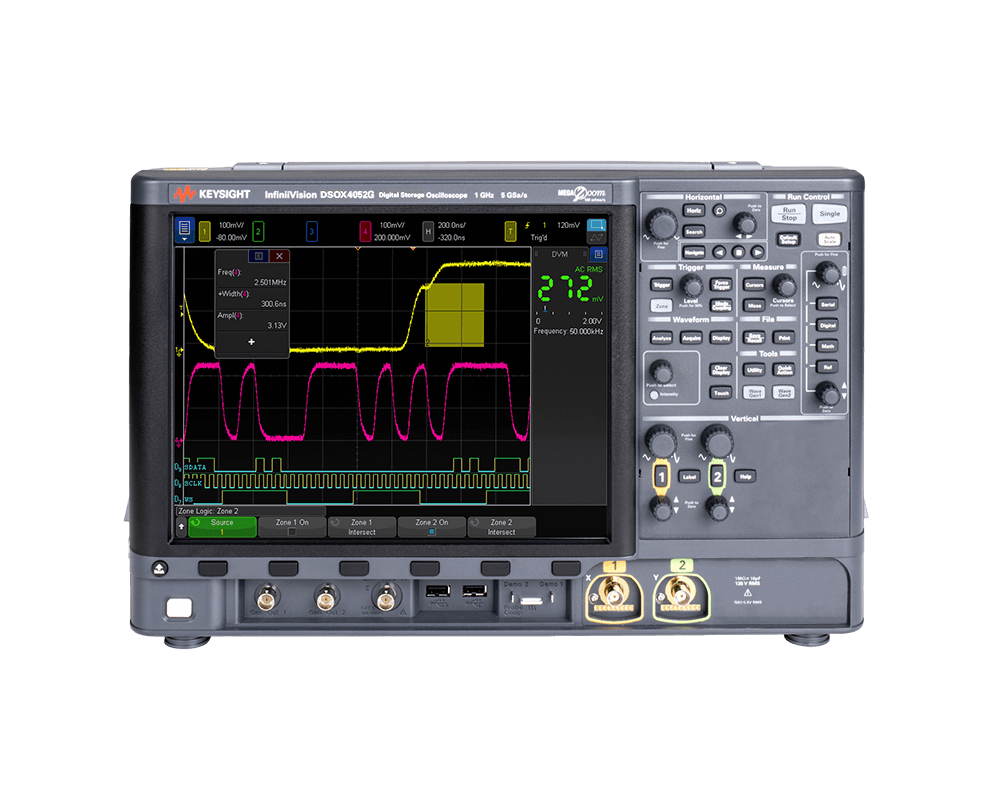
The InfiniiVision family covers 50 MHz to 1.5 GHz across four series:
- 1000 X-Series: 50–200 MHz, 2 or 4 analog channels, 2 GSa/s, entry-level bench and education
- 3000G X-Series: 100 MHz to 1 GHz, up to 4 analog + 16 digital channels, 4 Mpts memory, 1,000,000 waveforms/sec update rate
- HD3 Series: 200 MHz to 1 GHz,14-bit ADC, ultra-low 50 µVrms noise floor, 100Mpts memory, 1.3mil waveforms/sec
- 4000 X-Series: up to 1.5 GHz, 4 analog + 16 digital channels, 4 Mpts memory, 12.1-inch capacitive touch screen
- 4000G X-Series: up to 1.5 GHz with embedded analysis software and automated measurement workflows
All InfiniiVision models run Keysight’s MegaZoom IV ASIC, which keeps deep memory active at all times without the update rate tradeoff that affects competing instruments.
Recommended applications include:
- General-purpose bench debugging
- Embedded system development
- Power electronics
- Industrial automation
- Communications electronics
- University and teaching laboratories
- Production test and validation
Infiniium S-Series, EXR-Series, and MXR B-Series: High-Speed Digital Validation and Beyond
Where the InfiniiVision series ends, the Infiniium platform begins. Two series cover different tiers of high-speed measurement work:
Infiniium S-Series (500 MHz to 8 GHz)
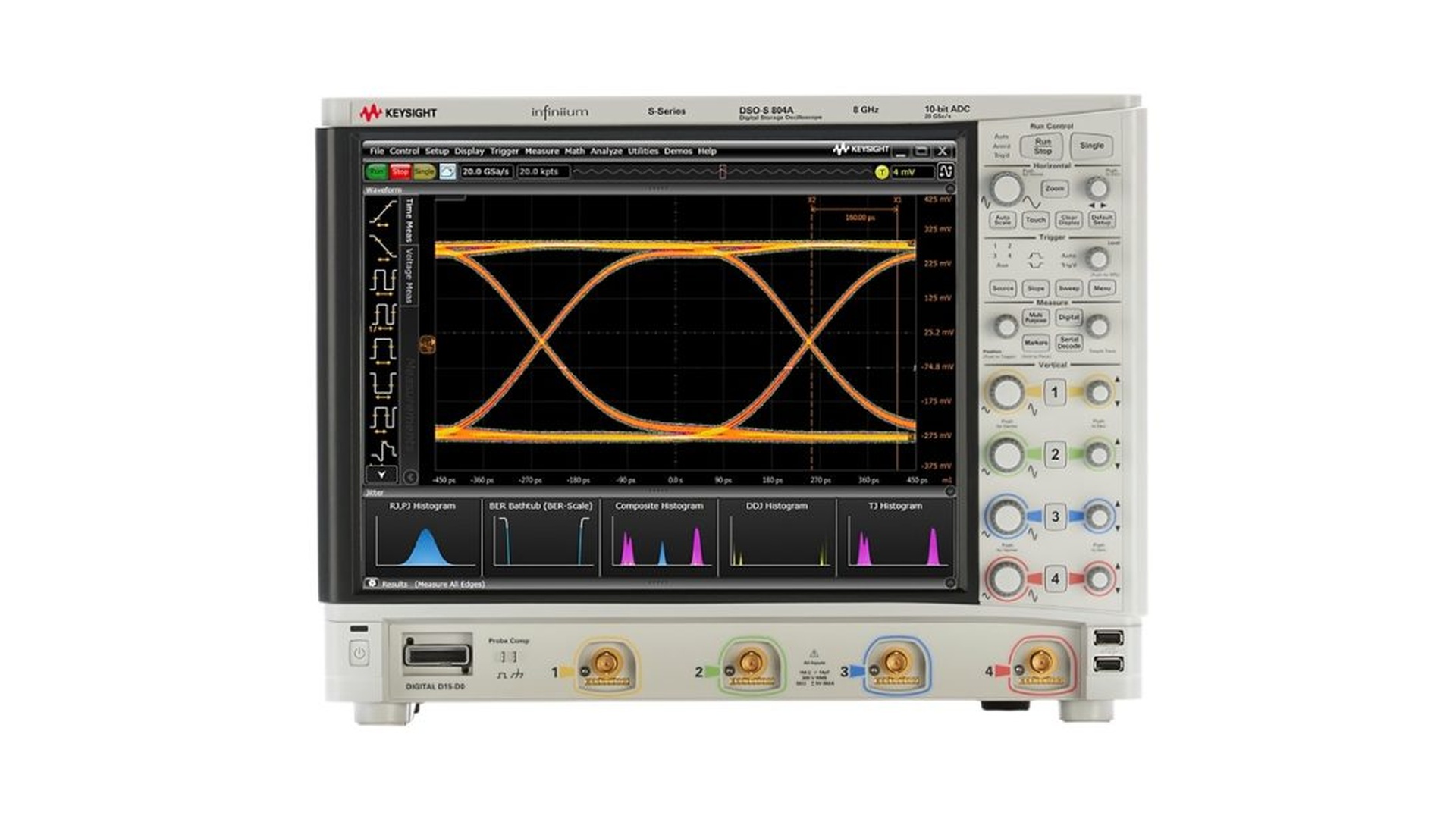
- Available in 2-channel (6 GHz and 8 GHz) and 4-channel (500 MHz to 4 GHz) configurations
- 10-bit ADC with low-noise front end
- High Resolution mode providing up to 16-bit vertical resolution
- Up to 20 GSa/s sample rate
- 100 Mpts standard memory, upgradeable to 800 Mpts
- Best suited for power integrity characterization, jitter analysis, signal integrity, and high-speed digital validation
Infiniium EXR-Series (500 MHz to 6 GHz)
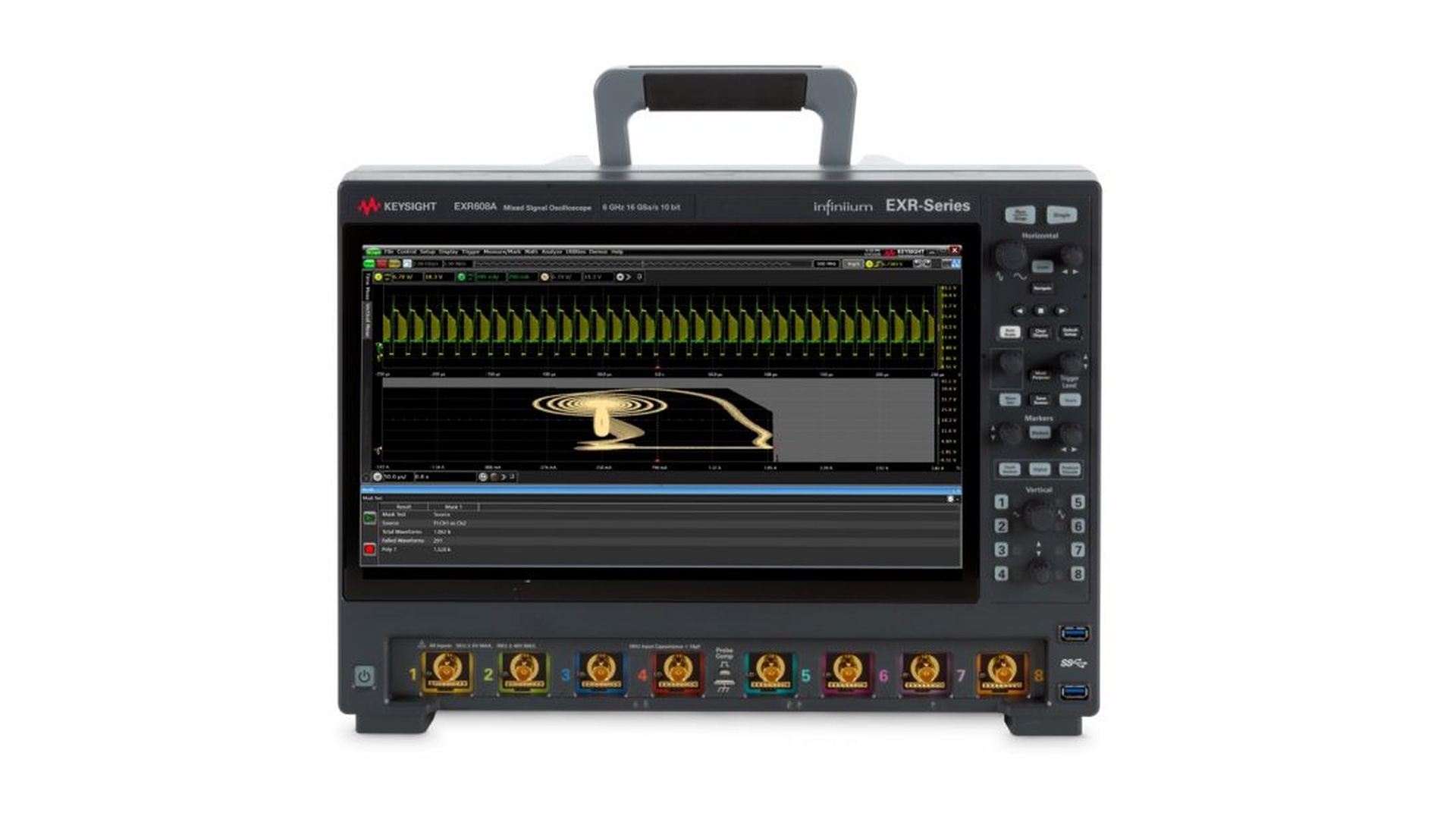
- Available in 4-channel and 8-channel configurations across the full bandwidth range
- 10-bit ADC with a low-noise front end; high-resolution mode up to 16 bits
- 16 GSa/s sample rate on all channels simultaneously
- Standard memory 100 Mpts per channel, upgradeable to 400 Mpts or 1.6 Gpts shared
- Up to 8 instruments integrated in one, with ASIC-accelerated test speeds
- Fully upgradeable in bandwidth and channel count via software or hardware
- Best suited to: multi-channel embedded and power electronics validation, high-speed digital debug, and applications requiring flexible channel scaling
Infiniium MXR B-Series (500 MHz to 6 GHz)
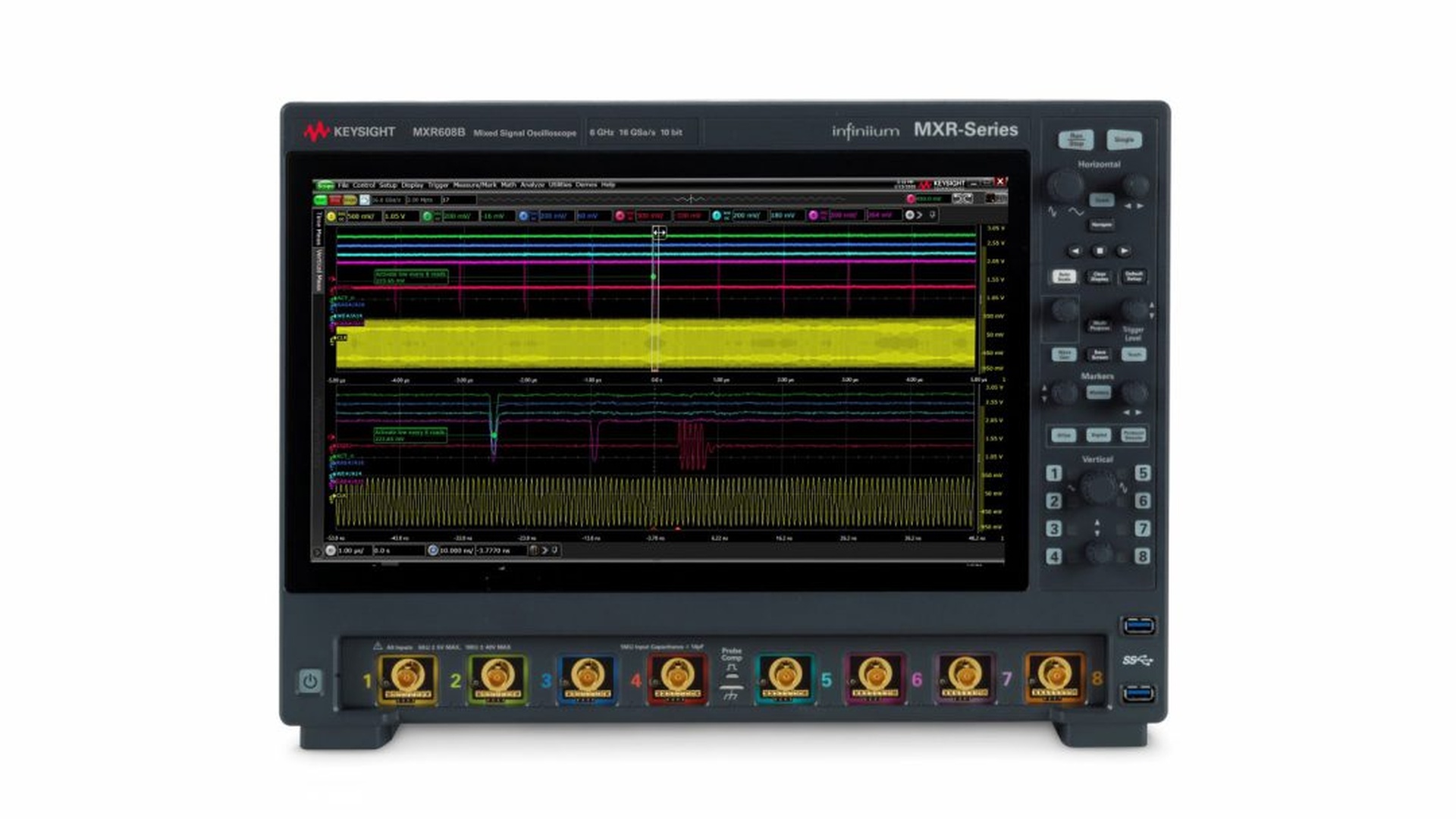
- Available in 4-channel and 8-channel configurations
- Up to 70% faster jitter analysis and 65% faster power integrity analysis than the previous MXR generation
- Maximum memory 1.6 Gpts (flexible)
- 8 instruments integrated in one; InfiniiScan and Wave Gen included as standard
- Upgradeable in bandwidth and channel count
- Best suited to: jitter characterization, power integrity, USB 2.0 compliance testing, and production test environments that require a high-throughput, upgradeable platform
Explore the complete range of Keysight oscilloscopes (including both series) at the Tekmark eShop, backed by local expertise and technical support in Malaysia, Singapore, and the Philippines.
Choosing the Right Instrument for Your Application
The four specifications covered here (bandwidth, sampling rate, memory depth, and channel count) do not work independently. A scope selected for bandwidth alone may fall short if memory depth forces it to reduce sampling rate during the acquisition windows your application requires. A scope with the right channel count but a mismatched probe will not deliver the signal fidelity the front end is capable of.
The right oscilloscope is the one that meets all four requirements simultaneously for your specific workflow, not the one with the highest number on any single row of the spec sheet.
Tekmark is the authorized Keysight distributor with strategic coverage across Southeast Asia, operating through direct offices in Malaysia, Singapore, and the Philippines. Contact Tekmark to discuss your application requirements (whether you are selecting a first bench instrument, upgrading an existing scope, or specifying for a production test environment) and receive a recommendation on the right Keysight oscilloscope for your work.
FAQs
The standard rule is 3-5x the highest signal frequency in your circuit. For a 40 MHz clock, at least 600 MHz bandwidth is adequate. For SMPS and motor drive circuits with fast edges, where rise times determine harmonic content rather than switching frequency alone, 200 MHz will be the practical minimum. Keysight’s InfiniiVision 1000 X-Series starts at 50 MHz for basic bench work and scales to 1.5 GHz in the 4000 X-Series for mid-range R&D.
Sampling rate is the number of samples per second the oscilloscope’s ADC captures when converting an analog signal to digital data. To reconstruct a waveform accurately, the sample rate must exceed the signal’s highest frequency component — in practice, at least 3–5x the oscilloscope bandwidth. The key point: maximum sample rate on the spec sheet is the peak value, not the sustained operating rate. Memory depth determines how long the scope can maintain full sample rate during an acquisition.
The oscilloscope reduces its sampling rate automatically to fit the acquisition window into available memory. It does not alert you. EDN Asia confirms that oscilloscopes provide no notification when the sample rate drops below the level adequate for the instrument’s rated bandwidth, so measurement results remain on screen while the waveform reconstruction may be undersampled. This is particularly problematic in production test and long-duration capture workflows.
Two analog channels cover the majority of bench debugging tasks. Four analog channels are needed when correlating multiple power rails or simultaneous bus signals. An MSO adds digital channels for embedded bus work, allowing firmware state and bus traffic to be viewed on the same trigger as analog signals, without a separate logic analyzer.
InfiniiVision oscilloscopes are designed for general-purpose measurements, embedded system debugging, power electronics, industrial automation and production testing. They provide an excellent balance of performance, ease of use and value for everyday engineering applications.
Infiniium oscilloscopes are designed for advanced measurement applications requiring higher bandwidth, lower noise, signal integrity analysis, compliance testing and high-speed digital validation. They are commonly used in semiconductor development, aerospace, automotive, communications and research laboratories.
Choosing between the two families depends on your application’s bandwidth, measurement accuracy and analysis requirements rather than budget alone. Both are available from Tekmark. Contact us for more details.
Yes. The overall measurement bandwidth of a test system is limited by the lowest-bandwidth component in the measurement path. For example, connecting a 200 MHz probe to a 500 MHz oscilloscope limits the effective measurement bandwidth to 200 MHz.
In addition to bandwidth, factors such as probe input capacitance, input impedance and probe loading also influence signal fidelity, especially when measuring high-speed or low-amplitude signals.
Keysight offers a comprehensive range of passive, active, differential and current probes designed to complement different oscilloscope families and applications. Selecting the appropriate probe is just as important as selecting the oscilloscope itself to achieve accurate and reliable measurements.
Related Articles