5 Best Robot Waiters in Malaysia to Maximize Your Business Operations
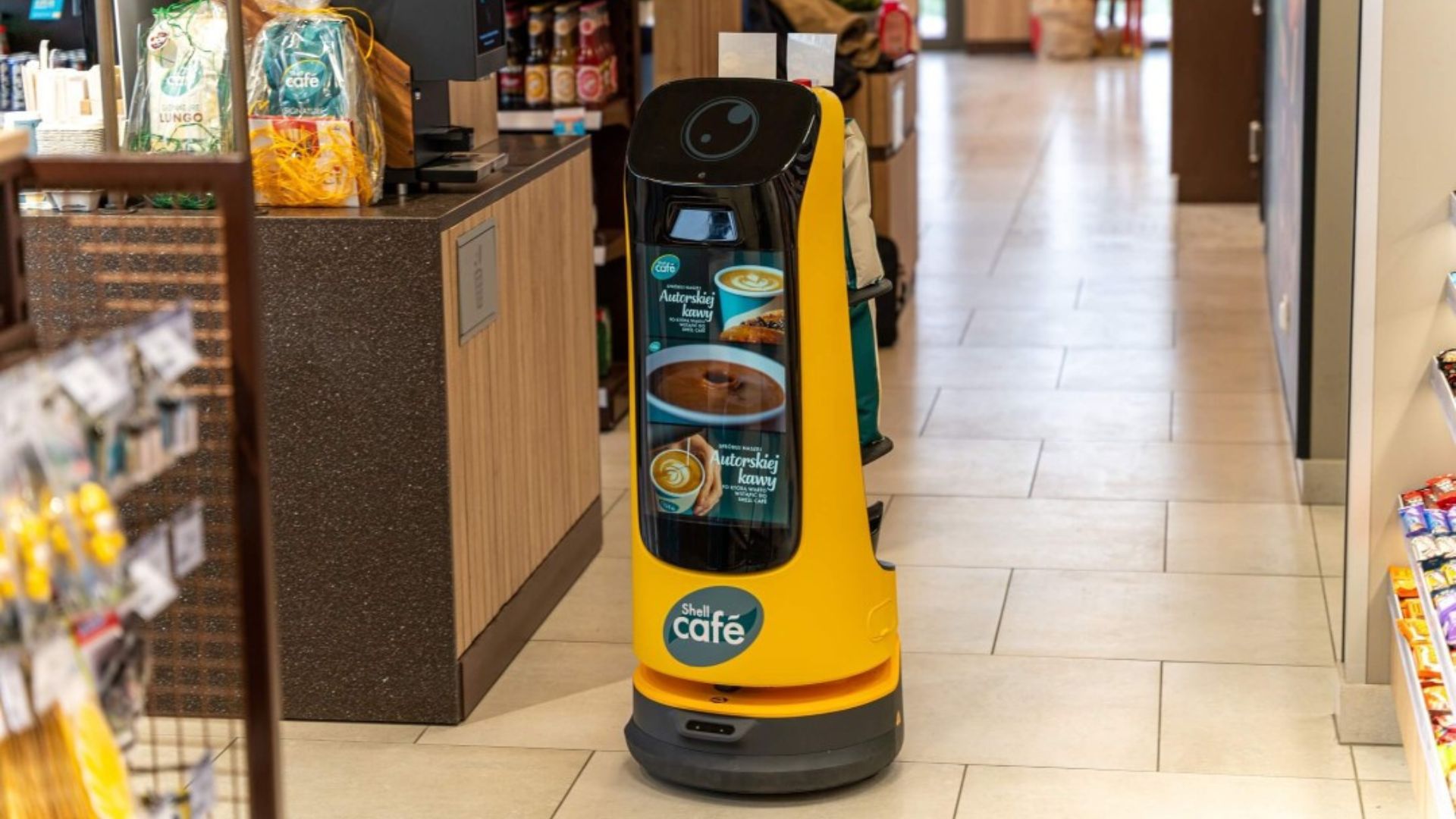
Running a restaurant in Malaysia today means balancing rising customer expectations with ongoing operational pressure. From labour shortages and peak-hour bottlenecks to the need for faster table service, many restaurant owners and managers are looking for practical ways to improve efficiency without compromising the dining experience.
That is why robot waiters are becoming part of the conversation. More than just a novelty, they can help streamline food delivery, reduce unnecessary staff movement, and support smoother front-of-house operations during busy service periods.
But choosing the right robot waiter is not simply about adopting new technology. Different models are built for different needs, from high-volume delivery and narrow aisles to stronger customer engagement and hospitality environments that extend beyond standard dine-in service.
In this guide, we compare five PUDU models available in Malaysia to help you find the option that best fits your restaurant’s layout, service style, and business goals.
Key Takeaways:
- Robot waiters are becoming a practical solution for restaurants in Malaysia facing labour shortages, rising costs, and growing pressure to deliver faster, smoother service.
- They help improve operations by handling repetitive tasks such as food delivery, dish return, and routine service runs, allowing staff to focus more on customer-facing responsibilities.
- The best robot waiter is not simply the one with the most features, but the one that best fits your restaurant’s layout, service style, workflow, and business goals.
- Different robot waiter models are designed for different environments, from high-volume casual dining and compact restaurants to hospitality venues and customer experience-led concepts.
- For the right restaurant, robot waiters can support more consistent, scalable, and efficient operations without replacing the role of human staff.
Why More Restaurants in Malaysia Are Considering Robot Waiters?
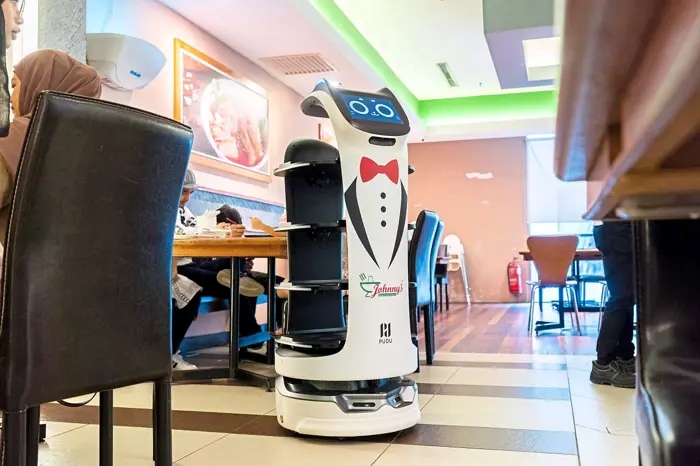
BellaBot Premium Delivery Robot
In the past, most restaurants in Malaysia operated without robot support because traditional staffing models were usually enough to keep service moving. Today, that is becoming harder to sustain.
Rising operating costs, tighter manpower, and growing expectations for faster, smoother service are putting greater pressure on restaurant operators. For many businesses, these challenges are being compounded by higher raw ingredient prices, supply chain disruptions, logistics costs, and broader economic uncertainty.
Labour shortages are making daily operations harder
Many restaurants are trying to operate with fewer people, but customer expectations remain high. Diners still expect timely food delivery, smooth service, and a pleasant dining experience, even during busy periods. When teams are already understaffed, routine tasks such as delivering food to tables, clearing used dishes, and moving between the kitchen and dining area can take up too much time and energy.
This puts additional pressure on service speed, consistency, and the overall dining experience, especially on weekends, during festive seasons, and peak service hours. As a result, more operators are becoming open to automation as a practical way to support daily operations.
Robot waiters help solve practical workflow problems
Robot waiters are appealing because they help solve specific workflow challenges in restaurant operations. By taking over repetitive tasks such as delivering dishes, clearing plates, and moving between the kitchen and dining area, they can reduce unnecessary staff movement and support smoother service during busy periods.
This allows front-of-house teams to focus more on customer-facing responsibilities, making robot waiters a practical operational tool rather than just a novelty.
Growing brands want more standardised operations
For growing restaurant brands, consistency matters as much as efficiency. As businesses expand across multiple outlets, it can become harder to maintain consistent service flow and operating standards in every location.
Robot waiters can help standardise part of the delivery workflow, making service support more consistent and predictable across outlets. This makes them appealing not just as a labour-support tool, but also as part of a more scalable operations strategy.
How We Chose These Robot Waiters?
As more restaurants in Malaysia explore robot waiters as a practical service solution, we narrowed down some of the best models for business use. To identify the strongest options, we focused on the factors that matter most in real operational settings.
We considered:
- suitability for delivery and service support
- manoeuvrability and layout fit
- payload and tray configuration
- customer interaction features
- fit for different restaurant formats
- scalability for growing businesses
5 Best Robot Waiters in Malaysia
Choosing the right robot waiter is not just about features alone. Restaurant operators also need to consider factors such as layout, service style, customer interaction needs, and whether the robot is meant purely for delivery or also for guest engagement. With that in mind, here are five PUDU robot waiters and delivery robots worth considering in Malaysia.
1. PuduBot 2 Universal Delivery Robot – Best for Casual Dining and Efficient High-Volume Delivery
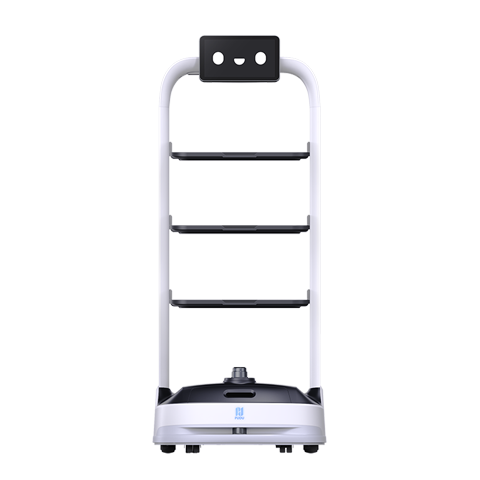
PuduBot 2 is a universal delivery robot built for restaurants that prioritise smooth, efficient food delivery. Compared with more guest-facing models, it is better suited to operators who want a practical robot focused on routine service support and workflow efficiency.
Best suited for
PuduBot 2 is a strong fit for restaurants that prioritise efficient, reliable delivery support over entertainment or promotional value.
- Casual dining restaurants
- Chain outlets and multi-outlet brands
- Food courts and higher-volume environments
- Restaurants that prioritise delivery efficiency over entertainment or promotional features
What it helps with
- Routine kitchen-to-table food delivery
- Multi-table delivery during busy periods
- Dish return and repetitive service runs
- Reducing unnecessary staff movement
- Supporting smoother service flow in busier outlets
Key features
- Up to 40 kg maximum load
- Battery life of 10 to 24 hours
- Smart navigation with PUDU VSLAM+ and Laser SLAM
- Up to 20 robots deployed in one environment
- Suitable for busier outlets that need reliable delivery support
| Pros | Cons |
|---|---|
| Strong fit for efficient, repetitive food delivery | Less guest-facing personality than models like BellaBot |
| Practical choice for busy outlets | Less marketing or promotional value |
| Good payload capacity | Better for efficiency than customer engagement |
| Supports multi-robot operation | Not the strongest fit for experience-led venues |
2. FlashBot Max Building Delivery Robot — Best for Hotel Restaurants and Room-Delivery Crossover
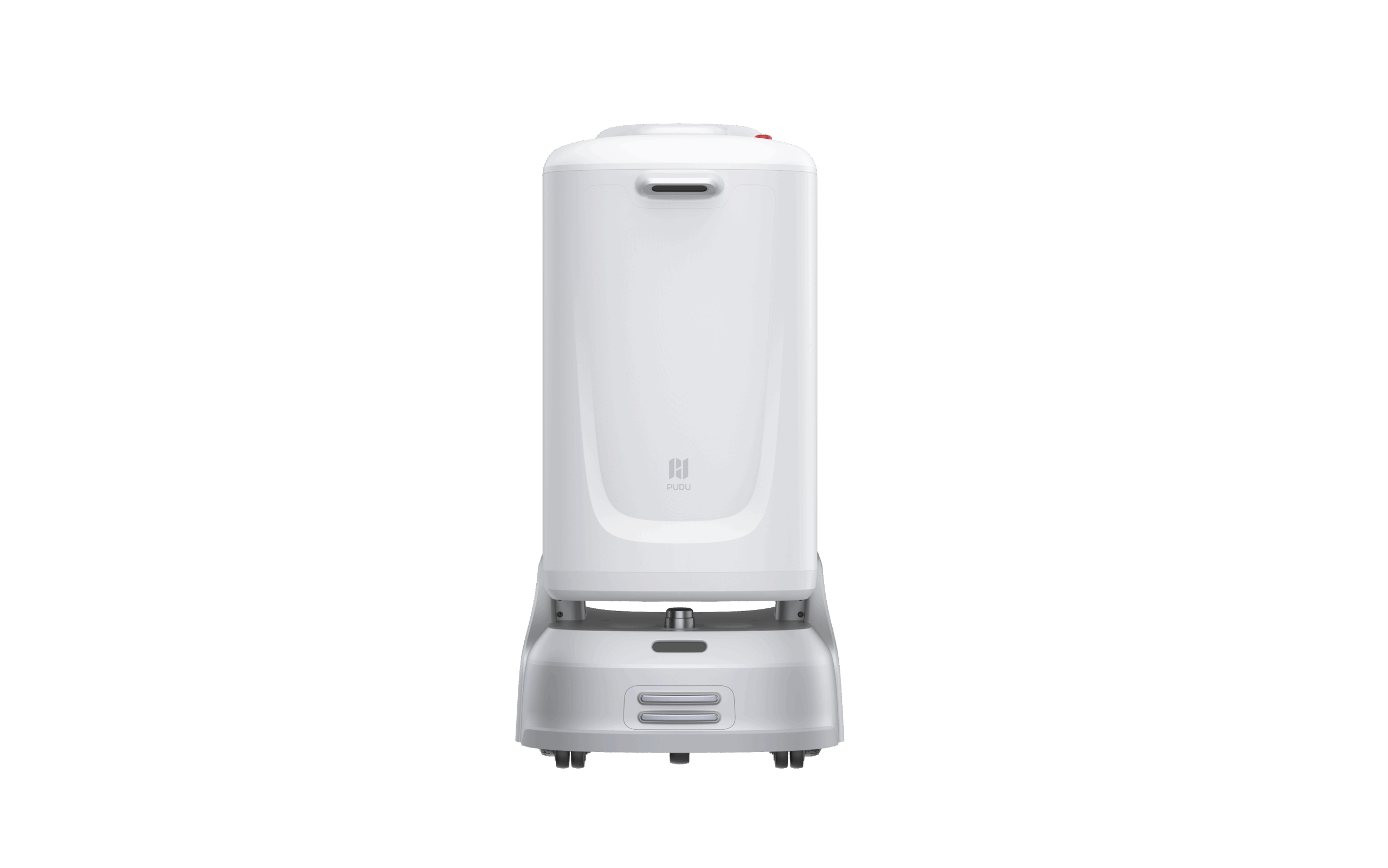
FlashBot Max is a building delivery robot designed for hospitality environments where restaurant service overlaps with room service, multi-floor operations, or integrated building delivery. Compared with the other models in this list, it is better suited to operators who need secure, multi-floor delivery support rather than standard dine-in table service.
Best suited for
FlashBot Max is a stronger fit for hospitality-led environments that require building and room-delivery support.
- Hotel restaurants
- Serviced residences
- Multi-floor hospitality venues
- Integrated building environments with room-delivery needs
- Businesses looking for restaurant and building-delivery crossover support
What it helps with
- Room-service-style delivery
- Multi-floor item delivery
- Secure compartment-based delivery
- Reducing repetitive staff movement across larger hospitality environments
- Supporting smoother delivery across hotel and building spaces
Key features
- 2 to 4 adjustable compartments
- 10 kg payload per layer
- 9-hour runtime
- VSLAM + Lidar SLAM navigation
- 70 cm minimum passability
- Elevator and IoT integration
- Password, phone number, and NFC access verification
| Pros | Cons |
|---|---|
| Suitable for multi-floor and room-delivery workflows | Not the default choice for standard dine-in table service |
| Adjustable compartments support more secure item delivery | More specialised than the other restaurant-focused models |
| Elevator and IoT integration improve building-level delivery automation | Best fit is hospitality rather than typical restaurant layouts |
| Semi-outdoor capability adds flexibility in hotel-style environments | May be more than what a standard restaurant actually needs |
3. BellaBot Premium Delivery Robot — Best for Family Restaurants and Customer-Facing Service
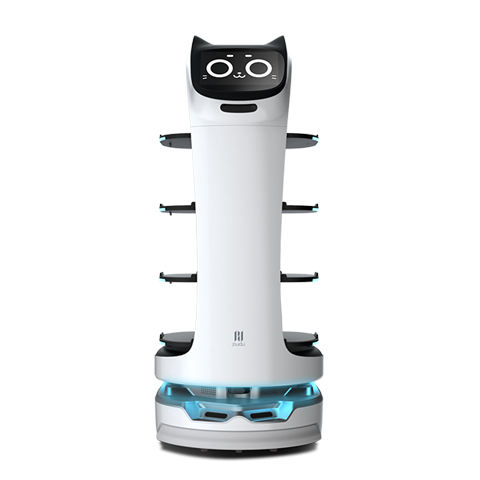
BellaBot is a premium delivery robot designed for restaurants that want both delivery support and a more engaging guest experience. Compared with more operations-first models, it places greater emphasis on greeting, guidance, interactive touchpoints, expressive design, and customer-facing engagement, while still supporting practical food delivery. This makes it a better fit for venues where service experience matters alongside efficiency.
Best suited for
BellaBot is a stronger fit for restaurants that want delivery support with a more visible customer-facing presence.
- Family restaurnts
- Themed dining venues
- Casual chains
- Restaurants that value customer interaction alongside service efficiency
- Venues where guest experience is part of the brand appeal
What it helps with
- Food delivery to multiple tables
- Dish return and repetitive service runs
- Reducing unnecessary staff movement
- Supporting smoother service during busy periods
- Adding a more engaging guest-facing experience
Key features
- Up to 40 kg maximum load, 10 kg per layer
- 4-layer tray setup for multi-table delivery
- 12 to 24 hours of battery life with a replaceable battery
- Dual navigation support with Visual SLAM and Laser SLAM
- Touch, light, and expression-based interaction features
| Pros | Cons |
|---|---|
| More engaging and guest-facing | Less focused on pure delivery efficiency than PuduBot 2 |
| 4-layer tray setup supports multi-table delivery | May be unnecessary for some utilitarian venues |
| Combines delivery, dish return, cruise, and greeting-style functions | Better for experience-led concepts |
| Strong fit for family-friendly and themed dining concepts | Less suited to pure workflow efficiency |
4. BellaBot Pro Premium Delivery and Advertising Robot — Best for Premium Venues and Branding Value
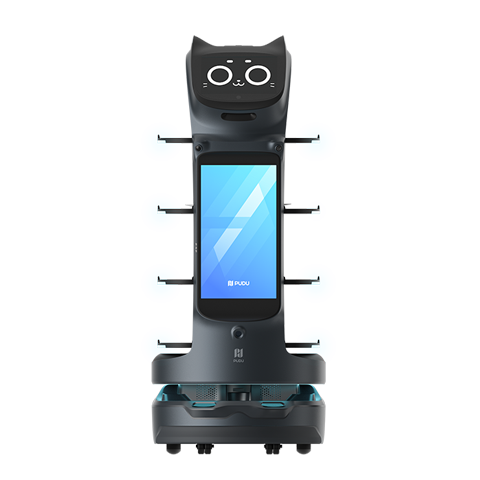
BellaBot Pro is a premium delivery and advertising robot designed for venues seeking both operational support and a stronger, more branded guest experience. Compared with standard delivery-focused models, it places more emphasis on in-store marketing, interactive engagement, and visual presence, while still helping staff handle repetitive delivery tasks more efficiently.
Best suited for
BellaBot Pro is a strong fit for venues that want delivery support with added promotional and customer-facing value.
- Premium restaurants
- Flagship outlets
- Hotel dining venues
- Restaurants that value customer engagement alongside service efficiency
- Businesses that want delivery support plus in-store promotional visibility
What it helps with
- Food delivery to multiple tables
- Reducing repetitive staff movement
- Freeing staff from dull and duplicate tasks
- Supporting smoother service during busy periods
- Delivering promotional content through its built-in ad display
Key features
- Up to 40 kg loading capacity, with 10 kg per tray
- 18.5-inch advertising screen plus 10.1-inch front screen
- 65 cm path clearance for tighter spaces
- VSLAM + Lidar SLAM navigation
- Smart tray detection and dish recognition
- 11-hour no-load runtime
- Multiple modes, including multi-table delivery, direct mode, cruise mode, dish return mode, and birthday mode
| Pros | Cons |
|---|---|
| Combines delivery support with stronger branding and promotional value | More feature-heavy than what some restaurants may need |
| Large ad display for in-store marketing | Better suited to premium or experience-led venues |
| Good maneuverability in tighter spaces | Ad features may not suit every outlet |
| Smart tray detection and dish recognition | Less efficiency-focused than PuduBot 2 |
5. KettyBot Pro Delivery and Advertising Robot — Best for Narrow Aisles and Compact Restaurant Layouts
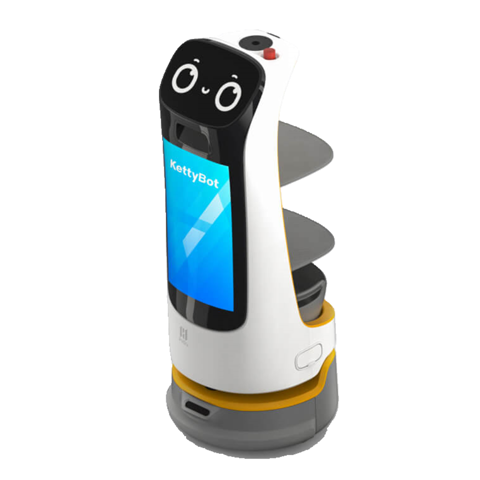
KettyBot Pro is a delivery and advertising robot designed for venues that need both service support and customer-facing promotional value. Compared with larger delivery-focused models, it has a more compact build for tighter walkways and places a stronger emphasis on engagement, in-store marketing, and guided interaction.
Best suited for
KettyBot Pro is a strong fit for venues that need a compact robot with both delivery and promotional functions.
- Compact restaurants
- Cafés and dessert shops
- Tighter-layout dining spaces
- Venues that want delivery support, plus in-store promotion
- Businesses that value customer interaction and attraction as part of the experience
What it helps with
- Multi-table delivery
- Dish return and auto return
- Search and guide functions
- Reducing unnecessary staff movement
- Supporting smoother service in tighter spaces
Key features
- 18.5-inch ad display
- Up to 9 hours of runtime
- 10 kg per tray
- Minimum clearance requirement of 52 cm in specific situations
- Dual SLAM navigation with laser SLAM and visual SLAM
- Smart tray detection and voice interaction
| Pros | Cons |
|---|---|
| Compact for tighter spaces | Less suited to purely utilitarian workflows |
| Combines delivery and promotion | Ad features may not suit every venue |
| Strong guest-facing interaction | Ad features may not suit every venue |
| Smart tray detection | Smaller carrying setup than larger delivery robots |
Is a Robot Waiter Worth It for Your Restaurant?
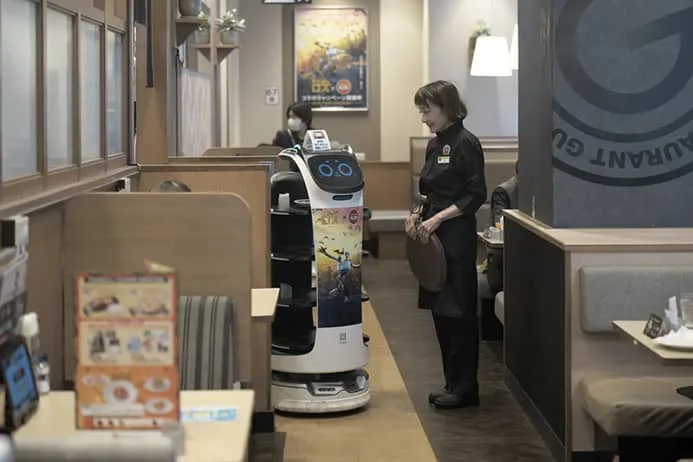
BellaBot Premium Delivery Robot
Not every restaurant needs a robot waiter, but for the right business, it can be a practical investment. The value usually comes down to whether the robot can ease repetitive workloads, support smoother service, and fit your restaurant’s operations.
A robot waiter may be worth considering if:
In these situations, a robot waiter can help improve workflow efficiency and reduce pressure on staff. Rather than replacing employees, it works best as a support tool that helps restaurants maintain smoother service while freeing teams to focus on higher-value responsibilities.
Exploring service robots for your business? Read Service Robots: Explore Key Features, Functions, and Real-World Uses to compare robot types, understand their main functions and features, see how they are used across industries, and learn adoption tips for long-term success.
Explore Robot Waiters for Your Restaurant Operations!
Robot waiters are no longer just a novelty in dining. For many restaurants, they are becoming a practical way to improve service flow, reduce repetitive staff movement, and support more consistent operations during busy periods. With the right model, restaurants can adopt automation in ways that fit their layout, service style, and customer experience goals.
Tekmark provides Pudu waiter robot solutions through our subsidiary iFACT, a leading regional partner of Pudu Robotics, delivering deployment-ready solutions for a wide range of restaurant and hospitality environments.
Why choose TekMark:
- ISO 9001:2015 certified since 2018
- Strong R&D capabilities
- Local expertise and reliable after-sales support
- Free demo and Proof-of-Concept (POC)
- Flexible Financing Plan
Ready to explore robot waiters for your restaurant? Contact us today!
FAQs
Not always, but layout does matter. Some restaurants may be able to use a robot waiter with minimal adjustments, while others may need to review aisle width, turning space, and table placement to ensure smooth navigation. The level of change depends on the robot model and the venue’s existing setup.
Robot waiters are designed for indoor service environments and typically include navigation and obstacle-detection features to move around people and furniture more safely. Even so, a model’s suitability depends on the restaurant’s layout, traffic flow, and how crowded the environment becomes during service.
Like most commercial equipment, robot waiters require routine maintenance to remain reliable. This may include battery charging, cleaning, basic inspections, and periodic servicing, depending on the model and usage level. Maintenance needs are generally more manageable when the robot is used consistently within its intended environment.
Yes, depending on the model. Some robot waiters can also support dish return, guest guidance, promotional display, or other front-of-house functions. This is one reason it is important to choose a model based not just on delivery needs, but also on how you want it to support the overall customer experience.
Not necessarily. A robot waiter is most effective when the model matches the restaurant’s layout, service style, and operational needs. Some are better suited to high-volume delivery, while others are better suited to compact spaces, customer engagement, or hospitality environments beyond standard dine-in service.
Related Articles