How to Build Automated Test Equipment With Keysight Instruments and SCPI
Automated test equipment (ATE) ranges from one computer driving two bench instruments to a production rack with switching, fixtures, safety interlocks and pass/fail software. The scale follows the test, not a fixed template.
For engineering work and small batch runs, Keysight instruments can form the source and measurement layer. SCPI commands and a remote interface let a PC set them up, trigger actions and collect results the same way each run.
Software alone does not make a complete ATE system. What hardware you need depends on the device under test, the accuracy you need, and your switching, timing, safety and throughput demands.
This guide shows where SCPI fits, works through a PyVISA source-and-measure example, and compares the Keysight instruments that suit ATE.
Key Takeaways
- ATE combines instruments, control software and the physical test setup. Larger systems add switching, fixtures, triggering and interlocks.
- SCPI defines the commands and VISA provides the programming interface. LAN, USB or GPIB carries them between the PC and the instrument.
- Automation cuts front-panel work, typing errors and procedural drift. It does not replace calibration, proper fixtures or engineering judgement.
- The Keysight E36312A power supply and Keysight 34465A digital multimeter are a practical first pair for a source-and-measure test.
- Add a scope, function generator or electronic load once the sequence needs waveform capture, stimulus or controlled loading.
- Confirm the exact model, fitted interface, programming guide, trigger functions and transfer speed before you settle an ATE build.
What Is Automated Test Equipment, and Where Does SCPI Fit?
ATE is a test setup where a PC applies the conditions, drives the instruments, collects readings and stores or judges the results. That PC may run Python, LabVIEW, PathWave software or another test program.
The build scales with the test. A basic ATE bench may hold just a DC supply and a digital multimeter (DMM). A line system may add:
- A scope, function generator or electronic load
- Switching and a fixture
- Safety controls and interlocks
Design it from the manual procedure and the risk the device under test carries.
SCPI stands for Standard Commands for Programmable Instruments. It is a text language that sets functions, asks for readings and reports status. The command set stays model-specific, so check each one against the relevant Keysight guide.
It helps to split the control path into three parts:
- SCPI is the command syntax the instrument reads.
- VISA is the standard interface software uses to reach them. Keysight IO Libraries Suite supplies Keysight VISA and Connection Expert.
- LAN, USB or GPIB is the physical link.
These layers span several instrument classes: a DMM, a power supply, a scope, a function generator and an electronic load. They do not make those classes interchangeable, since each holds a different role.
How Does a Keysight Instrument Turn a Manual Test Into an Automated One?
Start from a manual procedure that already repeats reliably. The program then converts each front-panel action into a command: select a function, apply limits, enable an output, wait for settling, trigger, retrieve the result, record it.
Fixtures and wiring still decide how the instrument meets the device under test. Keysight walks through the workflow in its Instrument Automation with Python white paper, including scope control over SCPI and PyVISA.
The PC normally runs the Keysight IO Libraries Suite. Connection Expert finds the instruments, tests the link and shows the VISA address your script uses to open a session.
The interface affects more than speed. It also shapes cable distance, network access, lag, setup and which remote features you get. Confirm what is fitted to the exact model rather than assuming each one carries the same ports.
LAN
LAN suits a shared bench, a distributed lab or a rack where each instrument holds its own network address. It reaches further than a direct USB run, though network configuration, permissions and security policy all come into play.
USB
USB connects one instrument to one PC. It is handy on a small bench and needs no network setup. Cable length and spare ports limit how far it scales.
GPIB
GPIB remains common in established ATE. It matters when current Keysight units must work alongside legacy gear. On many models it is an optional module or a gateway rather than a fitted port.
Read more: Choosing an oscilloscope before you automate it? Our guide on how to choose the right oscilloscope for your engineering work covers bandwidth, sample rate, memory and channel count.
What Does a SCPI Command Actually Look Like?
A SCPI command is readable text arranged in a tree. Colons separate levels, and a space separates the command from its parameters. Keysight sets out the structure in its SCPI learning material.
Take CONF:VOLT:DC 5. That sets a DMM to read DC volts on a 5 V range. It does not set an output voltage. A question mark turns a command into a query, so MEAS:VOLT:DC? asks for a DC reading.
SCPI accepts long and short forms. Capitals in a guide show the required short form, and the lower-case tail is optional. So TRIGger:COUNt shortens to TRIG:COUN. Use the exact syntax documented for your model.
IEEE 488.2 common commands begin with an asterisk. The *IDN? query asks a unit to identify itself, which makes it a good first check before your script applies any settings.
Subsystem commands then do the model-specific work: set a supply voltage, enable an output, ask a scope for a reading. Check units, valid ranges, channel syntax and the error queue as you go.
You need not look each command up by hand. Keysight Command Expert browses the commands, checks syntax, runs sequences and writes code. What it supports depends on your version and your dev setup.
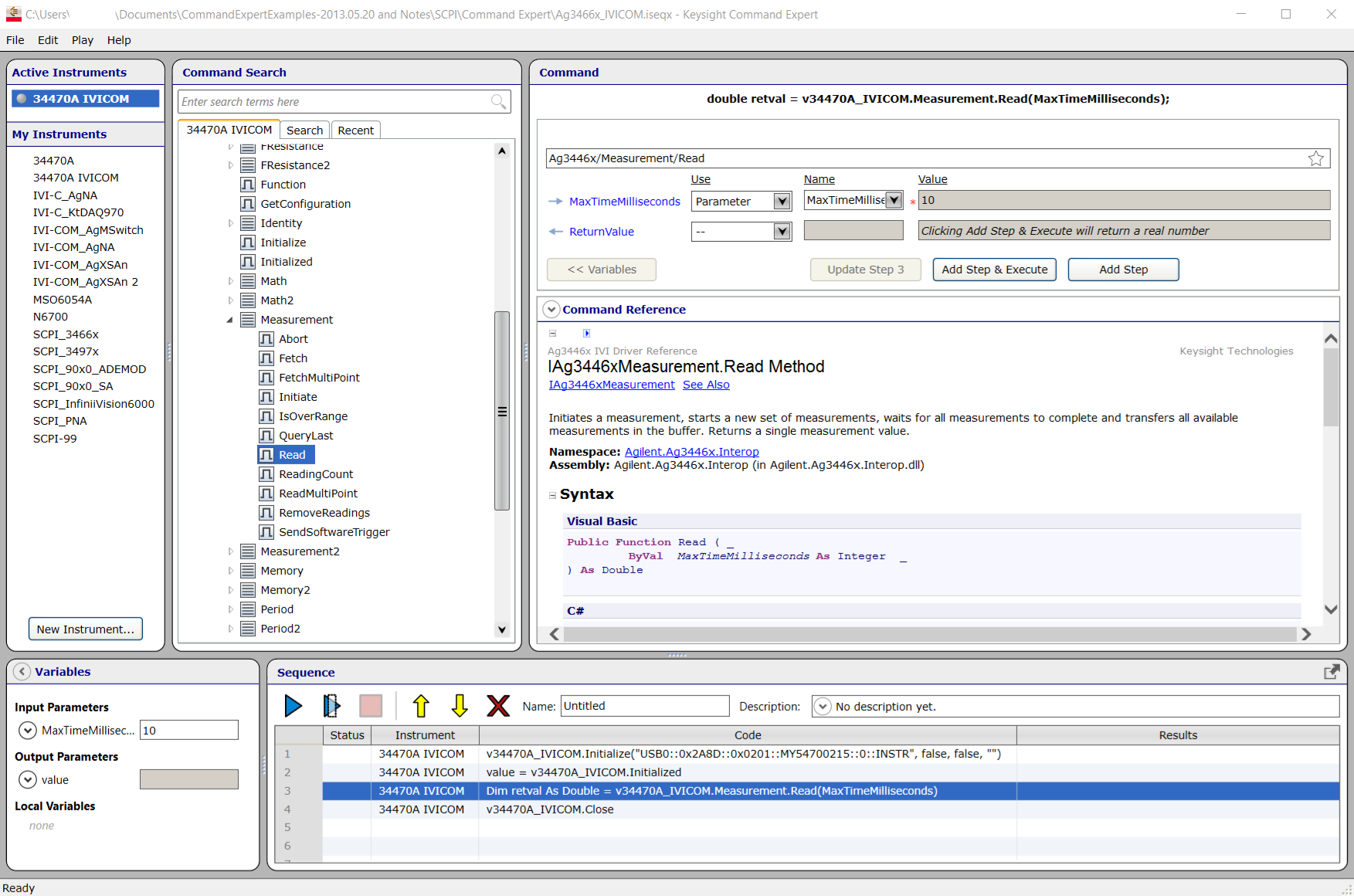
Keysight Command Expert
How Do You Automate a Basic Source-and-Measure Test?
A source-and-measure routine makes a good first project. A Keysight DC supply applies a set voltage and current limit, and a DMM reads the response at the right point on the device under test.
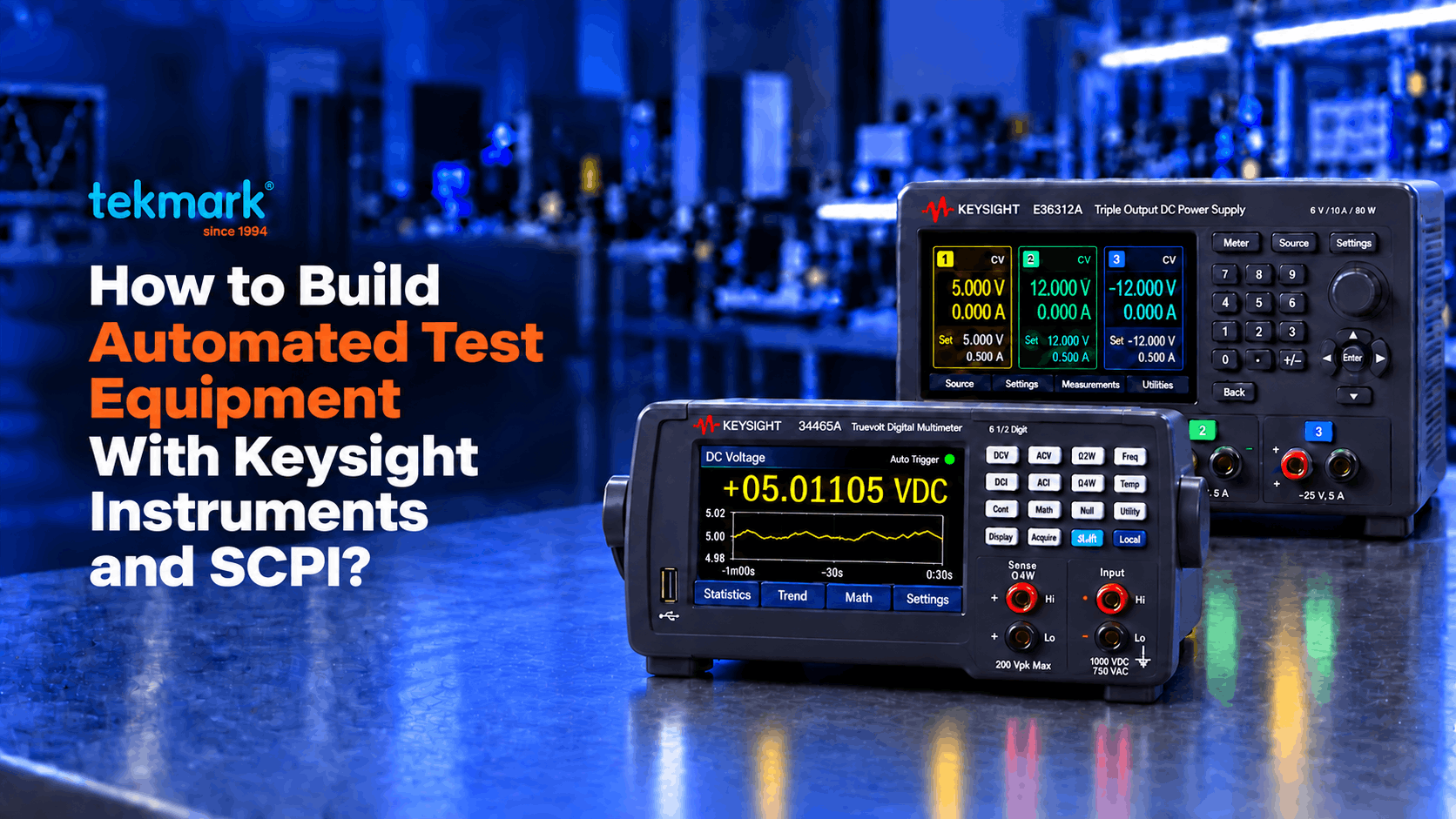
The Keysight E36312A is an 80 W triple-output supply with LAN and USB, and GPIB as an option. The Keysight 34465A is a 6.5-digit Truevolt DMM with the same ports. The pair suits a simple sequence when their ranges and accuracy fit the job.
The script below opens two VISA sessions and checks both identities. It applies 5 V with a 1 A limit on output 1, enables the output, settles, measures and prints. A try/finally block switches the output off even if the measurement fails.
This is a skeleton, not a tested production script. Swap in both addresses, check each command in the guide, and pick limits that are safe for your device. Settling, error handling, pass/fail limits and data storage all still need adding.
The payback depends on the whole cycle. Say a manual routine takes 90 seconds per unit and a scripted one takes 10 seconds on the same test. Those are example figures, not Keysight specs.
Across a 200-unit batch the manual route runs about five hours, the scripted route about 33 minutes. Real throughput must also count fixture loading, settling, switching, transfer, analysis and unloading.
Electrical limits matter just as much. Output 1 of the E36312A is rated 6 V and 5 A, and outputs 2 and 3 are each rated 25 V and 1 A. Keep voltage, current and total power inside the instrument, wiring, fixture and device limits.
Before you scale up, prove the routine against a known-good device and confirm your uncertainty. Check the system reaches a safe state when the link or the software fails.
If this pattern matches a test you run by hand, write down the instruments, settings, connections, limits and pass/fail rules first. Share those with Tekmark and our technical engineers will recommend a setup.
Which Keysight Instruments Fit Automated Test Equipment?
Several Keysight families work as ATE building blocks, and one PC can drive them all over SCPI. Confirm the ports and command set for each exact model, because they differ.
Digital Multimeter
A digital multimeter automates readings of voltage, current and resistance. The Keysight 34465A is a 6.5-digit Truevolt model rated up to 50,000 readings per second under applicable settings. The 34470A is the 7.5-digit option where you need finer resolution.
Both carry LAN and USB with optional GPIB. The 34470A is not needed on top of the 34465A. Pick the one whose accuracy, resolution, range, speed and memory meet the test.
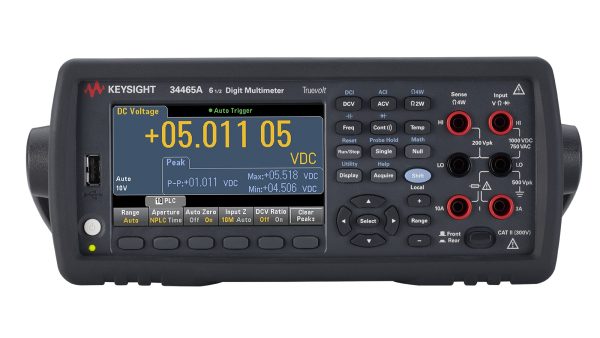
Keysight 34465A
DC Power Supply
A bench power supply controls the source side. It sets voltage and current limits, enables outputs, and on some models returns its own readings.
The Keysight E36312A is an 80 W triple-output supply. Its 6 V/5 A output and two 25 V/1 A outputs let one program bias several rails, as long as you respect the combined limits and the sequencing the device needs.
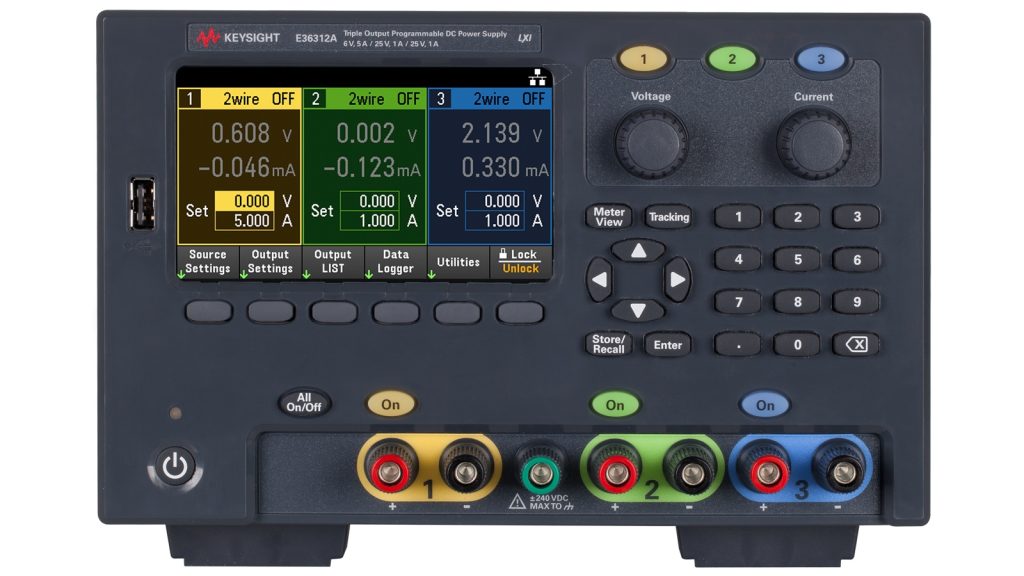
Keysight E36312A
(iii) DC-DC converter validation
A programmable electronic load can test converter regulation, efficiency, transient response, start-up behaviour and protection functions across multiple load levels. List mode can apply a sequence from light load to rated load, while the selected slew rate controls the transition between current levels. Efficiency testing also requires accurate input-side measurements; the load measurement alone does not provide the converter’s complete input-to-output efficiency.
Oscilloscope
An oscilloscope automates waveform capture, timing and amplitude readings, and waveform transfer. The Keysight DSOX2022A is a 200 MHz two-channel InfiniiVision model built for remote control.
USB is fitted; LAN operation needs the applicable DSOXLAN module. Confirm that before you plan a networked rack around it.
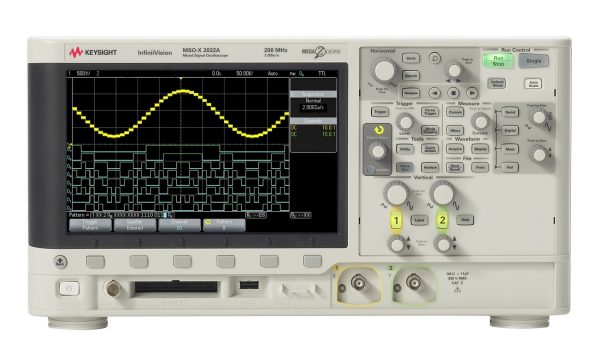
Keysight DSOX2022A
Function Generator
A Keysight function generator supplies a repeatable input signal. The Keysight 33612A is a two-channel Trueform model, and a script can set frequency, amplitude, offset and shape before it triggers a reading.
A scripted input improves repeatability, though you still have to confirm output impedance, amplitude units, load conditions and whether channels need to run in step.
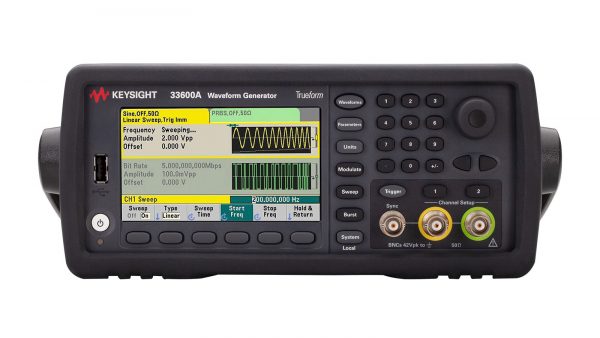
Keysight 33612A
Electronic Load
An electronic load controls the sink side. The EL33133A is a single-input bench load rated to 150 V, 40 A and 250 W, with constant-current, constant-voltage, constant-resistance and constant-power modes inside those limits. It suits automated testing of supplies, converters and batteries.
A larger build may add a data acquisition system for multi-channel logging, or a switch system for routing. Pick units from the test functions you need, not from a fixed list.
Comparing Keysight Instruments in an Automated Test Sequence
The table sets out each role. The SCPI examples show one basic action, not a whole test. Channel syntax and valid values vary by model and firmware.
| Instrument class | Role in the ATE sequence | Example Keysight model | Interfaces | Illustrative SCPI action |
| Digital multimeter | Measure voltage, current or resistance | 34465A or 34470A | LAN and USB; GPIB optional | MEAS:VOLT:DC? |
| DC power supply | Apply controlled voltage and current limits | E36312A | LAN and USB; GPIB optional | VOLT 5, (@1); CURR 1, (@1); OUTP ON, (@1) |
| Oscilloscope | Capture waveforms and return measurements | DSOX2022A | USB; LAN with DSOXLAN module | :MEAS:VPP? |
| Function generator | Drive a controlled waveform input | 33612A | LAN and USB; GPIB optional | APPL:SIN 1E3,2,0; OUTP ON |
| Electronic load | Apply a controlled sink condition | EL33133A | LAN and USB; GPIB optional | FUNC CURR; CURR 5; INP ON |
Verify each command in the matching Keysight guide before use: the E36300 supply, the InfiniiVision oscilloscope, the Trueform generator and the EL30000 load.
Read more: An automated RF bench brings its own questions on synchronisation, calibration and signal routing. See our guide to RF testing and radio frequency measurement.
What Should You Confirm Before Selecting Automated Test Equipment?
Start from the test requirement, not the port. Settle these first, then check each unit can hold its role:
- Stimulus and readings
- Switching and timing
- Safety limits
- Data and pass/fail rules
| What to confirm | Why it matters | How to specify it |
| Test function and range | The unit must safely source, sink or read your values | Voltage, current, power, bandwidth, accuracy and channel count |
| Remote port | The PC needs a supported path to the unit | Whether LAN, USB or GPIB is standard or optional on that model |
| Programming support | Commands and parameters differ by model | The current programming guide, checked for the commands you need |
| Speed and transfer | Throughput rests on more than the headline reading rate | Settling, triggering, transfer, processing and fixture time |
| Trigger and timing | Several units must act in the intended order | Hardware or software triggering, and the timing tolerance |
| Safety and recovery | A lost link or crashed script must not leave a hazardous state | Current limits, interlocks, timeouts and safe shutdown |
Use Keysight product pages, datasheets and guides to confirm the exact model and its fitted options. The finished design also has to cover fixtures, calibration, uncertainty and software upkeep.
Conclusion
ATE is a coordinated system, not an instrument plugged into a PC. Keysight units supply the source, reading, input, capture and loading roles, while the PC runs the sequence and records results.
Begin with one stable manual procedure. Write down its connections, settings, limits, timing and expected result, then automate it in steps. SCPI with VISA and PyVISA is one practical route when your units support the commands you need.
Before you buy or fit any model, confirm its electrical range, accuracy, interface, guide, trigger functions and transfer speed. Those choices settle whether the system is safe, repeatable and fast enough for the work you have.
Why Tekmark?
Tekmark is the authorized Keysight distributor with strategic coverage across Southeast Asia, operating through direct offices in Malaysia, Singapore, and the Philippines.
- Over 30 years of expertise as a regional electronic test and measurement solutions provider
- Established presence across Southeast Asia, supporting customers through an extensive regional network.
- In-house R&D engineering expertise for application support and system integration.
- Value-added services, including calibration, professional training, and technical consultation.
- Dedicated local technical support before, during, and after your purchase.
FAQs
Automated test equipment is a setup where a PC drives the instruments, applies test conditions, collects readings and stores or judges the results. It may also include fixtures, switching, safety interlocks and line software.
SCPI gives a standard text way to control many instruments. Commands set functions, apply values, trigger actions and ask for readings. The supported commands and values still have to be checked in each model’s guide.
SCPI is the command language sent to the unit. VISA is the interface software uses to talk over LAN, USB or GPIB. PyVISA exposes VISA functions to Python.
LAN suits networked or spread-out benches, and USB is handy for a direct PC link. GPIB still helps where legacy units are in the system. Compare speed, distance, fitted options, network policy and trigger needs before choosing.
Yes. Python with PyVISA is one flexible route, and Keysight also offers Command Expert and PathWave BenchVue. How much you can do without code depends on the task, the units and the licensed parts.
A script does not improve an instrument’s rated accuracy. That still rests on the spec, range, settings, environment, calibration, wiring and method. What a script improves is consistency, and it cuts repeated manual entry.
Check the exact model’s remote ports and its guide. Confirm the commands, options, firmware needs and trigger functions your test calls for. A remote port alone does not prove each action you need is there.
Related Articles