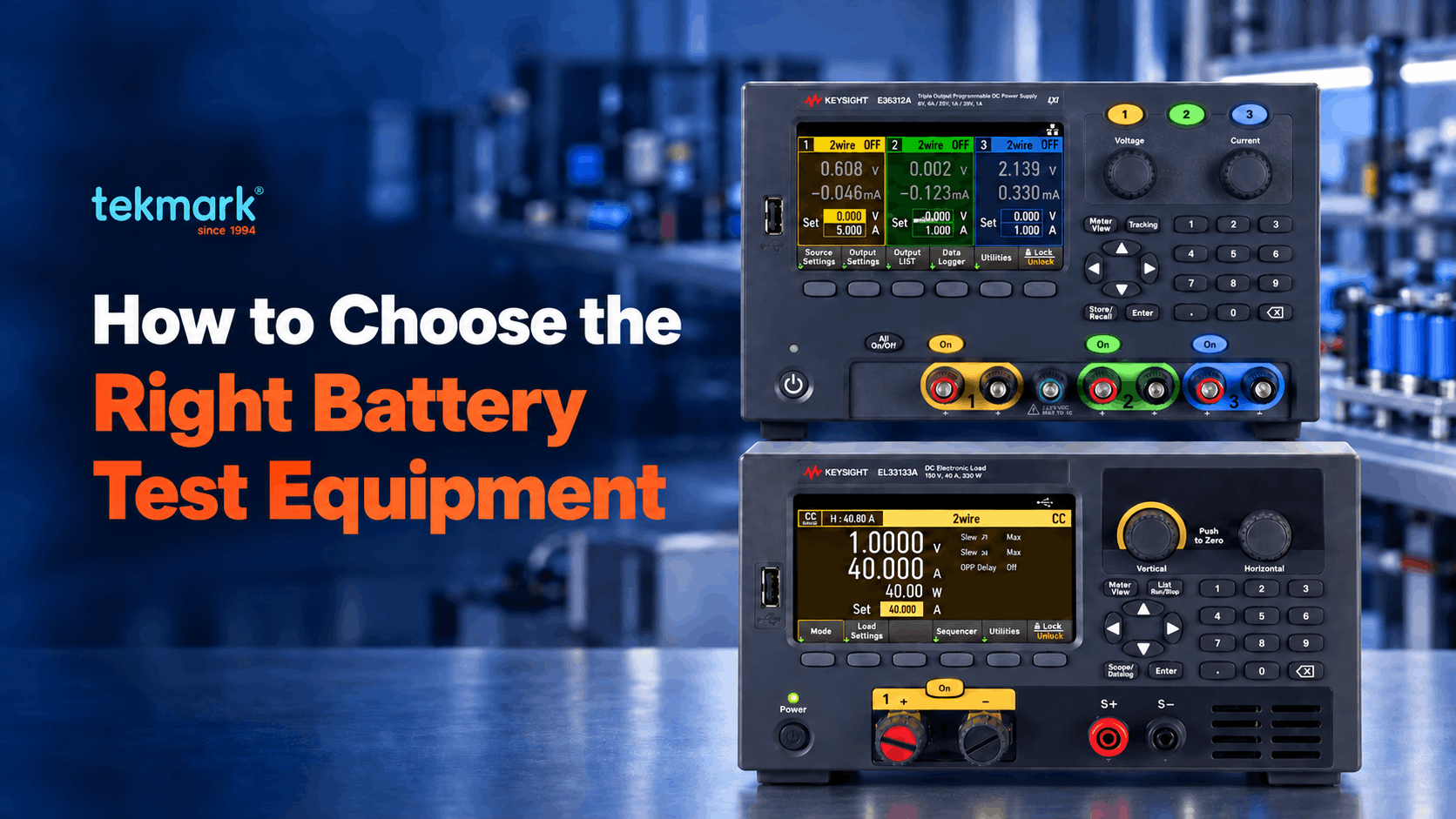
How to Choose the Right Battery Test Equipment
Different battery tests require different instruments. Measuring capacity, analysing device current, emulating charge levels and diagnosing fast electrical events are separate tasks.
A practical bench may therefore combine electronic loads, SMUs, DC power supplies, DAQ systems and oscilloscopes. The Keysight E36731A adds battery profiling and emulation.
This guide explains how these Keysight instruments support consumer electronics, general R&D and selected EV components. They perform specific measurement and diagnostic tasks, not complete high-voltage EV battery-pack cycling.
Key Takeaways
- Matching the test to the right instrument prevents discrepancies between lab findings and field performance.
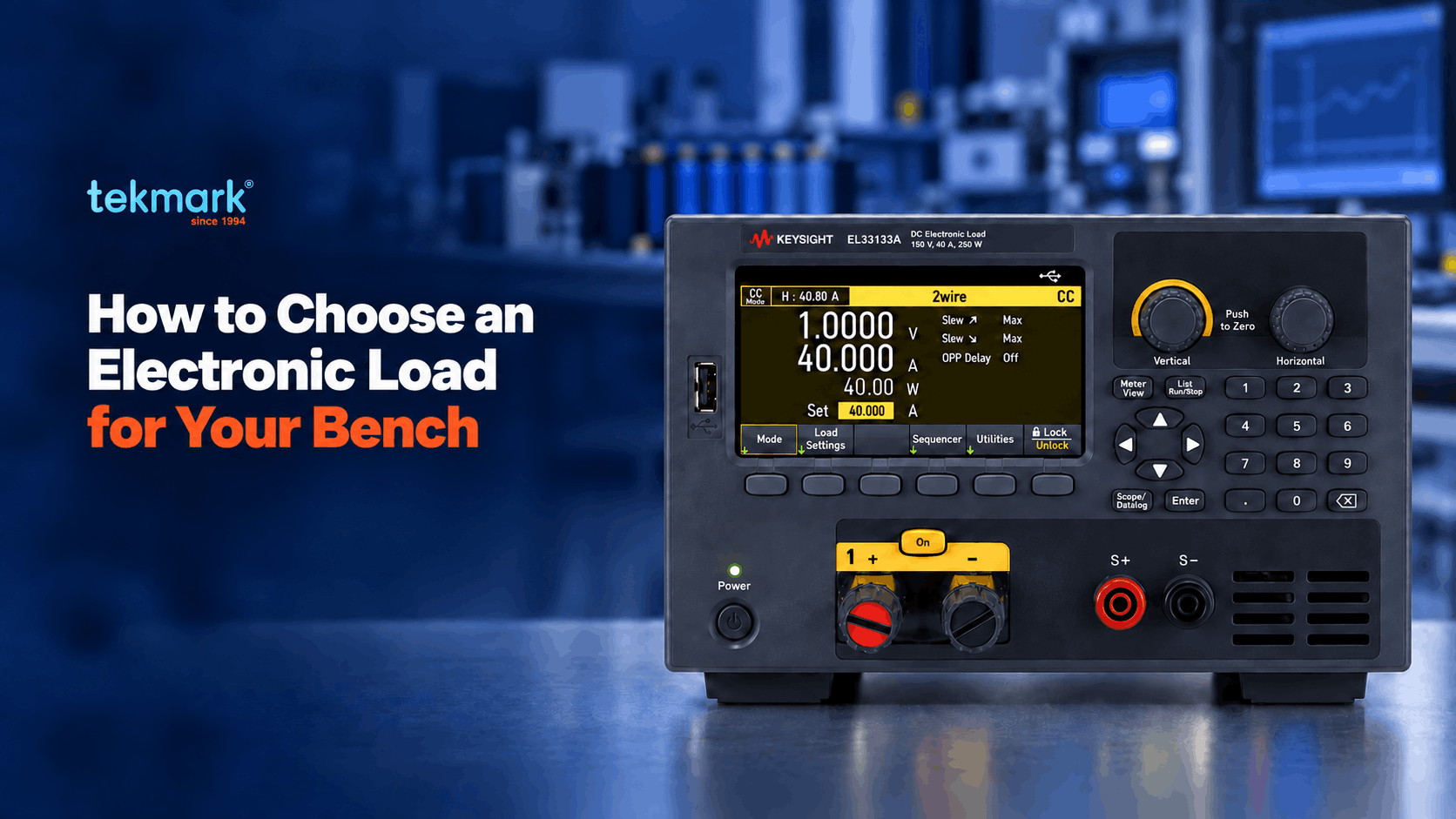
- A bench electronic load like the Keysight EL34143A safely sinks up to 60 A across three ranges for accurate capacity testing.
- Analyzing complex current drain requires an SMU like the Keysight N6781A, which seamlessly measures dynamic current ranges.
- To evaluate device performance across different charge states without waiting on physical cells, rely on a battery emulator like the Keysight E36731A.
- Charging and continuous cycling call for a DC power supply or a regenerative bidirectional source like the Keysight RP5945A.
- Usable capacity drops as current draw increases, so always test under conditions that reflect your device’s actual operation.
Why do battery test results differ from real-world performance?
Laboratory results can differ from field performance when the test does not reproduce the real load. Higher current creates a larger internal voltage drop, causing a product to reach its low-voltage cutoff sooner than a gentle discharge test suggests.
A fixed-voltage supply can also be a poor battery substitute. Real battery voltage and effective internal resistance change with state of charge, load, temperature, chemistry and age.
Keysight’s EV Battery Testing Equipment Guide separates cycling and environmental equipment from data acquisition, BMS or bus testing, and the electrical measurement bench. The same principle applies beyond EV development: no single instrument replaces every layer.
Which battery test equipment does each test need?
Each battery test maps to one instrument role: sinking current, sourcing current, or doing both while measuring. The table pairs common tests with the role each needs and the Keysight model Tekmark stocks.
| Battery test | What the instrument must do | Keysight example | Appropriate use |
|---|---|---|---|
| Controlled discharge and capacity-related testing | Sink programmed current or power and stop at defined limits | EL34143A or EL34243A DC electronic load | Cells and batteries within ratings; charger and converter loading |
| Battery-drain analysis | Source or sink while measuring low and high current states | N6781A SMU with an N6700-series mainframe | Portable, IoT, wearable and embedded products |
| Battery profiling and emulation | Profile a suitable battery and reproduce modelled battery behaviour | E36731A Battery Emulator and Profiler | Consumer electronics and low-voltage R&D within 30 V, 20 A and 200 W |
| Multi-output power analysis | Host configurable source and measurement modules | N6705C DC Power Analyzer | Multi-rail products, BMS boards and R&D benches |
| Controlled source power | Supply regulated voltage and current | E36312A or another correctly sized Keysight DC supply | Charging research, auxiliary rails and fixture power |
| Long-duration monitoring | Scan many voltage and temperature points | DAQ970A with suitable modules and sensors | Thermal tests, cell monitoring and environmental measurements |
| Fast-event diagnosis | Capture high-speed voltage, current and digital or serial activity | InfiniiVision HD3 oscilloscope with suitable probes | Inrush, ripple, switching, resets and EV subsystem diagnostics |
Each instrument has a distinct role: electronic load absorbs energy, supplies deliver it, SMU sources or sinks while measuring, and emulator reproduces battery behaviour. DAQ system and oscilloscope observe different time scales.
Evaluating Discharge and Capacity with Electronic Loads
Bench electronic loads assess discharge and total capacity by pulling a continuous, controlled current from a cell. The instrument tracks how long the battery maintains that current until it reaches its cut-off threshold, revealing its true usable capacity.
The Keysight EL34143A is a bench load rated for 150 V, 60 A, and 350 W. With three distinct current ranges, it easily handles everything from small milliamps up to 60 A. Dedicated ranges preserve precision, letting you test compact coin cells cleanly or evaluate high-drain power tool packs at higher settings.
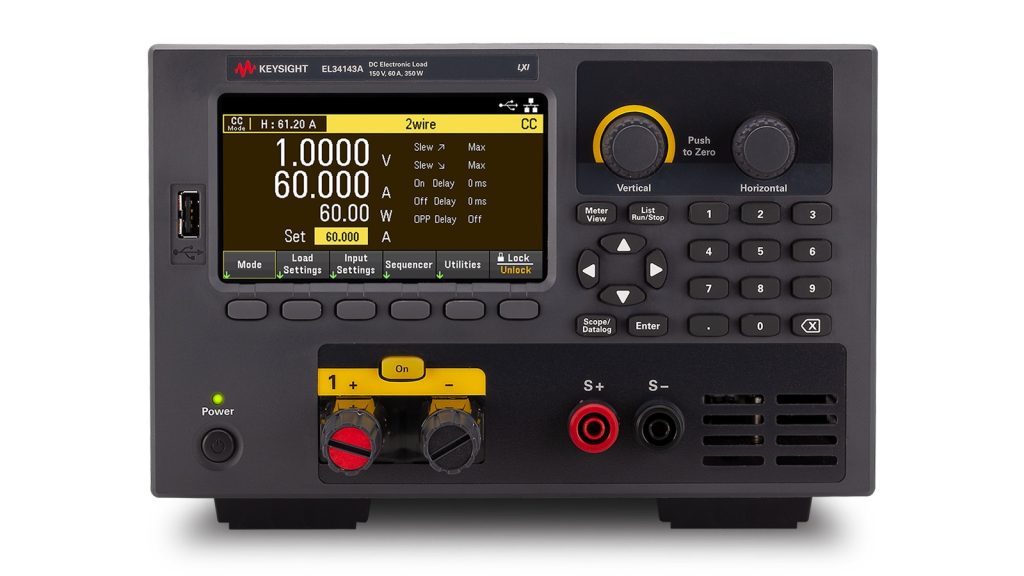
Keysight EL34143A
Two key operating modes are particularly useful for battery work:
- Constant-Current Mode: Pulls a steady current to establish standard amp-hour capacity measurements.
- Constant-Power Mode: Maintains uniform power consumption as cell voltage degrades, closely mimicking real device loads.
The EL34143A also includes constant voltage and constant resistance modes, making it a versatile tool for general power supply testing alongside battery tasks.
Testing demonstrates how load current impacts real-world delivery. In Keysight benchmarks, a cell rated at 1350 mAh yielded 1005 mAh under a steady 200 mA load over 5 hours and 1 minute, totaling 3784 mWh before cutoff.
Because actual output decreases as current demands rise, testing should mirror the true current draw of your target device rather than relying solely on datasheet ratings.
Features like the EL30000 Series Battery Test mode streamline this testing. You can set discharge cut-offs by voltage, capacity, or elapsed time while onboard measurement tools sample voltage and current from 20 microseconds up to 60-second intervals.
Read more: Reading cell voltage down to the last millivolt during a discharge? Our guide on choosing between a benchtop vs handheld digital multimeter covers the accuracy that matters for battery work.
Using SMUs and Battery Emulators for Advanced Testing
Using SMU for Battery-Drain Analysis
Battery-powered products move through several operating states. A wireless sensor may sleep at low current, then wake and transmit in short bursts. The measurement system must capture both levels and their transitions.
The 20 W Keysight N6781A two-quadrant SMU provides 20 V at 1 A or 6 V at 3 A ranges. It sources and sinks while measuring voltage and current, with seamless measurement ranging for changing current levels.
It suits IoT nodes, wearables, portable medical devices and automotive electronics within its ratings, allowing engineers to compare sleep, wake-up and transmit states.
The N6781A requires a compatible N6700-series mainframe. The four-slot N6705C DC Power Analyzer provides a bench interface for sourcing, measurement, data logging and waveform analysis across compatible modules and multiple rails.
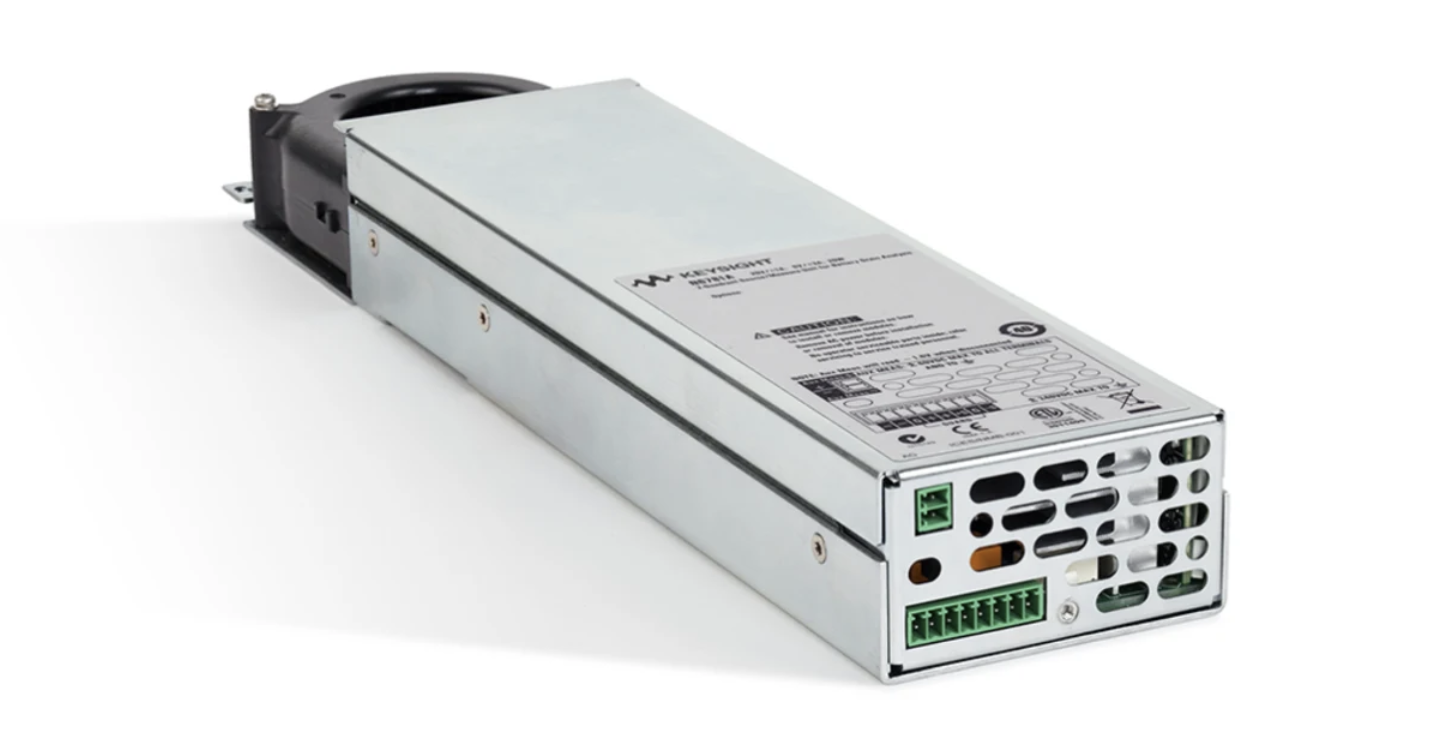
Keysight N6781A
Profiling & Emulating Batteries with E36731A
The Keysight E36731A integrates an electronic load and power supply for battery profiling, emulation and power analysis. It provides one output rated up to 30 V, 20 A and 200 W. Current firmware enables native two-quadrant source and sink operation.
1. Create a battery profile
A battery profile characterises voltage and effective internal resistance against state of charge under defined conditions. The method must suit the chemistry, and the battery must remain within the instrument’s voltage, current and power limits. Chemistry-appropriate charge control, temperature monitoring, protection limits, cabling and a safe test environment are still required.
2. Emulate battery behaviour
The E36731A can emulate selected charge states, allowing repeatable product tests without discharging a physical battery to the same point each time. This helps investigate low-state-of-charge startup, burst-current brownouts and firmware changes while reducing variation caused by physical battery ageing.
3. Analyse device power consumption
The E36731A displays real-time device current drain.
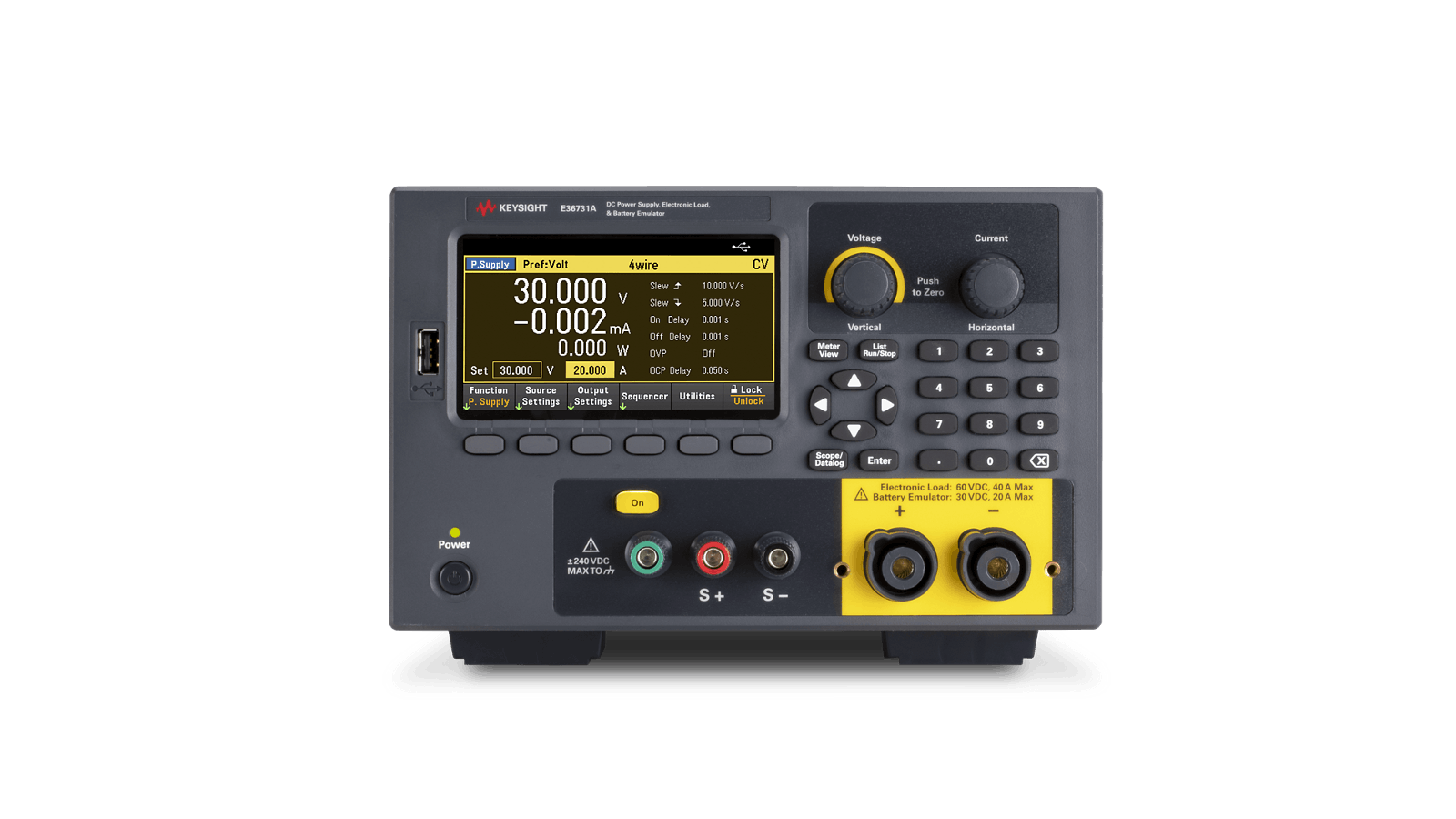
Keysight EL36731A
How do you charge and cycle batteries safely?
You charge a battery with a DC power supply that controls both current and voltage. A dc power supply such as the Keysight E36312A supplies a controlled charge. Its triple outputs are rated 6 V at 5 A and 25 V at 1 A for small cells and modules.
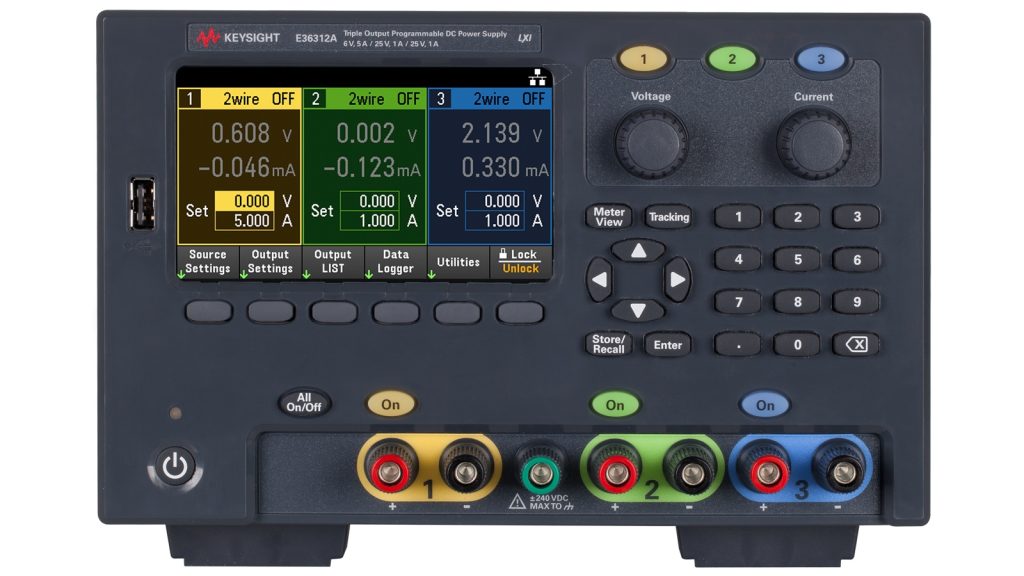
Keysight E36312A
Lithium cells charge in two stages: constant current up to the target voltage, then constant voltage while the current tapers. A supply with tight regulation holds those stages without overshooting, which protects cell life and safety. Overshoot on a lithium cell is a safety issue, not just a measurement error.
Charge and discharge cycling measures how capacity fades over many runs. A separate supply and load works, but a bidirectional source does both in one instrument. It switches from charge to discharge without rewiring the bench.
The Keysight RP5945A charges and discharges through a single connection. It recovers up to 90 percent of the discharge energy, which cuts heat and running cost on long cycling jobs. It also reads voltage and current together, with built-in amp-hour and watt-hour totals.
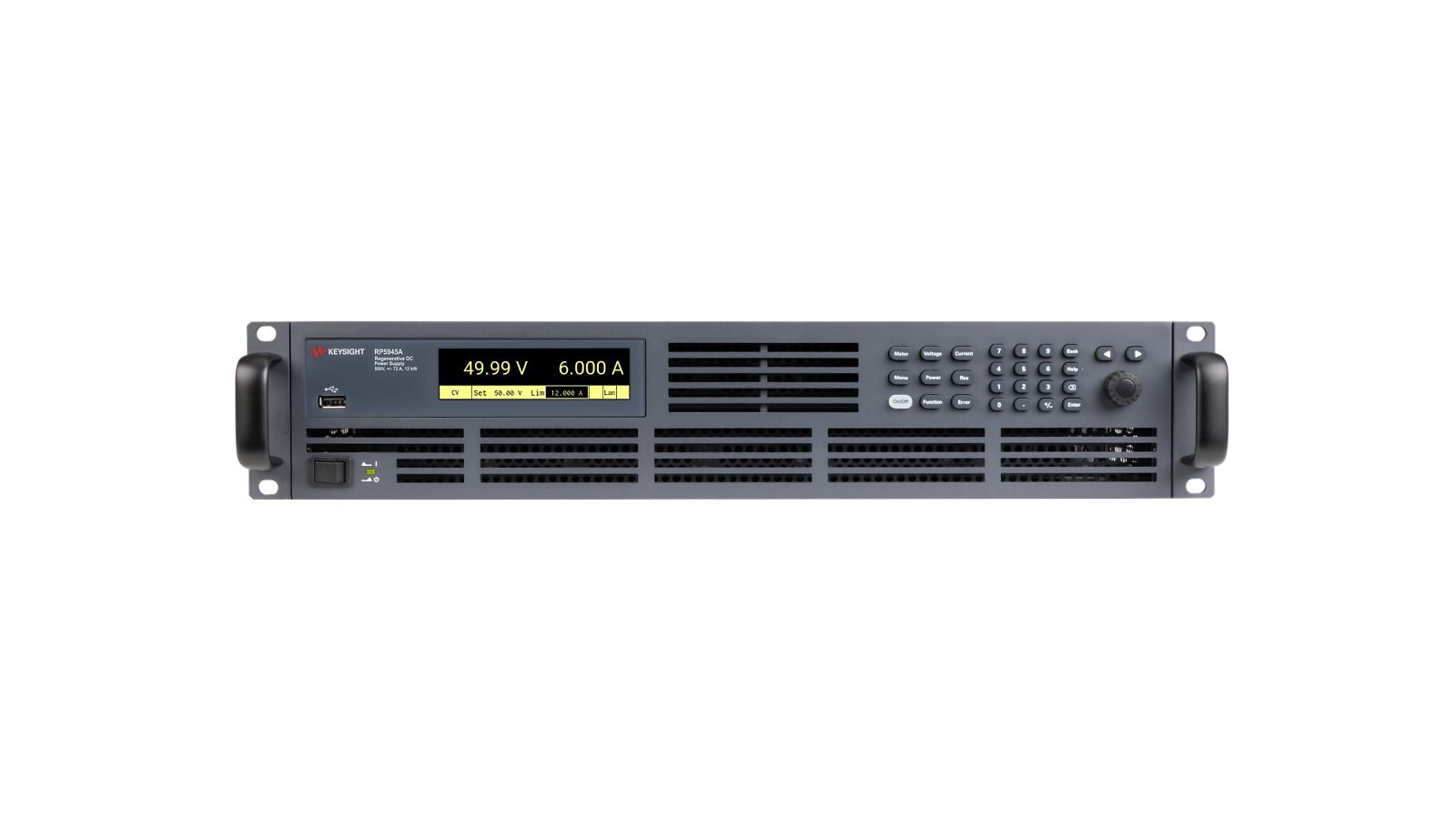
Keysight RP5945A
For multi-cell modules or battery packs, monitoring individual cell conditions is critical. A data acquisition system such as the Keysight DAQ970A allows you to scan multiple channels simultaneously.
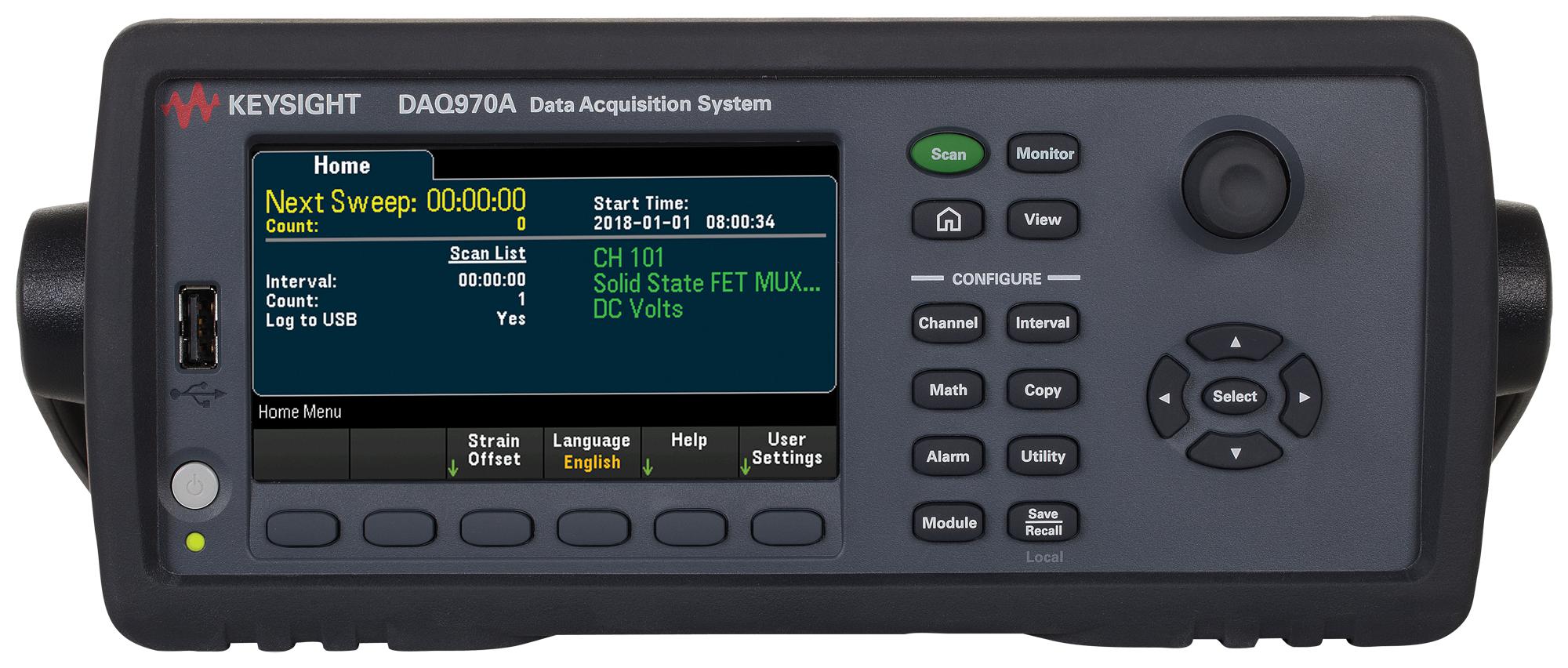
Keysight DAQ970A
Thermocouple inputs track cell temperatures for safety limits, while a high-precision bench digital multimeter verifies precise voltage levels across the pack.
Read more: Building out the charging side of the bench? Our guide on how to choose a DC power supply walks the current, voltage, and regulation decisions for battery work.
What Battery Test Equipment Fits Each Application?
Consumer electronics and IoT
The E36731A profiles and emulates suitable batteries while measuring device demand within 30 V, 20 A and 200 W. Choose the N6781A for specialised battery-drain analysis, and an electronic load for controlled discharge or charger and converter loading.
General R&D and education
The E36731A provides an integrated battery workflow, while the N6705C supports modular source-and-measurement functions across several rails. Add a supply, load, DAQ or oscilloscope as required.
EV components and electrical subsystems
For EV components, an electronic load can exercise converter or charger outputs; a supply or N6705C can power control electronics; a DAQ can log temperature and voltage; and an HD3 can diagnose switching, ripple, resets and communications. The E36731A can emulate suitable low-voltage sources within its ratings.
High-energy cell, module and traction-pack cycling requires purpose-built equipment, safety infrastructure, cooling, environmental control and automation beyond these bench instruments.
Read more: Chasing a voltage dip when the load steps on and off? Our guide on how to choose the right oscilloscope covers capturing fast load transients on the bench.
What to confirm before you choose battery test equipment
Before requesting equipment quotes, reviewing key technical parameters helps ensure proper sizing from the start. These criteria align with guidance from Keysight’s Electronic Load Fundamentals and Power Supply Buyer’s Guide:
| What to confirm | Why it matters | How to specify it |
| Voltage range | Equipment must accommodate peak voltage levels, including maximum charging voltage which exceeds nominal ratings. | State the maximum voltage under test, including the charge peak, plus a little headroom. |
| Current range | The range must cover your peak current, yet not be so wide that low currents lose accuracy. A sleep current read on a 60 A range is mostly noise. | Give both the peak current and the smallest current you need to measure. |
| Power envelope | Maximum voltage and maximum current usually cannot be delivered together. Your peak voltage times peak current must sit inside the model’s operating map. | Multiply peak voltage by peak current, then check it against the model’s rated power and map. |
| Operating mode | Capacity needs constant current, a fixed-power device needs constant power, and cell emulation needs a battery emulator. The mode decides the instrument class. | Specify test requirements clearly: capacity, drain analysis, emulation, charging, or cycling. |
| Current slew rate | A battery-powered device switches load fast, so the load or source must change current fast enough to reproduce that step. A slow slew rate hides the real voltage dip. | State the fastest load change you must reproduce, in amps per microsecond if you know it. |
| Measurement accuracy and resolution | High measurement accuracy across operating ranges ensures capacity and drain calculations remain trustworthy. | State the smallest current or voltage step you must resolve, and the accuracy you can trust. |
| Safety limits | A discharge must stop before over-discharge, and a charge must stop before over-voltage, or you damage or endanger the cell. | Define cutoff parameters (voltage, time, capacity) and protection thresholds (OVP, OCP). |
When evaluating multi-cell setups, also determine total channel counts needed for simultaneous voltage and temperature tracking.
Final Thoughts
Match each test to the correct instrument: an electronic load for controlled discharge, an SMU for changing device current, a DC supply for regulated power, a DAQ for longer records and an oscilloscope for fast events.
For consumer electronics and low-voltage R&D, the E36731A integrates profiling, emulation and power analysis. In EV development, these bench instruments remain valuable for appropriately rated components and subsystems but do not form a complete traction-battery test system.
Tekmark carries the complete range of Keysight battery testing solutions. Our technical support engineers provide expert assistance with equipment selection, calibration, and support across Malaysia, Singapore, and the Philippines.
Why Tekmark?
Tekmark is the authorized Keysight distributor with strategic coverage across Southeast Asia, operating through direct offices in Malaysia, Singapore, and the Philippines.
- Over 30 years of expertise as a regional test and measurement solutions provider
- Established presence across Southeast Asia, supporting customers through an extensive regional network.
- In-house R&D engineering expertise for application support and system integration.
- Value-added services, including calibration, professional training, and technical consultation.
- Dedicated local technical support before, during, and after your purchase.
Frequently Asked Questions
No. Keysight instruments support consumer products, IoT devices, portable equipment, general R&D, automotive electronics and selected EV component measurements. Selection depends on the objective and ratings.
An electronic load absorbs controlled current or power. A battery emulator powers a product while reproducing modelled battery behaviour. The E36731A integrates source and load hardware for profiling, emulation and power analysis.
Measured capacity is usually lower than the rating because usable capacity falls as discharge current rises. The rating is set at a gentle current, but your device may draw more, which costs extra voltage across the cell’s resistance. In one Keysight test, a 1350 mAh cell delivered 1005 mAh under a 200 mA load, so test at the current your device draws.
You need a source measure unit when the test is about the dynamic current a device draws, not the cell’s capacity. The Keysight N6781A sources and measures at once, capturing microamp sleep currents and active-mode amps in one run. For capacity alone, a bench electronic load is enough.
Choose the N6781A for specialised current-drain analysis and seamless measurement ranging in an N6700-series system. Choose the E36731A for integrated battery profiling and emulation up to 200 W.
Testing a high-power pack needs a bidirectional source that charges and discharges through one connection. The Keysight RP5945A does this, recovers much of the discharge energy, and can be paralleled for higher power. Add a DAQ970A to monitor voltage and temperature on each cell for safety.
Related Articles