Autonomous Mobile Robots Explained: Why More Industries Are Turning to AMRs

Malaysia’s manufacturing, logistics, and healthcare operations are expanding rapidly—and so is the volume of materials that must move inside facilities. Parts need to reach lines on time, finished goods must flow to packing and dispatch, and critical supplies must be delivered across departments without delay.
When these internal deliveries slow down, the effects are immediate: delayed production, longer order cycles, and increased strain on frontline teams. That’s why organizations are increasingly turning to Autonomous Mobile Robots (AMRs).
Unlike traditional automation, which relies on fixed routes, AMRs use sensors and intelligent mapping to navigate safely around people, avoid obstacles, and adapt to layout changes. As the technology becomes more accessible, AMRs are emerging as a practical way to strengthen productivity, reliability, and operational resilience.
In this article, we’ll explain what AMRs are, the main types used today, and how industries, from manufacturing and warehousing to healthcare, are using them to improve efficiency and keep operations moving.
What Are Autonomous Mobile Robots (AMRs)?
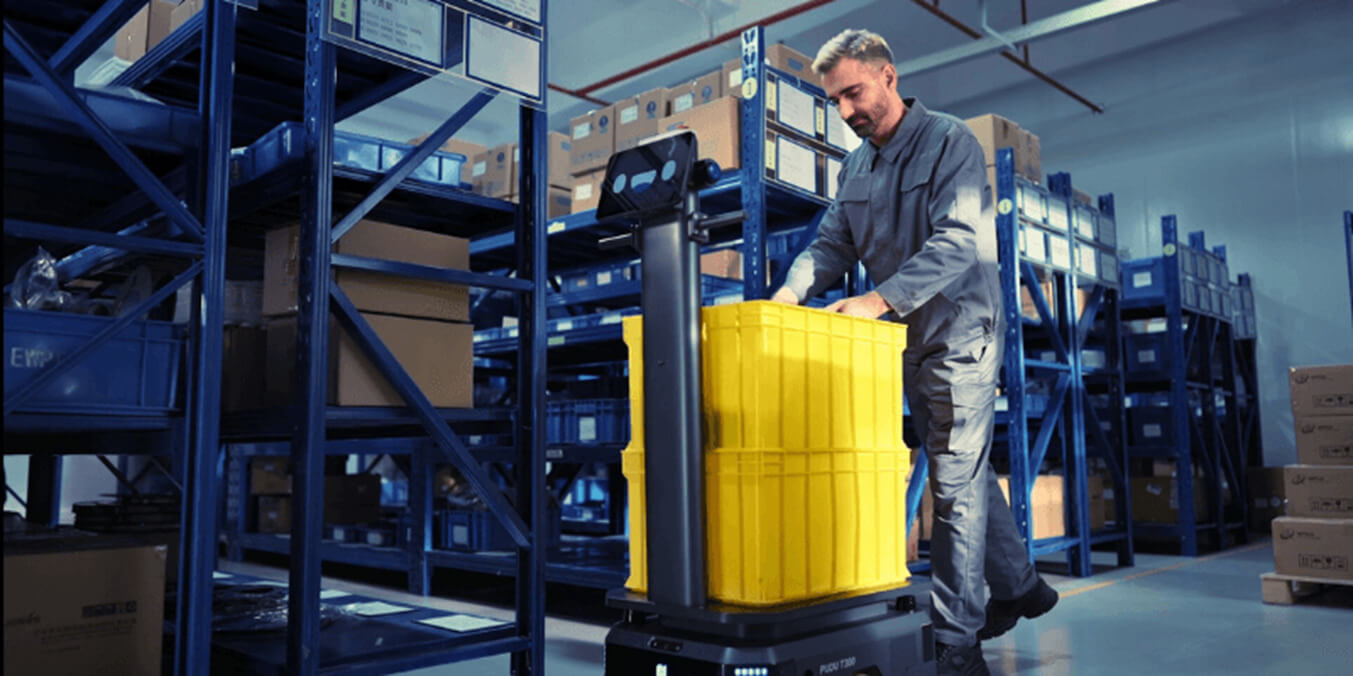
An Autonomous Mobile Robot (AMR) is a driverless, self-navigating robot that moves items within indoor environments, such as warehouses, factories, and hospitals, without relying on fixed tracks, magnetic strips, or physical guide paths.
Instead, AMRs use a digital map of the facility and collect data from sensors, cameras, and LiDAR to understand their surroundings
With AI-powered navigation, AMRs can determine their location, plan efficient routes, and respond in real time to changing conditions. This allows them to identify and avoid obstacles, such as people, carts, or temporary blockages, while keeping internal deliveries moving safely and consistently.
In simple terms, an AMR is a “smart mover” that can:
- map a facility and localize itself
- navigate dynamically through changing environments
- re-route automatically when a pathway is blocked
- operate safely around workers and ongoing operations
The technology behind AMRs
You don’t need to be an engineer to understand what powers AMRs. Most AMRs combine these core capabilities:
- LiDAR and 3D sensing: Detect obstacles, measure distances, and support safe movement in a complex indoor environment.
- Computer vision (cameras + algorithms): Recognize objects and improve navigation in complex areas.
- SLAM (Simultaneous Localization and Mapping): Build a map of the facility and continuously localize the robot within it.
- Onboard computing: Processes sensor data and runs navigation and decision-making logic for real-time response.
AMRs vs. AGVs: What’s the difference?
AMRs are often compared with Automated Guided Vehicles (AGVs) because both move materials inside warehouses and factories. The key difference is how they navigate.
| Feature | AMRs (Autonomous Mobile Robots) | AGVs (Automated Guided Vehicles) |
| Navigation method | Dynamic navigation using sensors + mapping | Follows predefined routes |
| Route guidance | No fixed tracks; adapts to the environment | Often depends on tape, wires, markers, or reflectors |
| Handling obstacles | Slows down, detours, or reroutes in real time | May stop or require manual intervention |
| Layout changes | Easier to adjust via software/map updates | Often requires physical changes to guidance paths |
| Best fit environments | Changing facilities with people and mixed traffic | Stable, predictable routes and controlled traffic |
Common AMR Types
AMRs come in several categories, but in most industrial and commercial settings, AMRs mainly refer to autonomous delivery or transport robots—built to move materials, items, or supplies reliably within a facility. Choosing the right type depends on what you need to move, how often you move it, and where the bottlenecks occur.
1. Delivery/Transport AMRs
Delivery AMRs act as internal couriers, moving items between departments, lines, and zones. In practice, they typically fall into two groups based on where they operate and what they are designed to carry.
Industrial delivery robots
Industrial delivery robots are designed for manufacturing and industrial settings such as factories and warehouses. They support heavier-duty, frequent transport tasks and are often deployed to improve throughput, reduce waiting time between processes, and keep materials flowing reliably across shifts.
Typical industrial use cases
- Line-side replenishment and intra-factory material movement
- Transport of components, WIP, tools, or finished goods between zones
- Warehouse-to-production and production-to-packing transfers
If your facility needs reliable transport support, Tekmark’s portfolio includes industrial delivery robots such as:


Commercial delivery robots
Commercial delivery robots are designed for public-facing environments such as restaurants, hotels, hospitals and retail spaces. They typically carry lighter payloads (meals or small items) and prioritize smooth navigation in customer areas and service corridors.
Typical commercial use cases
- Food delivery and service support
- Promotional/advertising interactions (where applicable)
- Indoor room service and item delivery in hospitality environments
If you need delivery support in restaurants, hotels, or retail spaces, Tekmark’s portfolio includes commercial delivery robots such as:


2. Cleaning AMRs
Some AMRs are designed specifically for automated floor cleaning to help facilities maintain cleanliness standards more consistently, especially in commercial sites and larger operational spaces.
For facilities looking to automate routine floor cleaning, Tekmark offers options such as:


3. Goods-to-person AMRs
Goods-to-person robots bring shelves, totes, or bins directly to workers, reducing walking time and improving pick efficiency. These AMRs are commonly used in warehouse fulfillment operations where travel time is a major productivity drain.
4. Sorting and picking AMRs
These AMRs support sorting and picking workflows by moving items between zones, sorting points, and packing stations. This helps reduce handling errors and maintain consistent throughput in fast-paced fulfillment environments where speed and accuracy are critical.
5. Mobile manipulators
Mobile manipulators combine an AMR base with a robotic arm, enabling both transport and handling, such as picking items, loading/unloading, and machine tending. They’re typically used in more advanced automation projects that require both mobility and manipulation.
6. Hybrid / indoor–outdoor capable AMRs
Hybrid AMRs are designed for larger facilities with multiple zones and mixed conditions, such as connected buildings or sheltered loading zones. They are used when routes are longer or operational zones vary, and stability across environments is required.
Why Malaysian Industries Are Adopting AMRs Now?

1. Workforce constraints
Across Malaysia and the wider Southeast Asia region, operations teams are facing tighter labor conditions, especially for repetitive, physically demanding roles in factories, warehouses, and frontline service environments.
At the policy level, Malaysia has also been signaling a clear direction: reduce reliance on foreign workers and encourage the manufacturing sector to transition toward automation and technology to support productivity-driven growth.
What this looks like on the ground:
- Rising attrition and retention pressure: Attrition rose to 16.2% in 2023 (from 14.9% in 2022), increasing recruitment costs and operational disruption.
- High frontline turnover in Southeast Asia: Frontline turnover can reach up to 48% annually, driving frequent replacements and retraining costs.
- Hidden costs from ongoing churn: Constant hiring and retraining reduces process consistency, slows ramp-up time, and increases the workload on experienced staff.
Why AMRs fit this challenge:
AMRs help reduce reliance on labor for repetitive, time-consuming work—whether that’s internal deliveries (moving items between zones, lines, and departments) or routine facility tasks like scheduled cleaning. This allows teams to focus on higher-value work while keeping operations more consistent across shifts.
2. Productivity and reliability under operational pressure
As facilities grow busier, internal movement becomes harder to manage consistently. AMRs address this by providing predictable transport cycles that do not depend on fatigue, shift changes, or manual availability. This often translates into:
- Faster material flow and fewer “waiting” gaps between processes
- More consistent operations across shifts and peak periods
- Better accuracy and traceability, since tasks can be digitally dispatched and tracked
Over time, they bring consistency to internal transport, helping teams maintain performance even when volumes spike.
3. Cost and ROI considerations
AMRs are often adopted because they can deliver impact without the heavy fixed infrastructure associated with conveyors or the route rigidity found in traditional guided systems. In many facilities, ROI is achievable within 12–24 months, depending on shift patterns, utilization, and workflow selection.
Just as importantly, AMRs support a scalable investment approach:
- start with a small pilot fleet
- prove savings and throughput improvements
- expand coverage route-by-route, zone-by-zone
This makes AMRs easier to justify for both fast-growing sites and facilities modernizing in phases.
4. Technology readiness in Malaysia
AMR adoption is accelerating because the technology has matured and deployments are more practical:
- AMR navigation and fleet tools are more robust and proven across industries
- Malaysia’s logistics and warehousing footprint is expanding, increasing the need for efficient internal movement systems
- Policy direction and industry sentiment are increasingly supportive of automation as a competitiveness lever
For many organizations, this combination—labor pressure, operational growth, clearer ROI, and stronger automation readiness—makes AMRs a timely and practical step forward.
Benefits of AMRs for Malaysian Businesses

By now, it’s clear that AMRs deliver practical, measurable improvements in internal transport. But in Malaysian operations, the benefits often go further. From safer workflows to flexible scaling, better visibility, and improved space efficiency, here are the key advantages businesses can expect.
1. Workplace safety and compliance
AMRs support safer internal transport in shared environments by reducing collisions and manual handling strain.
How they help:
- Obstacle detection + safe navigation to avoid people, carts, and equipment in real time
- Fewer manual trips compared to pushing carts or rushing short “last-mile” deliveries
- Reduced reliance on forklifts for frequent, small internal movements
- Less manual handling exposure, helping lower strain and injury risk over time
- Reduced exposure to repetitive facility tasks, such as routine cleaning in large spaces
- Supports safety expectations aligned with internationally recognized industrial practices
2. Flexibility and scalability
Unlike fixed automation that requires facility renovation, AMR routes and task logic can often be adjusted through software, making it easier to respond to layout changes, new stations, or shifting workflows.
This flexibility also makes AMRs scalable. Organizations can start with a small fleet and expand when needed, particularly useful during festive peaks, seasonal demand, or growth phases. As a result, multi-shift productivity can increase without requiring a proportional increase in headcount.
3. Operational visibility
AMRs do more than move items—they generate operational data. With tasks dispatched digitally, organizations gain better visibility into:
- where materials are moving
- how long deliveries take
- where waiting time accumulates
- which zones are creating bottlenecks
Fleet insights can help teams identify inefficiencies that are difficult to see with manual workflows alone. In more advanced deployments, AMRs can also integrate with existing systems such as WMS or ERP platforms to support traceability and smoother coordination across operations.
4. Space and energy efficiency
AMRs can support more efficient use of floor space by reducing reliance on large material-handling equipment for frequent, short trips. In some facilities, this enables better aisle planning and improves overall space utilization, especially in high-density environments.
They can also lower energy use per task compared to heavier equipment used for short, frequent transport runs. Over time, optimizing internal movement can reduce unnecessary trips, congestion, and idle time, thereby improving day-to-day operations.
AMR Applications in Malaysia
As Malaysian operations scale, AMRs are being deployed wherever internal movement is frequent, time-sensitive, and difficult to manage consistently. While the workflows differ by industry, the goal is the same: ensure materials reach the right place at the right time, supporting steady production flow, faster fulfillment, and consistent service levels.
1. Manufacturing and Electronics
AMRs help keep production moving by stabilizing internal deliveries between key process points.
Common applications:
- Line-side delivery to reduce stoppages and maintain production continuity
- Intra-factory transport between workstations, kitting, QA, and packaging zones
- Frequent small deliveries to support fast cycle times in high-mix environments
- More consistent movement in electronics, where handling procedures are more controlled
2. Warehousing and E-Commerce

In warehouses, AMRs reduce travel time and support faster, more consistent fulfillment.
Common applications:
- Goods-to-person workflows (bringing totes/shelves to pickers) to improve picking efficiency
- Cross-docking transfers from inbound to outbound staging to speed turnaround
- Returns and replenishment movement to keep inventory available and pick-ready
3. Healthcare and Pharmaceuticals
Hospitals use AMRs to reduce manual trips and improve consistency for internal deliveries across departments and wards.
Common applications:
- Medicines and supplies delivery between the pharmacy, wards, and storage areas
- Lab sample transport between departments to support faster testing cycles
- Meal serving to hospital beds/rooms/wards to support timely distribution and reduce repetitive staff trips
- Linen and waste handling to reduce repeated manual runs and corridor congestion
4. Food, Beverage, and Retail

In restaurants, cafés, shopping malls, and retail outlets, AMRs are used to support service workflows where speed, consistency, and staff efficiency matter, especially during peak hours.
Common applications:
- Food serving at tables in restaurants to reduce repeated trips and support faster service
- Back-of-house to front-of-house delivery, such as moving dishes, drinks, or condiments from the kitchen to the service areas
- Tray and item delivery within large venues, including food courts, shopping malls, and hypermarkets
- Lightweight internal deliveries between zones (e.g., counter, storage room, and service areas) to keep operations flowing
Getting Started: Is Your Facility Ready?
AMRs are most successful when they’re deployed into the right workflows and supported by the right operational setup. Use the checklist below to quickly assess readiness, then follow a pilot-first approach to reduce risk and prove results.
1. Readiness indicators
Your facility is a strong candidate for AMRs if you have:
Repetitive routes with frequent daily trips (high-volume internal transport)
Suitable floor conditions and layout (clear pathways, manageable ramps, safe crossings)
Reliable Wi-Fi coverage in operational zones (for dispatching, monitoring, and fleet coordination)
Clear visibility into current material-handling costs (labor time, equipment usage, delays, and safety incidents)
2. Implementation approach
A low-risk way to start is to:
- Run a pilot with 1–3 units on a high-frequency route or bottleneck area
- Engage operations teams early (line leaders, warehouse supervisors, safety, and IT) to ensure adoption
- Deploy and optimize in less than a week (depending on site complexity and integrations)
- Plan budget beyond hardware—include software, fleet tools, training, support, and any integration needs
3. Choosing the right partner
AMR outcomes depend heavily on implementation quality. A strong partner should provide:
- On-site assessment and ROI projection based on your actual workflows
- Local technical support and spare parts availability for reliable uptime
- System integration capability (e.g., WMS/MES, doors, elevators, application specific customization where needed)
- Flexible financing options to support phased scaling and expansion
Explore AMRs for Your Operations!
AMRs are becoming a practical standard for internal transport—improving safety, consistency, and scalability as operations grow. With today’s technology maturity, Malaysian businesses can adopt AMRs faster and with less disruption than traditional fixed automation.
Tekmark supports this transition with application-specific integrations for PUDU robots, helping businesses implement AMRs effectively for their specific operational needs.
Through our subsidiary, Intelligent Factory Sdn Bhd (iFACT), we further strengthen our implementation capabilities. iFACT is a pioneering force in industrial automation, specialising in the design and development of innovative conveyor systems as well as the fabrication and installation of high-quality aluminium profiles and racking systems.
With strong expertise in industrial automation and mechanical engineering, iFACT delivers smart factory automation and robotics solutions tailored to operational needs — including assembly, pick & place, sealing, capping, packaging, and labelling systems. This integration enables Tekmark to support AMR deployments within a broader end-to-end material handling and automation ecosystem.
Why choose Tekmark:
- ISO 9001:2015 certified since 2018, with an ISO 9001:2015 certified R&D arm (Myreka Technologies)
- Malaysia Digital (MDEC) status for Myreka, reflecting engineering and system integration capability
- Strong R&D capabilities
- Local expertise and reliable after-sales support
- Free demo and Proof-of-Concept (POC)
- Flexible Financing Plan
Ready to evaluate AMRs in your facility? Get in touch today!
FAQs
Yes. AMRs can be a strong fit for SMEs because they don’t require large, fixed infrastructure like conveyors, and they can be deployed in phases.
Many small and medium-sized facilities start with a focused pilot, often 1 to 3 robots on a high-frequency route such as moving materials between storage, production, and packing. As results are proven, the fleet can scale gradually by adding robots, expanding routes, or redeploying units to new workflows as needs change.
AMRs typically require routine preventive maintenance, such as:
- checking wheels/casters and drive components
- cleaning sensors/cameras to maintain detection performance
- monitoring battery health and charging systems
- applying software/firmware updates and health checks
Most suppliers provide maintenance schedules based on operating hours and site conditions.
Yes—modern AMRs are designed to work in shared spaces. They use obstacle detection and safety behaviors (slowing down, stopping, rerouting) to operate safely around people and equipment. Safe operation still depends on proper site setup, traffic rules, training, and following the supplier’s deployment guidelines.
This depends on the AMR system and site configuration. Many AMRs can continue short tasks safely using onboard navigation while following fail-safe behavior if communication drops.
However, reliable Wi-Fi (or equivalent network coverage) is strongly recommended for stable dispatching, monitoring, and fleet coordination—especially in multi-robot deployments.
A pilot can often be deployed less than a week, depending on site readiness, route complexity, and any required integrations (e.g., doors, elevators, WMS/ERP systems). Larger rollouts take longer because they typically involve workflow redesign, multi-zone mapping, validation testing, and change management.
Related Articles